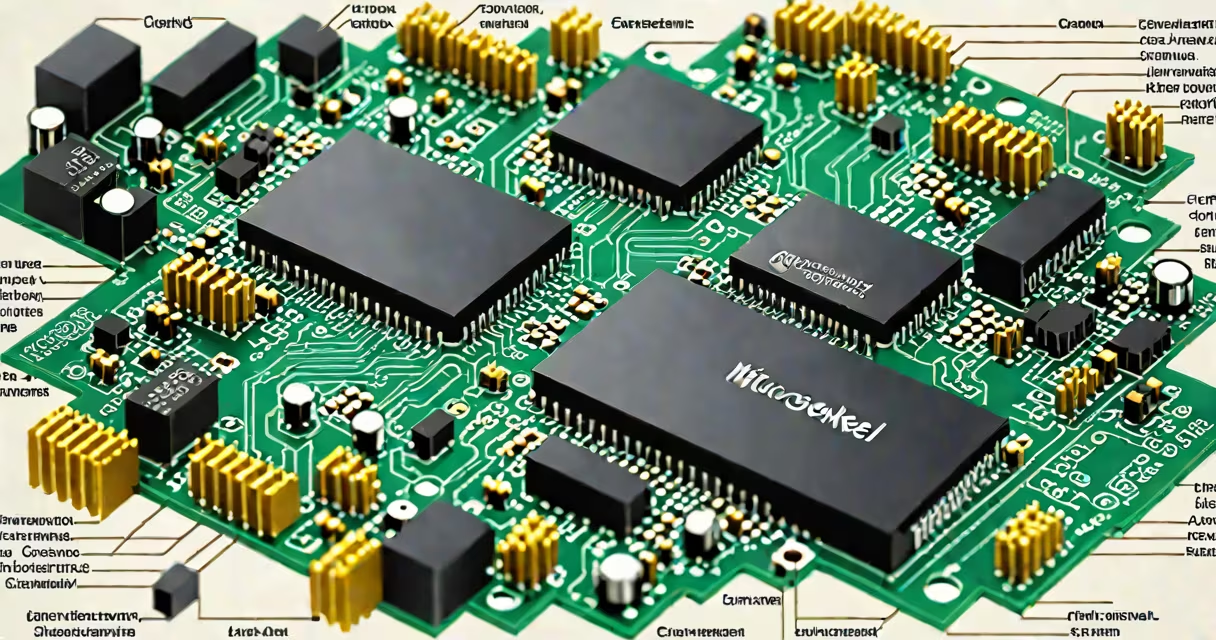
A microkernel is a minimal kernel that provides only core functions-process management, inter-process communication, and memory management-while running all other OS services, such as file systems and device drivers, in user space. This design separates critical operations from non-essential ones, reducing the attack surface and increasing system reliability.
Unlike traditional monolithic kernels, which run everything in privileged kernel mode, microkernels delegate most tasks to external servers. This approach limits the amount of code executing at the highest privilege level, making crashes and security breaches less likely to bring down the entire system.
The concept originated in the 1980s with research projects like Mach at Carnegie Mellon University and later influenced modern systems such as QNX, L4, and Apple's XNU kernel (used in macOS and iOS). These systems demonstrate that microkernels can deliver high performance while maintaining strong isolation between components.
When a process requests a service-such as reading a file-the request is sent via message passing to a dedicated server running in user space. The server performs the task and returns the result through a reply message. All interactions happen through well-defined interfaces, avoiding direct access to hardware or kernel memory.
This model relies heavily on efficient inter-process communication (IPC). Message passing introduces overhead compared to direct function calls in monolithic kernels, but modern implementations minimize this cost using shared memory, optimized scheduling, and hardware support like Intel's Virtualization Technology (VT-x).
For example, in the L4 microkernel family, IPC can complete in under 100 nanoseconds on modern x86 processors. Benchmarks show that L4-based systems achieve performance comparable to monolithic kernels in many workloads, especially when services are designed for low-latency response.
Microkernels enforce strict separation of concerns. Only three functions remain in kernel space:
All other services-networking, storage, graphics, authentication-run as separate programs in user space. Each service operates within its own address space, isolated from others. If a driver fails, it crashes only its own process, not the whole system.
This isolation prevents cascading failures. For instance, in a car's infotainment system using a microkernel-based OS, a malfunctioning audio driver won't disable the navigation module. This is critical in safety-critical environments like medical devices and autonomous vehicles.
While all microkernels share the core principle of minimalism, they differ in implementation details. The following table compares major microkernel families:
| Microkernel | Primary Use Case | Key Feature | Performance Notes |
|---|---|---|---|
| L4 (e.g., seL4) | Real-time embedded systems | Formal verification of correctness | Sub-millisecond IPC latency; proven secure |
| Mach (originally CMU) | Research and hybrid systems | Supports multiple architectures | Higher IPC overhead; influenced macOS |
| XNU (Apple) | macOS, iOS, tvOS | Hybrid design (microkernel + BSD layer) | High performance via caching and kernel extensions |
| QNX Neutrino | Industrial control, automotive | Deterministic real-time behavior | Used in Tesla's vehicle systems |
SeL4-a formally verified microkernel-has been mathematically proven to enforce memory and timing isolation. Researchers at NICTA (now Data61) demonstrated that no unauthorized access can occur between processes, even under malicious conditions. This makes seL4 ideal for defense and aerospace applications.
Microkernels dominate domains requiring high dependability and security. They're widely used in:
For example, the Linux kernel powers over 90% of cloud servers, but in embedded systems, microkernels often outperform it due to predictability and lower resource usage. A study by the University of Cambridge found that microkernel-based systems consumed 30% less power on average in mobile IoT devices.
Many assume microkernels are inherently slower than monolithic kernels. This is false. While early versions suffered from high IPC overhead, modern designs have closed the gap. The seL4 microkernel achieves performance levels matching or exceeding traditional kernels in benchmarks involving file I/O and network packet handling.
Another confusion is equating microkernels with "minimal" or "basic" systems. A microkernel is not simpler-it's more disciplined. It enforces architectural rigor. The complexity moves from the kernel into carefully designed user-space services, which are easier to test, update, and audit.
Some also mistake hybrid kernels like XNU as pure microkernels. XNU combines elements of both models: it uses a microkernel foundation (Mach) but includes a BSD-compatible layer running in kernel space. This hybrid approach balances performance and compatibility, but it doesn't eliminate all trade-offs.
In 2015, the Australian Department of Defence adopted seL4 for secure communications in military drones. The system needed to prevent data leaks and ensure that no single component could compromise the entire flight stack.
Engineers deployed seL4 on ARM64 processors. Each drone component-navigation, camera feed, command reception-ran as a separate process. The kernel enforced strict access policies based on capability-based security. Even if a sensor driver were compromised, it couldn't read memory belonging to the flight controller.
After six months of field testing, the system showed zero security breaches and maintained deterministic response times under load. The project was cited by the National Institute of Standards and Technology (NIST) as a benchmark for secure system design.
A microkernel is a foundational design pattern in modern operating systems where only essential functions run in kernel mode. By moving services to user space, it improves security, reliability, and maintainability. This model underpins critical systems in aviation, healthcare, and defense.
Understanding what is a microkernel reveals more than just a technical choice-it reflects a philosophy of trust through isolation. As software grows more complex, the principles behind microkernels remain important for building trustworthy systems.