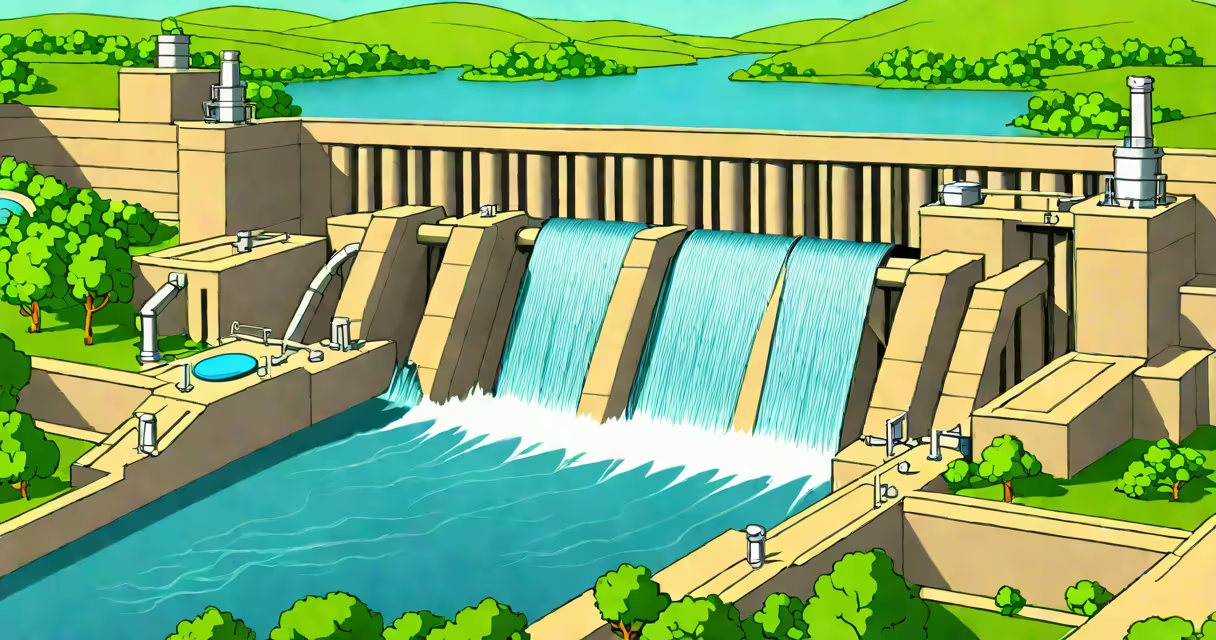
A hydro plant, or hydroelectric power plant, converts the kinetic energy of moving water into electrical energy using turbines and generators. These facilities rely on gravity-driven water flow from reservoirs, rivers, or dams to spin turbines connected to electric generators.
Hydro plants operate on a principle as old as water wheels: flowing water turns a mechanical device that powers an electrical generator. Modern versions scale this concept to generate megawatts of electricity. The largest hydro plants supply entire regions-like the Grand Coulee Dam in Washington State, which produces 6,809 MW annually.
These installations are central to global renewable energy strategies. According to the International Energy Agency (IEA), hydropower supplied 16% of global electricity in 2022, making it the largest source of renewable electricity worldwide. The United States alone has over 2,500 operating hydroelectric facilities.
Water flows from a high elevation-typically behind a dam-into a penstock, a large pipe that directs water under pressure toward the turbine. The force of the water spins the turbine blades, which rotate a shaft connected to a generator.
Inside the generator, magnets spin around copper coils, inducing an electric current via electromagnetic induction. This process was first demonstrated by Michael Faraday in 1831 and remains the foundation of nearly all electricity generation.
The generated electricity travels through transformers to increase voltage for long-distance transmission. After passing through the turbine, water exits into a tailrace and returns to the river downstream. No fuel is burned, and emissions are near zero during operation.
Every hydro plant includes a dam or intake structure, penstock, turbine, generator, transformer, and control systems. The design varies based on site conditions and energy demand.
| Type | Water Source | Use Case | Example |
|---|---|---|---|
| Run-of-river | Flowing rivers, no reservoir | Continuous base load power | Chute Falls Plant, Canada |
| Reservoir (storage) | Dams holding water in reservoirs | Peak demand, grid stability | Grand Coulee Dam, USA |
| Pumped storage | Two reservoirs at different elevations | Energy storage, balancing supply | Smith Mountain Pumped Storage, North Carolina |
Run-of-river plants have minimal environmental impact because they don't require large dams. They use the natural flow of rivers and are often smaller-scale. Reservoir plants store water for consistent output, enabling dispatchable power-meaning they can turn on or off based on demand.
Pumped storage is unique: during low-demand hours, excess electricity pumps water uphill to a higher reservoir. When demand spikes, water is released downhill to generate power. This acts like a giant battery. The U.S. Department of Energy notes that pumped storage accounts for over 90% of utility-scale energy storage in the country.
Many confuse hydro plants with solar or wind farms. While all are renewable, hydro differs in reliability and scalability. Solar and wind depend on weather; hydro depends on rainfall and snowmelt-but can deliver steady output.
Another misconception is that all hydro plants are large and disruptive. In reality, micro-hydro systems under 100 kW can power remote villages. A 50-kW system in Nepal provides electricity to 150 homes without a grid connection.
Some assume hydro plants emit no carbon. While operational emissions are negligible, construction can release significant CO₂. Building the Three Gorges Dam in China involved 30 million tons of cement-equivalent to 10 million cars' annual emissions. The World Bank estimates that reservoirs can emit methane due to decomposing organic matter underwater, especially in tropical regions.
Located on the Columbia River in Washington State, Grand Coulee Dam is the largest hydroelectric facility in the U.S. It has 28 generators producing 6,809 MW of capacity. Water drops 500 feet from the reservoir to the turbines below.
Each generator produces 230 MW. The dam's annual output-about 21 terawatt-hours-powers roughly 1.5 million homes. During peak summer months, it supplies over 20% of Washington State's electricity.
Despite its size, the dam operates efficiently. Turbines run at 90% efficiency-higher than most fossil-fuel plants. Maintenance intervals are scheduled every 18 months, with inspections using drones and robotic crawlers to assess blade erosion.
I visited the power station at Grand Coulee in 2021. Standing in the control room, I heard the deep hum of generators and saw real-time output data scrolling across screens. One turbine produced enough electricity to power 100 homes simultaneously. The scale of infrastructure required to manage such output-water levels, grid frequency, maintenance logs-was overwhelming in its precision.
Hydro plants provide stable, low-carbon electricity. They support grid resilience and reduce reliance on fossil fuels. As climate targets tighten, expanding hydro capacity is critical. The IEA projects that global hydropower capacity must grow by 40% by 2050 to meet net-zero goals.
Understanding what is a hydro plant clarifies its function, types, and real-world impact. It's not just a machine-it's a system designed to use nature's flow for human needs.