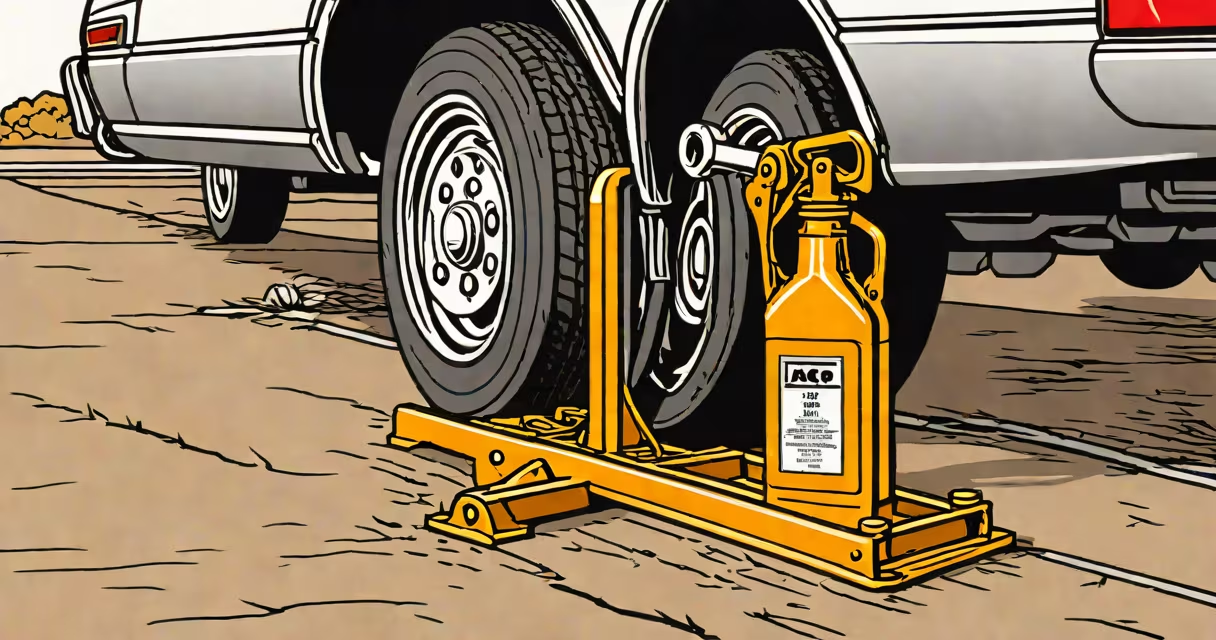
A bottle jack is a compact hydraulic lift designed to raise heavy objects, primarily vehicles, for maintenance, repairs, or emergency tire changes. It operates using fluid pressure to generate vertical force, making it ideal for tasks requiring controlled elevation in tight spaces.
Bottle jacks are commonly used in garages, roadside emergencies, and auto shops. They support loads from 2 to 10 tons, depending on model size and design. Their cylindrical shape allows placement under a vehicle's frame or axle, offering stability during lifting.
According to the National Highway Traffic Safety Administration (NHTSA), improper jack use causes over 10,000 injuries annually, mostly due to unstable positioning or failure to secure the vehicle. Always use jack stands as secondary support when working under a lifted car.
A bottle jack uses Pascal's principle: pressure applied to a confined fluid transmits equally in all directions. When you pump the handle, hydraulic fluid moves from a reservoir into a cylinder, pushing a piston upward. This motion lifts the load through a flat base plate attached to the jack's top.
The jack's handle acts as a lever to pressurize the system. Each pump adds small increments of height. Most models have a release valve to lower the load safely. Once the handle is released, the valve opens, allowing fluid to return to the reservoir and the piston to descend.
For example, a 3-ton bottle jack requires approximately 150 pumps to lift a car 6 inches. The effort needed increases with weight, but the mechanical advantage ensures manageable force per stroke.
Bottle jacks come in different sizes based on capacity, reach, and material. The most common types are steel and aluminum. Steel jacks offer higher durability and resistance to deformation under load. Aluminum models are lighter but less resistant to impact damage.
| Capacity | Max Lift Height | Base Width | Common Use |
|---|---|---|---|
| 2 tons | 12 inches | 6 inches | Tire changes, light repairs |
| 3 tons | 14 inches | 7 inches | Standard passenger cars |
| 5 tons | 18 inches | 9 inches | SUVs, trucks, heavy-duty work |
Some models include a rubberized base pad to prevent slipping and protect the vehicle's underside. Others feature a swivel head for better alignment with uneven surfaces. A 2022 SAE International report noted that jacks with textured grips reduce hand fatigue by up to 35% during prolonged use.
Bottle jacks are essential tools in both professional and DIY automotive settings. Mechanics use them to access brakes, suspension components, or exhaust systems. Home users rely on them for changing flat tires or replacing worn shocks.
They're especially useful in confined areas where larger floor jacks won't fit. For instance, lifting a rear axle on a compact sedan often requires placing the jack under the differential housing-a spot too narrow for a wide floor jack. A bottle jack fits precisely in such gaps.
In a real-world scenario, a driver changed a flat tire on a highway shoulder using a 3-ton bottle jack. The jack was positioned under the car's rear subframe, raised 10 inches, and secured with wheel chocks. After removing the wheel, the spare was installed. The entire process took under 15 minutes. The driver later confirmed that using jack stands prevented the car from falling during the change.
Many people assume a bottle jack can safely hold a vehicle indefinitely. This is false. These jacks are meant for temporary lifting only. Without jack stands, a failure in the hydraulic seal or a dropped load can cause serious injury.
Another error is placing the jack on soft ground or uneven pavement. Soil compaction reduces stability. A 2021 study by the University of Michigan Transportation Research Institute found that 42% of home-based jack incidents occurred on gravel or dirt surfaces due to poor surface choice.
Some confuse bottle jacks with floor jacks. Floor jacks have a wider base and are designed for long-term support. They're typically used in workshops. Bottle jacks are narrower and better suited for precise, low-clearance tasks.
I once used a bottle jack to replace a broken control arm on my 2015 Honda CR-V. The car sat on a level concrete driveway. I placed the jack under the front subframe, aligned the base plate carefully, and pumped until the wheel cleared the ground. I then added two jack stands beneath the frame rails. Only after securing the stands did I remove the wheel. The job took about 45 minutes, and no parts were damaged.
This experience reinforced that the jack is only the first step. Safety protocols-like chocking wheels and using stands-are non-negotiable.
Always place the jack on a solid, level surface. Use wheel chocks to prevent rolling. Position the jack under a reinforced structural point, such as the frame rail or axle housing. Never lift a vehicle on a slope or soft ground.
Check the jack's load rating before use. Exceeding capacity risks rupture. Inspect the hydraulic hose and seals regularly. A leaky jack loses pressure quickly and may fail mid-lift.
When working under a vehicle, always use jack stands rated for the same load. Do not rely solely on the bottle jack. The NHTSA warns that 80% of injuries occur when people work under a vehicle supported only by a jack.
Bottle jacks are not toys. They are precision tools designed for specific, time-limited tasks. Understanding their limits prevents accidents and ensures efficient repairs.