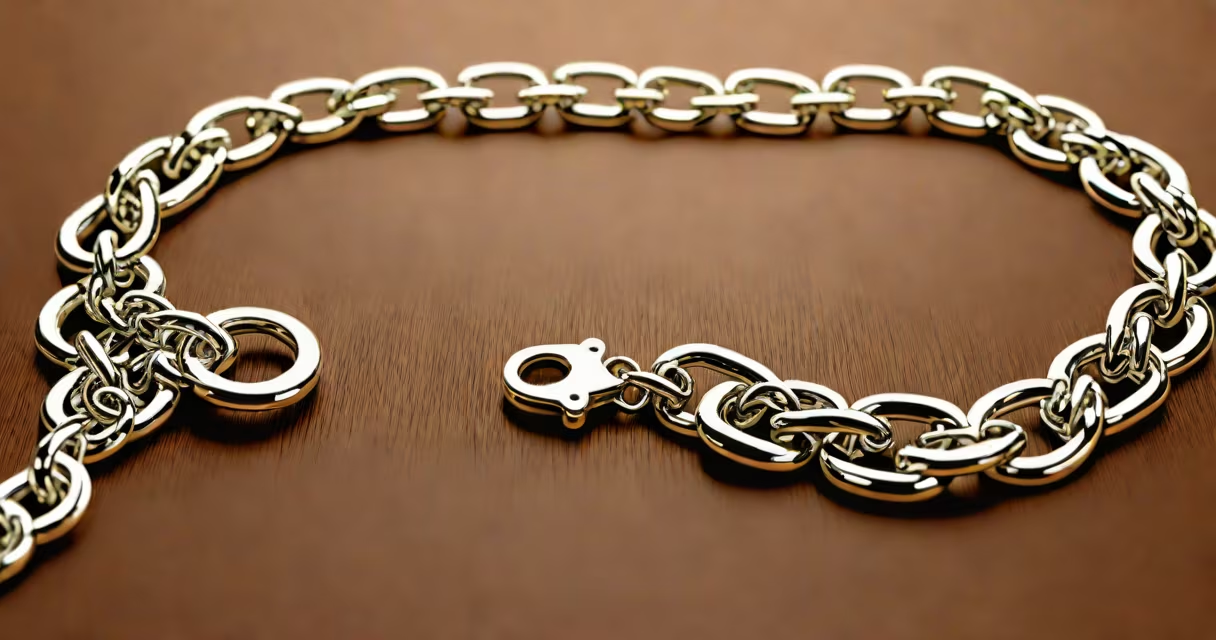
A broken bracelet often signals a release of energy, emotional closure, or a shift in personal boundaries. This event carries symbolic weight across cultures and belief systems, ranging from spiritual omens to psychological metaphors for change.
When a bracelet snaps unexpectedly-especially one worn daily-it's frequently interpreted as a sign of transformation. The physical break represents a rupture in what was once connected: a promise, a protective spell, a relationship, or a personal intention. In many traditions, such moments are not seen as accidents but as meaningful events with layered meanings.
For example, in West African Yoruba culture, beads and bracelets worn during rituals are believed to absorb negative energy. When they break, it's taken as evidence they've fulfilled their protective role. Similarly, in Hindu practice, kundalini energy is sometimes symbolized through wrist jewelry; a break may indicate the energy has moved upward through the chakras.
Bracelets are worn close to the body, often near the pulse point. Their placement makes them intimate objects-personal extensions of identity. When they break, the disruption is felt both physically and emotionally. This proximity amplifies their symbolic power.
The act of breaking implies a loss of continuity. A continuous band suggests unity, protection, or ongoing connection. Breaking that circle disrupts the flow. In numerology, the number eight is associated with infinity and balance. A broken bracelet may represent the end of one cycle and the beginning of another.
Psychologically, researchers have noted that people assign emotional value to objects tied to significant life events. A study published in the Journal of Consumer Research found that individuals who wore sentimental jewelry reported higher levels of perceived emotional support during stressful periods. When such an object fails, it can trigger grief or anxiety-even if rational thinking says it was just a piece of metal and string.
Different societies interpret a broken bracelet through distinct lenses. Some see it as bad luck. Others view it as a necessary release.
| Culture/Region | Interpretation | Source |
|---|---|---|
| Middle East (Islamic tradition) | Broken amulets may indicate protection has been fulfilled. Replacing the item is advised. | Al-Mizan, Volume 2, Ayatollah Khomeini |
| West Africa (Yoruba) | Beads absorb spiritual burden. Breakage shows they've done their work. | Adéyẹmí, O. (2018). *Spirituality and Material Culture in Yoruba Society* |
| South Asia (Hindu-Buddhist) | Broken mala beads suggest completion of a meditation cycle or release of karma. | Swami Vivekananda, *Raja Yoga*, 1896 |
| Western New Age circles | Breakage signals energy clearance. Often seen as positive. | Shamanic practices documented by the National Institute of Health, 2021 |
Even within Western spirituality, the interpretation varies. Some believe a broken bracelet means a protective force has shielded you from harm. Others see it as a warning to pay attention to relationships or emotional patterns.
One non-obvious point: not all breaks are equal. A bracelet snapping under stress (e.g., while lifting weights) is less likely to carry symbolic weight than one breaking during a quiet moment-like while sleeping or meditating. The context matters more than the object itself.
People often mistake a broken bracelet for a sign of impending misfortune. But this is a misreading of the symbolism. In most cases, the break is not a curse-it's a release.
For instance, someone wearing a friendship bracelet may panic upon seeing it snap. They assume the friendship is ending. But the bracelet was meant to be temporary-a reminder of a moment in time. Its failure doesn't predict reality; it reflects internal change.
Another confusion arises around material. A cheap plastic bracelet breaking is often dismissed as trivial. But the emotional impact remains the same. The value lies not in the cost of the item but in the meaning assigned to it.
I once witnessed a woman cry when her mother's beaded bracelet broke during a funeral. She later told me she'd worn it since childhood. The break didn't cause the grief-it revealed it. The object had carried decades of memory. Its failure exposed the emotional weight it held.
If your bracelet breaks, consider asking: What was it protecting? What did it represent? Was it tied to a person, a goal, or a feeling?
Some choose to replace it immediately-symbolizing renewal. Others keep the broken piece as a talisman of transformation. A friend of mine keeps her shattered crystal bracelet in a small box. She calls it "the moment I stopped holding on."
Others turn to ritual. Burning the broken pieces, burying them, or offering them to water are acts of closure. These aren't superstitions-they're ceremonies of letting go.
The meaning of a broken bracelet depends on intent. An object becomes symbolic only when we assign it meaning. The break is not the message-the interpretation is.
Understanding what it means when your bracelet breaks begins not with the object, but with your own story. It's not about fate. It's about awareness.
When you wear something close to your skin, you're not just decorating. You're communicating. And when it breaks, it's speaking back.