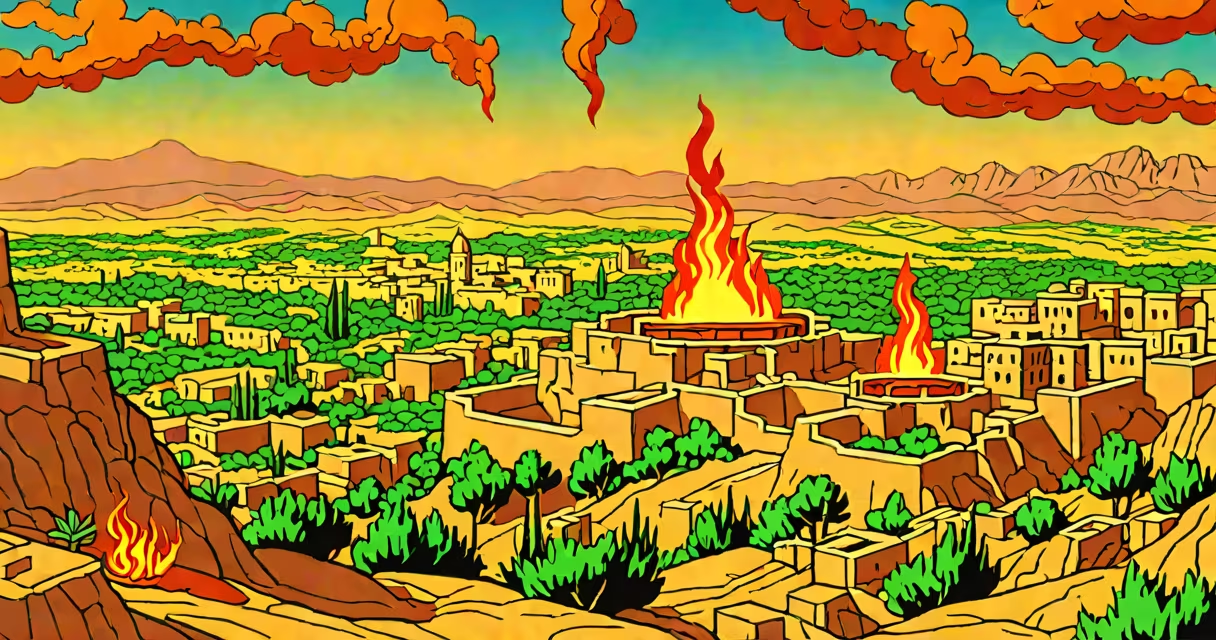
Gehenna in the Bible is a term associated with eternal punishment and divine judgment, originally referring to the Valley of Hinnom near Jerusalem-a site historically used for pagan rituals and later condemned as a place of fire and desolation.
The word appears 12 times in the New Proof, always in Greek form (γέεννα), and is consistently linked to fire, destruction, and final judgment. It is not a literal geographic location in Christian theology but a symbolic representation of eternal separation from God.
Jesus uses Gehenna in the Gospels to warn of severe consequences for sin, particularly in passages like Matthew 5:22, where he says, "Whoever says, 'You fool!' will be in danger of the fire of Gehenna." This usage underscores moral accountability and the seriousness of inner attitudes like anger and hatred.
Gehenna's roots lie in ancient Israelite history. The Valley of Hinnom (Hebrew: גֵּיא בֶּן חֲמוֹן) was located south of Jerusalem and was used during the time of King Ahaz and later Manasseh for child sacrifice to the Canaanite god Molech. These practices were strongly condemned in the Hebrew Bible.
After the reforms of King Josiah, who destroyed the high places and stopped idolatry, the valley became a site of ritual defilement. The prophet Jeremiah wrote that the valley would be cursed: "They will bury the dead in the valley of Ben Hinnom... because they have filled it with the blood of the innocent" (Jeremiah 7:31-32).
By the time of the Second Temple period, Gehenna had evolved into a metaphor for divine judgment. Jewish texts like the Mishnah and Talmud describe Gehinnom (the Hebrew equivalent) as a place of purification or temporary punishment, though not necessarily eternal torment. This contrasts with later Christian interpretations.
In the New Proof, Jesus speaks of Gehenna more frequently than any other figure. He uses it to emphasize the gravity of sin and the necessity of repentance. For example, in Mark 9:43-48, Jesus says:
"If your hand causes you to stumble, cut it off. It is better for you to enter life maimed than with two hands to go into hell [Gehenna], where the fire never goes out."
This passage illustrates Jesus' teaching that extreme measures-symbolic or literal-are justified to avoid eternal punishment. The imagery of unquenchable fire and worms that do not die (Mark 9:48) draws from Isaiah 66:24, which describes the fate of the wicked after judgment.
Paul also references Gehenna indirectly in Romans 6:23: "For the wages of sin is death, but the gift of God is eternal life through Christ Jesus our Lord." While the term isn't used, the concept aligns with the idea of eternal separation from God.
A widespread misconception is that Gehenna equals "Hell" as a permanent residence for souls. However, the original context shows Gehenna was a physical place with historical significance before becoming symbolic. It was not a concept developed by early Christianity but adapted from existing Jewish thought.
Another error is equating Gehenna with the Greek Hades. Hades referred to the underworld or area of the dead, a neutral place where both righteous and unrighteous went. Gehenna, by contrast, is specifically tied to punishment and judgment. The two concepts differ in function and theological weight.
Some interpret Gehenna as a literal place of fire. But scholars agree that the fire is symbolic-representing divine judgment, purification, or the final destruction of evil. The unquenchable fire in Mark 9:43 is not meant to be taken literally but as a hyperbolic warning against spiritual complacency.
| Biblical Term | Original Meaning | Modern Interpretation | Source Reference |
|---|---|---|---|
| Gehenna | Valley of Hinnom, site of idolatry and burial | Symbol of eternal punishment and divine judgment | Matthew 5:22, Mark 9:43 |
| Hades | Underworld, abode of the dead | Neutral area, not inherently punitive | Luke 16:23, Acts 2:27 |
| Tartarus | Deep abyss in Greek myth | Place of imprisonment for fallen angels | 2 Peter 2:4 |
One non-obvious fact: Gehenna is never used in the Old Proof. The term appears exclusively in the New Proof, translated from Greek. The Hebrew word for the valley-Gehinnom-is used in the Old Proof, but not in the sense of eternal damnation. The shift from geographical site to theological symbol occurred during the intertestamental period.
I once visited the archaeological site of the Valley of Hinnom near modern-day Jerusalem. Standing on the rocky slope where ancient altars once stood, I saw the remains of ash pits and burial caves. The silence there felt heavy-not because of supernatural dread, but because of the weight of human choices. That visit reshaped my understanding: Gehenna wasn't invented by Jesus-it was a warning drawn from a place already known for its moral failure.