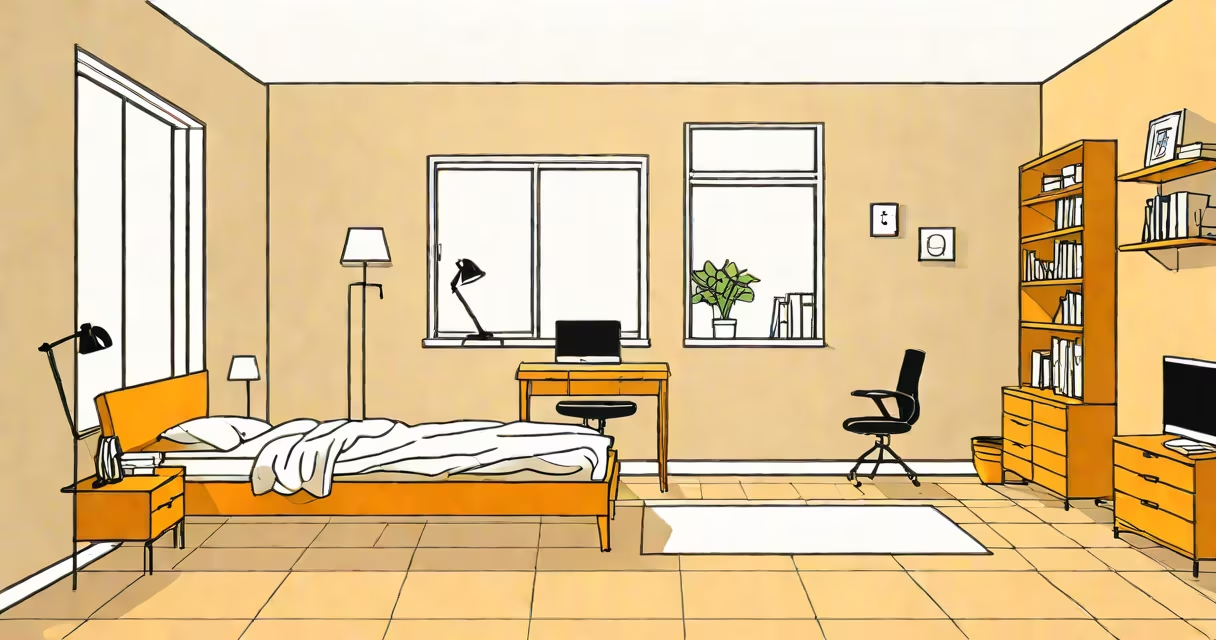
Austere describes something marked by severity, simplicity, or strictness-especially in appearance, behavior, or lifestyle. It implies minimal decoration, restrained emotion, or rigorous discipline, often associated with asceticism or practicality rather than comfort.
The term originates from Latin *austerus*, meaning "strict" or "harsh," and entered English via French in the 16th century. It's not synonymous with coldness or unkindness, though it may appear so. Instead, austere emphasizes deliberate restraint-choosing function over flair, necessity over indulgence.
For example, a monastery cell with whitewashed walls, a wooden bed, and a single chair is austere. So is a person who avoids luxury, speaks plainly, and lives with few possessions. The word applies to physical spaces, personal demeanor, and even artistic expression.
Austere environments prioritize utility. They eliminate distractions, reduce visual noise, and emphasize structure. This isn't about poverty-it's about intentionality. A minimalist home designed by architect Tadao Ando uses raw concrete, natural light, and open space. The result feels austere, yet deeply calming and focused.
In behavior, an austere person avoids excess. They don't wear flashy clothes, make grand gestures, or seek attention. Their speech is direct. Their actions follow principle, not impulse. This isn't emotional repression-it's control rooted in values.
When describing art or architecture, "austere" signals a lack of ornamentation. Think of ancient Roman temples with clean lines and no statues. Or the work of artist Agnes Martin, whose grid paintings use subtle pencil lines on white canvas-minimal, repetitive, emotionally restrained.
While the core meaning stays consistent, context shapes nuance. Here's how "austere" appears across domains:
| Context | Meaning of Austere | Example |
|---|---|---|
| Architecture | Simple forms, limited materials, no decorative elements | Le Corbusier's Unité d'Habitation in Marseille-concrete, geometric, unadorned |
| Personality | Reserved, disciplined, emotionally restrained | A teacher who speaks in short sentences and avoids humor in class |
| Lifestyle | Minimal possessions, low consumption, intentional living | An individual who owns fewer than 100 items and avoids advertising |
| Art & Design | Plain composition, absence of color or texture | Robert Ryman's white-on-white paintings, which rely on subtle variations in surface |
Not all austere things are unpleasant. The Japanese concept of *wabi-sabi* embraces imperfection and simplicity-qualities found in austere aesthetics. A tea house with uneven floorboards, a chipped bowl, and quiet stillness embodies both wabi-sabi and austerity.
People often mistake "austere" for "cold" or "unfriendly." But severity doesn't imply hostility. An austere person may be kind, thoughtful, and deeply principled. Their reserve stems from focus, not disinterest.
Another error is equating "austere" with "poor." A wealthy person can live austere-think of a CEO who wears the same suit daily, eats simple meals, and donates most income. Their lifestyle isn't defined by lack, but by choice.
Also, "austere" is not interchangeable with "plain." Plain means unremarkable. Austere means deliberately stripped of excess. A plain wall might be dull. An austere wall is purposefully minimal-its emptiness is meaningful.
According to Merriam-Webster, "austere" describes "severe or strict in manner or attitude" and "marked by simplicity or lack of ornament." The Oxford English Dictionary notes its use in religious contexts-referring to monks who lived with little food or comfort. These sources confirm that the term centers on discipline, not deprivation.
Diogenes of Sinope, a Greek philosopher in the 4th century BCE, lived in a large ceramic jar (pithos) in Athens. He owned nothing but a cloak, staff, and bowl. He ate scraps, slept in the open air, and mocked social customs. His life was austere-not because he lacked resources, but because he rejected materialism.
When asked why he lived so simply, he replied, "I am not rich, but I am free." His austerity wasn't punishment-it was resistance to vanity and excess. Modern thinkers like Seneca and Epictetus echoed this view: simplicity leads to clarity and freedom.
This example shows that "austere" is not just a descriptor-it's a philosophical stance. It reflects a worldview where external things don't define value.
Use "austere" when describing something that is intentionally simple, restrained, or severe. Avoid it for things that are merely boring, ugly, or empty. The word carries weight-it implies intention, not accident.
For instance, saying "The office had an austere look" suggests the designer chose minimalism. Saying "The office looked dull" says nothing about intent.
"Austere" remains a precise tool for describing restraint, clarity, and deliberate simplicity. Whether in design, behavior, or philosophy, it names a choice: to do less, think more, feel deeper.