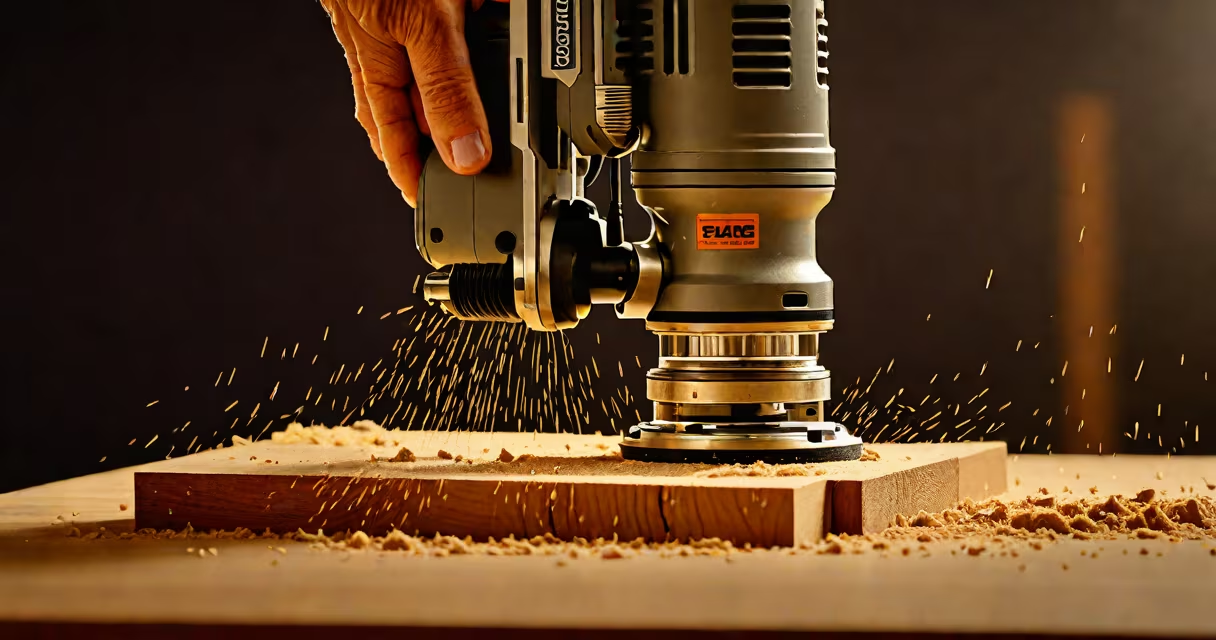
A wood router is a power tool that shapes edges, cuts grooves, and creates joinery in wood. It removes material with a spinning bit to produce clean, precise results for furniture, cabinetry, and trim work.
Wood routers operate at high speeds-typically 10,000 to 30,000 RPM-using interchangeable carbide-tipped bits. The tool moves along a surface while the bit cuts into the wood, enabling consistent results across multiple pieces. Unlike hand planes or chisels, routers deliver uniformity and speed, especially when replicating profiles across several components.
For example, a 1/4-inch round-over bit can be used to soften sharp edges on a tabletop. A single pass with the router produces a smooth, rounded edge on all four sides of a 6-foot-long table. This consistency is impossible to achieve reliably by hand.
Routers perform four primary tasks: edge profiling, dado and rabbet cutting, mortising, and template routing. Each function serves distinct purposes in construction and finishing.
Edge profiling shapes the outer edges of wood. Common profiles include round-over, ogee, chamfer, and bevel. These aren't decorative only-they improve safety by removing sharp corners and improve visual appeal in frames, shelves, and doors.
Dado and rabbet cutting create recesses for joining boards. A dado slot holds a shelf within a cabinet frame. A rabbet fits one board into the edge of another, such as in picture frames or drawer boxes. Both require precise depth control, which routers provide via adjustable fences and depth stops.
Mortising involves cutting rectangular holes for tenons in mortise-and-tenon joints. While specialized mortisers exist, many woodworkers use a router with a straight bit and a fence setup to cut mortises quickly and accurately. A 1/2-inch wide bit set to 1 inch depth can cut a 12-inch long mortise in under 30 seconds.
Template routing allows replication of complex shapes. A template-a pattern made from plywood or MDF-is clamped to the workpiece. The router follows the edge of the template using a bearing-guided bit, producing identical parts. This method is standard in making chair backs, curved table legs, or custom moldings.
Two main types exist: fixed-base and plunge routers. Each suits different tasks based on precision and control needs.
| Type | Best For | Key Advantage | Example Use |
|---|---|---|---|
| Fixed-base | Edge profiling, repetitive cuts | Stability and accuracy on flat surfaces | Routing a round-over profile around a door edge |
| Plunge | Starting cuts in the middle of a board | Ability to lower the bit into the material mid-cut | Cutting a circular pocket for a drawer pull |
Plunge routers allow you to start a cut anywhere on the wood surface. This is critical when creating inset openings-like a hole for a knob or a recessed handle. Fixed-base routers require you to position the bit at the edge and begin the cut, limiting flexibility.
Many woodworkers use both types. A fixed-base router handles edge shaping, while a plunge router cuts pockets or slots. For example, building a bookshelf requires a dado cut for the shelf supports. Using a plunge router with a 3/4-inch straight bit set to 1 inch depth, you can cut a 36-inch long dado in one continuous pass.
One widespread misunderstanding is that routers are only for decorative edges. They're not. Routers are structural tools. A properly routed joint-like a flush-mounted dovetail or a rabbet joint-can support significant weight. A 1-inch-wide rabbet cut into solid oak can hold over 200 pounds when joined with screws and glue.
Another error is assuming all routers are the same size. Power matters. A 1.5-horsepower router handles dense hardwoods like walnut or maple. A 1/2-horsepower model struggles with tear-out and overheats when cutting through thick oak. According to the Woodworking Magazine, routers below 1 horsepower are unsuitable for continuous production work.
Also, people think routers are dangerous. With proper setup-clamping the workpiece, using a guide fence, and wearing eye protection-they're among the safest power tools. I once used a plunge router to cut a 6-inch diameter circle in a 2-inch-thick cherry board. The bit stayed centered, and the cut was smooth. Safety gear and steady hands prevent accidents.
Consider building a floating shelf. You need to cut a 1-inch-deep rabbet along the back edge of a 24-inch-long pine board. Set the plunge router to 1 inch depth, clamp a straight edge as a guide, and make one pass. The result is a clean, even groove that hides the mounting bracket.
Another example: crafting a wooden jewelry box. Use a round-over bit to finish the lid's edge. Then, cut a dado for the base using a 3/4-inch bit. The lid fits snugly into the base, and the rounded edges feel smooth to the touch. This level of detail is hard to achieve without a router.
Even small projects benefit. A router can cut a 1/8-inch groove in a 12-inch-long strip to hold a brass inlay. The precision ensures the metal sits flush and doesn't wobble.
Understanding what a wood router does unlocks many possibilities-from simple trim work to complex joinery. It's not just a shaping tool. It's a core component of professional-grade woodworking.