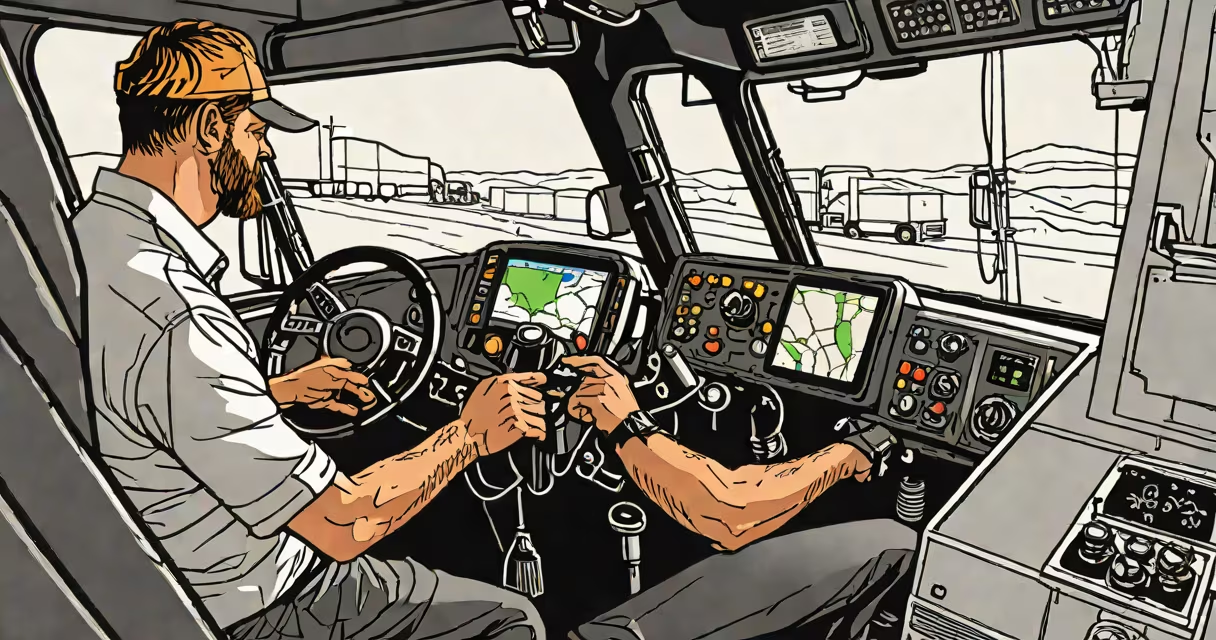
Truck drivers typically earn between $0.35 and $0.60 per mile for long-haul routes, with rates influenced by route length, equipment type, and company policy. This pay structure compensates for fuel, wear-and-tear, and time away from home.
Per-mile pay is a standard model in the freight industry, especially for owner-operators and independent contractors. Carriers set base rates based on market conditions, fuel costs, and regional demand. For example, a driver hauling refrigerated goods across the Midwest may earn $0.52/mile, while a flatbed hauler in the Pacific Northwest might receive $0.48/mile due to terrain and seasonal traffic patterns.
The U.S. Bureau of Labor Statistics (BLS) reports median annual earnings for heavy and tractor-trailer truck drivers were $50,220 in May 2023. That translates to roughly $0.42 per mile for a driver logging 110,000 miles annually-a common benchmark for full-time long-haul work. Actual take-home pay varies based on hours driven, fuel surcharges, and bonuses.
Truckers are paid a set rate per mile driven, usually calculated on a gross basis before deductions. A typical contract might state "$0.50 per mile," meaning the driver earns $500 for every 1,000 miles completed. This rate is often adjusted monthly based on fuel prices through a fuel surcharge program.
For example, a driver transporting electronics from Los Angeles to Chicago (2,400 miles) at $0.50/mile earns $1,200 before expenses. The carrier may then apply a fuel surcharge of $0.10/mile when diesel averages $4.50/gallon, adding $240 to the total. The driver's gross income becomes $1,440 for the trip.
Some companies use a hybrid model combining per-mile pay with guaranteed minimums. A carrier might offer $0.45/mile with a $2,000 weekly guarantee. If the driver completes fewer than 4,444 miles in a week, they still receive $2,000. This protects income during low-volume periods but reduces potential earnings.
Not all per-mile pay is equal. Rates differ based on job classification, equipment, and contract type. The table below outlines common categories:
| Type | Avg. Rate ($/mile) | Common Loads | Notes |
|---|---|---|---|
| Long-Haul Dry Van | $0.45-$0.55 | General freight, retail goods | Most common; higher volume, lower risk |
| Reefer (Refrigerated) | $0.50-$0.60 | Frozen food, pharmaceuticals | Higher pay due to temperature control requirements |
| Flatbed | $0.48-$0.58 | Construction materials, machinery | Higher risk; requires securement skills |
| Owner-Operator | $0.60-$0.75 | Self-directed routes | Higher pay but covers all operating costs |
Independent drivers often negotiate higher per-mile rates because they cover their own fuel, insurance, and maintenance. According to the American Trucking Associations (ATA), owner-operators averaged $0.68/mile in 2023, compared to $0.49/mile for company-employed drivers.
One non-obvious factor: pay rates are frequently higher on return trips. Carriers pay more per mile for outbound runs to incentivize drivers to accept loaded returns. A round-trip from Atlanta to Denver might pay $0.52/mile out and $0.58/mile back, increasing total compensation by 11%.
Regional differences in pay stem from cost of living, local regulations, and supply-demand imbalances. The ATA notes that drivers in the Southwest and Midwest earn 8-12% more per mile than those in the Northeast due to lower operational costs and higher freight volume.
For example, a dry van driver hauling from Houston to Seattle (1,800 miles) earned $0.53/mile in 2023. The same route from New York City to Portland, Oregon (2,800 miles) paid $0.47/mile. Despite longer distance, the latter route had lower pay due to congestion, tolls, and stricter environmental rules in California.
Pay also varies by season. During peak shipping months (September-December), carriers increase per-mile rates by 5-10% to attract drivers. In 2023, the average rate rose to $0.54/mile during Q4, according to the FreightWaves Index.
Many assume per-mile pay is pure profit. In reality, it's gross revenue. After deducting fuel, tolls, repairs, and taxes, net earnings drop. A driver earning $0.55/mile might spend $0.22/mile on fuel alone, leaving $0.33/mile after fuel costs.
Another misconception: all drivers get the same rate. In practice, pay depends on experience, safety record, and contract terms. A veteran driver with a clean DOT record might command $0.58/mile, while a new hire receives $0.45/mile even on the same route.
I once drove a 1,200-mile stretch from Phoenix to Salt Lake City at $0.50/mile. The trip took 42 hours. Fuel cost $0.23/mile, tolls $0.04/mile, and maintenance added $0.02/mile. After subtracting $0.29/mile in direct costs, my net pay was $0.21/mile-about $252 for the entire run. This illustrates how per-mile pay doesn't reflect take-home pay until expenses are accounted for.
Carriers sometimes advertise high per-mile rates without disclosing hidden fees. Always review the full contract. Some companies charge for vehicle maintenance, even if they claim "all-inclusive" pay. The Federal Motor Carrier Safety Administration (FMCSA) warns against such practices and requires transparency in pay agreements.
Per-mile pay for truck drivers ranges from $0.35 to $0.60, depending on route, load type, and employment status. Rates are not uniform and fluctuate with fuel, season, and location. Net earnings depend heavily on operating costs, which can reduce effective pay by nearly half.
When evaluating offers, compare total compensation-not just the per-mile rate. Consider fuel surcharges, bonuses, and expense reimbursement. Owner-operators earn more per mile but bear all financial risks.