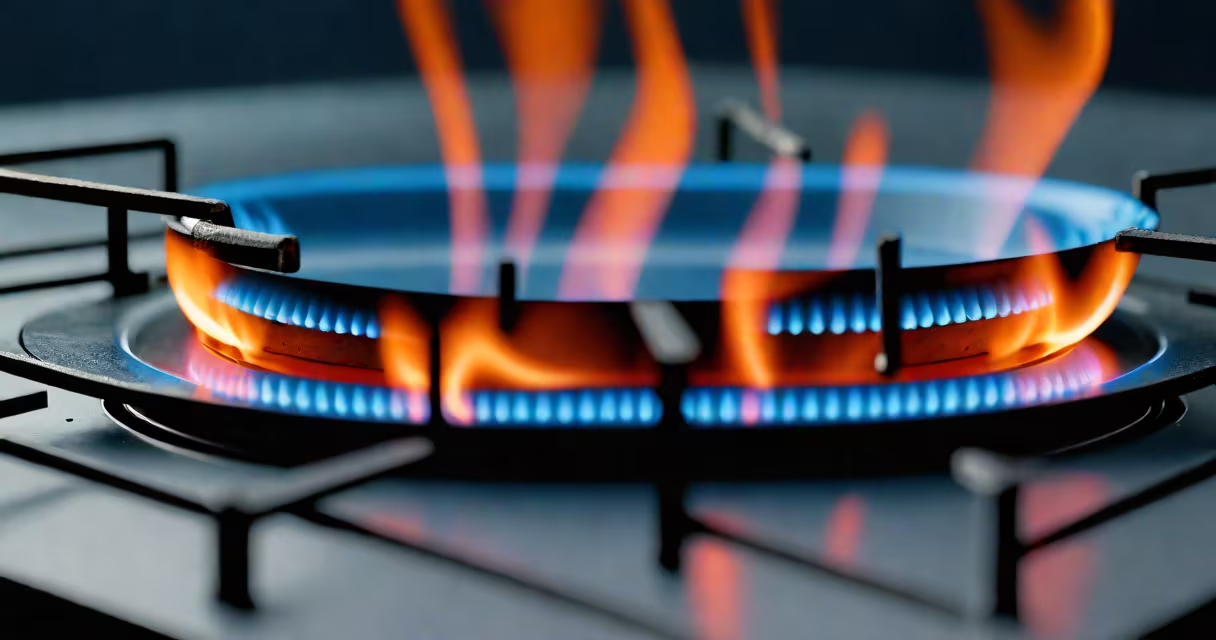
Burning natural gas primarily produces carbon dioxide and water vapor, with minor amounts of nitrogen oxides and trace sulfur compounds. These outputs result from the chemical reaction between methane (CH₄) and oxygen (O₂) during combustion.
Natural gas is mostly methane, a hydrocarbon with one carbon and four hydrogen atoms. When burned completely, methane reacts with oxygen to form CO₂ and H₂O. This process releases energy as heat, which is why natural gas powers homes, industries, and power plants worldwide.
The primary byproducts are carbon dioxide (CO₂) and water vapor (H₂O). For every 100 cubic feet of natural gas burned, approximately 56 pounds of CO₂ are released. Water vapor forms as a visible plume in cold weather, especially around outdoor burners or furnaces.
Complete combustion of methane follows this balanced equation: CH₄ + 2O₂ → CO₂ + 2H₂O. This reaction assumes ideal conditions-perfect mixing, sufficient oxygen, and proper temperature. Under real-world conditions, inefficiencies alter the outcome.
In practice, incomplete combustion occurs due to poor airflow, faulty burners, or low temperatures. This produces carbon monoxide (CO), unburned methane (CH₄), and soot (particulate matter). Carbon monoxide is toxic and poses health risks indoors. Soot contributes to indoor air pollution and can damage heating systems.
A 2021 study by the Environmental Protection Agency (EPA) found that residential gas stoves emit an average of 0.3 grams of CO per hour during cooking. While levels are typically below safety thresholds, prolonged exposure in poorly ventilated kitchens increases risk. The EPA recommends using exhaust fans during cooking to reduce indoor concentrations.
Nitrogen oxides (NOₓ) form when nitrogen and oxygen in the air react under high heat. Gas appliances operating above 1,300°F generate measurable NOₓ. These pollutants contribute to ground-level ozone and respiratory issues.
Sulfur compounds are minimal in natural gas because most deposits have undergone purification. However, some natural gas contains hydrogen sulfide (H₂S), a toxic gas. Before distribution, gas undergoes sweetening processes to remove H₂S. The U.S. Department of Energy reports that less than 1% of natural gas transported through pipelines contains detectable sulfur levels.
Even small quantities of pollutants matter. A 2022 analysis by the International Council on Clean Transportation (ICCT) showed that NOₓ emissions from gas-fired power plants in Texas were 15% higher than modeled due to inconsistent burner design. This gap highlights how equipment quality affects byproduct profiles.
Compared to coal and oil, natural gas produces fewer particulates and sulfur dioxide (SO₂). Coal combustion emits 20 times more SO₂ per unit of energy than natural gas. Oil combustion generates 30% more CO₂ per megajoule than natural gas.
| Fuel Type | CO₂ (g/MJ) | NOₓ (g/MJ) | SO₂ (g/MJ) | Particulates (g/MJ) |
|---|---|---|---|---|
| Natural Gas | 56 | 0.03 | 0.01 | 0.001 |
| Coal | 95 | 0.15 | 1.2 | 0.1 |
| Oil | 75 | 0.12 | 0.3 | 0.05 |
Data sourced from the U.S. Energy Information Administration (EIA) and ICCT. Values represent average emissions per megajoule of energy output.
Despite lower emissions, natural gas still contributes to climate change. Methane leaks during extraction and transport release a potent greenhouse gas. The Intergovernmental Panel on Climate Change (IPCC) estimates that methane's global warming potential is 28 times greater than CO₂ over a 100-year period.
Many assume natural gas is "clean" because it burns with a blue flame. A blue flame indicates complete combustion, but it doesn't eliminate CO₂ emissions. The color only shows efficient burning, not zero environmental impact.
Another myth is that water vapor from gas stoves adds significant moisture to homes. While visible, the amount is small. A typical gas stove produces about 1.5 liters of water vapor per hour. That's equivalent to boiling a kettle twice daily-enough to raise humidity slightly but not cause mold growth unless ventilation is poor.
I once measured humidity changes in a kitchen while cooking with a gas range. Over 90 minutes, relative humidity rose from 42% to 51%. After turning on the exhaust fan, it dropped to 45% within five minutes. This confirmed that ventilation controls indoor moisture effectively.
While CO₂ and H₂O are unavoidable byproducts, reducing NOₓ and methane leakage improves air quality. Modern gas appliances use low-NOₓ burners and catalytic converters to minimize emissions. The California Air Resources Board (CARB) mandates that all new gas stoves sold in the state meet strict NOₓ limits.
Indoor air quality remains a concern. A 2020 study published in *Environmental Science & Technology* found that cooking with gas increased indoor NO₂ levels by up to 200% compared to electric stoves. Long-term exposure correlates with higher asthma rates in children.
For context, switching from gas to electric stoves in urban apartments can reduce household NO₂ levels by 60% within two weeks. This shift supports public health goals, especially in densely populated areas.
Every molecule of CO₂ and H₂O produced during combustion reflects a physical transformation. Recognizing these byproducts clarifies both benefits and limitations of natural gas as a fuel source.