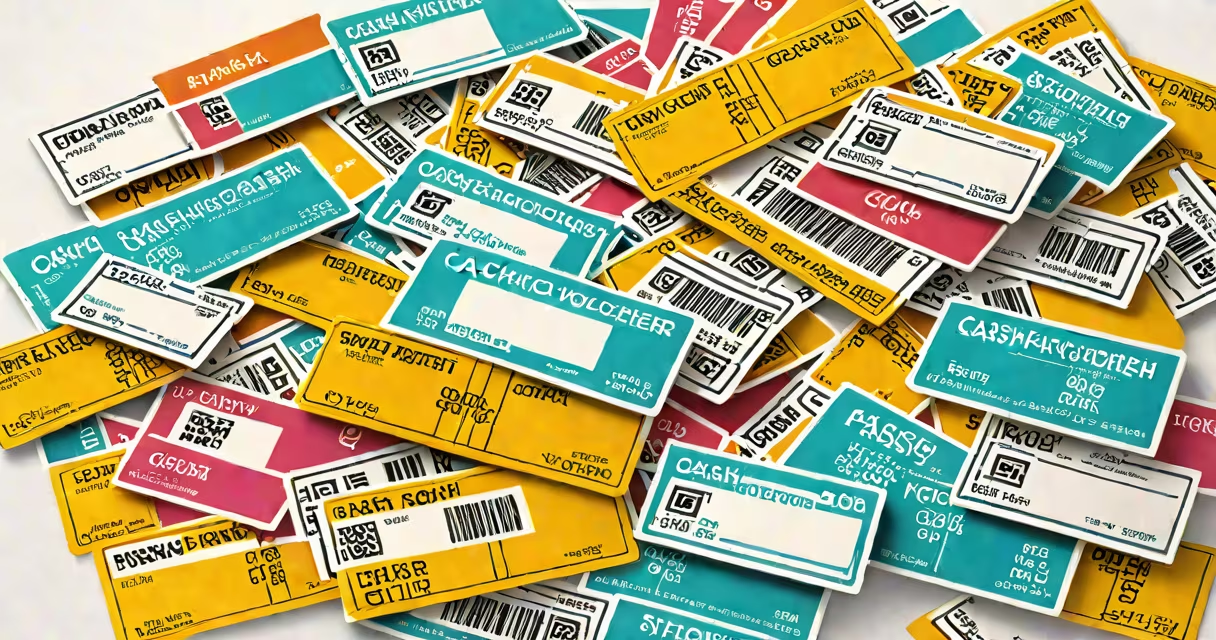
Cash vouchers are prepaid instruments issued by businesses or institutions that entitle the holder to a specified amount of money or goods, often redeemable at a designated location or online. They function as a form of stored-value payment, distinct from physical currency but usable in place of it under agreed terms.
Cash vouchers operate on a closed-loop system: the issuer sets the value, controls distribution, and defines redemption rules. Unlike credit or debit cards, they don't require a bank account or credit check. Instead, they rely on a preloaded balance that expires after a set period unless used.
These instruments are widely used in retail, corporate rewards programs, and government assistance initiatives. For example, Walmart offers $50 cash vouchers to customers who return eligible electronics, while state agencies distribute food vouchers to low-income families through SNAP programs.
When a business issues a cash voucher, it records the value on a secure database or prints a unique code. The recipient presents the voucher-either physically or digitally-at a participating outlet. The merchant scans the code or enters the serial number, verifies it against the issuer's system, and applies the value toward a purchase or issues cash.
Redemption typically requires verification. A grocery store may accept a $25 food voucher from a local health department, but only if the voucher hasn't expired and the transaction doesn't exceed the remaining balance. Once redeemed, the system marks the voucher as used and updates the issuer's ledger.
Some systems integrate with mobile apps. For instance, Amazon's promotional gift cards allow users to apply the balance during checkout. The app checks the card's validity, deducts the amount, and sends a confirmation receipt-all within seconds.
Cash vouchers come in several formats, each suited to different use cases:
| Type | Form | Use Case | Example |
|---|---|---|---|
| Physical Paper Voucher | Printed slip with barcode or PIN | Retail promotions, event giveaways | Target's $10 off coupon for holiday shoppers |
| Digital Voucher | Email or SMS with unique code | Online sales, e-commerce discounts | Netflix gift card sent via email |
| Prepaid Card | Plastic card with chip or magnetic stripe | Employee bonuses, payroll alternatives | Paychex's prepaid payroll card for hourly workers |
| Mobile App Voucher | QR code or digital wallet integration | Restaurant loyalty programs, ride-sharing | Uber's $20 ride credit sent through the app |
Not all vouchers are redeemable for cash. Some are restricted to specific products or services. For example, a $50 movie theater voucher may only cover tickets and concessions-not merchandise. However, true cash vouchers allow direct withdrawal or spending equivalent to cash.
A common misconception is that all gift cards are cash vouchers. While both are prepaid, only those explicitly redeemable for cash qualify. A $25 Starbucks gift card is not a cash voucher-it's a product-specific voucher. The distinction matters legally and financially.
Businesses issue cash vouchers to drive customer traffic, clear inventory, or reward loyalty. A restaurant chain might send $10 vouchers to past customers to encourage return visits. These incentives boost retention without immediate cash outlay.
Employers use cash vouchers as part of compensation packages. A tech company might give employees $500 in prepaid vouchers for wellness programs, covering gym memberships or mental health counseling. This allows flexible benefit allocation while maintaining budget control.
Government programs also rely on cash vouchers. The U.S. Department of Agriculture's Supplemental Nutrition Assistance Program (SNAP) issues electronic benefits transfer (EBT) cards, which function similarly to cash vouchers. Recipients load funds monthly and spend them at approved retailers. According to USDA data, over 40 million people used SNAP benefits in 2023.
During economic downturns, cash vouchers serve as emergency relief. After Hurricane Maria in 2017, Puerto Rico distributed $500 cash vouchers to displaced families through the Federal Emergency Management Agency (FEMA). These were processed via mobile wallets and accepted at local stores, enabling rapid access to essentials.
One widespread error is assuming cash vouchers have universal acceptance. A $100 voucher from a regional retailer won't work at national chains unless explicitly authorized. Always verify acceptance policies before relying on a voucher.
Another issue is expiration dates. Many cash vouchers carry time limits. A $25 voucher issued in January 2023 may expire in December 2024. If unused by then, the balance is forfeited. The Consumer Financial Protection Bureau (CFPB) reports that nearly 14% of prepaid cards lose value due to unclaimed balances.
There's also confusion between cash vouchers and gift cards. While both are prepaid, only cash vouchers represent actual monetary value. A gift card for a clothing store is not interchangeable with cash unless the store allows cash refunds. The legal definition varies by jurisdiction-California law, for example, requires issuers to disclose expiration and fees.
In 2022, a mid-sized software firm in Austin, Texas, replaced traditional holiday bonuses with $300 cash vouchers. Employees received digital vouchers via email, valid for six months at any local retailer, including grocery stores, pharmacies, and gas stations.
The company partnered with a fintech provider to issue the vouchers. Each was linked to a virtual account with a unique ID. Employees accessed the balance through a mobile app, scanned the QR code at checkout, and completed transactions instantly.
Results showed a 22% increase in employee satisfaction compared to previous years. The firm saved $18,000 in processing costs by eliminating paper checks and direct deposits. More, 94% of recipients used the full value, indicating high engagement and trust in the system.
This example illustrates how cash vouchers support financial inclusion. Low-income employees who don't maintain bank accounts can still receive and use benefits securely. The program also reduced administrative overhead and improved transparency.
Cash vouchers are not just promotional tools-they are functional financial instruments with real-world applications. Understanding their mechanics, limitations, and proper use prevents loss and maximizes utility.
For those managing personal finances, knowing how to handle cash vouchers-especially when transferring or redeeming-can prevent lost funds. Always track expiry dates and confirm acceptance policies before making purchases.
Finally, if you're exploring options to cash out digital assets or rewards, cash vouchers offer a straightforward path. They provide liquidity without needing a bank account, making them ideal for informal economies and underbanked populations.