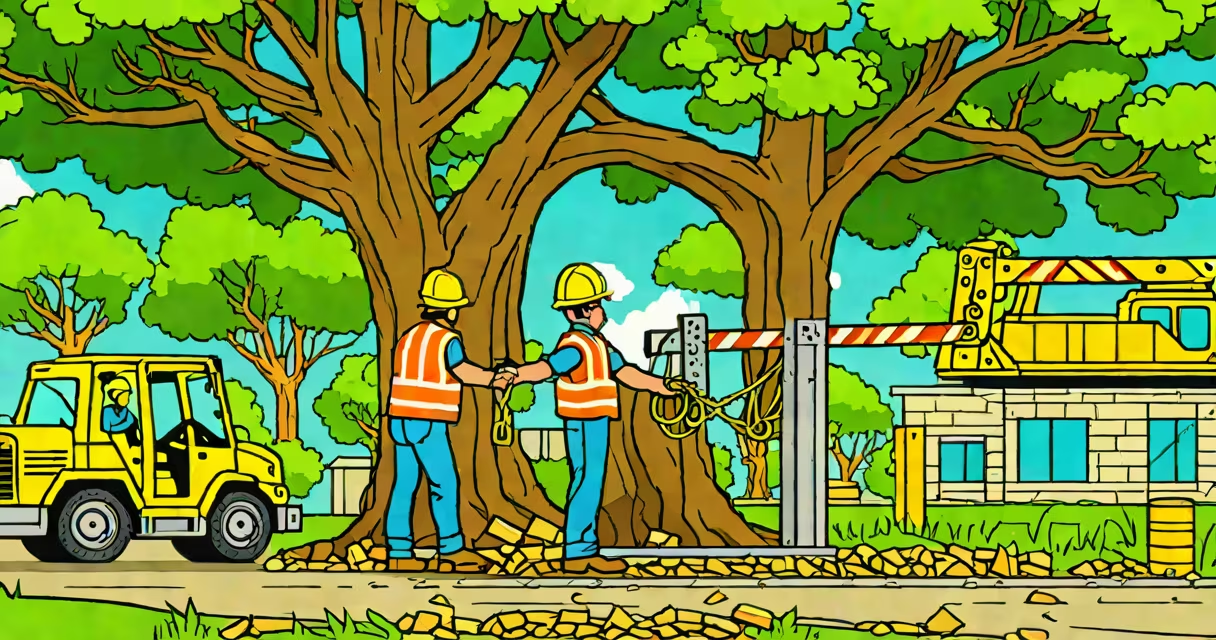
Tree protection orders are legally binding directives issued by local governments to prevent damage to specific trees during construction or land development projects. These orders define exclusion zones around trees and prohibit activities like digging, grading, or installing utilities within those areas.
Local authorities issue tree protection orders under municipal codes or environmental ordinances. They apply to individual trees or groups of trees deemed ecologically, historically, or aesthetically significant. Violations can result in fines, project delays, or mandatory restoration work.
For example, in New York City, the Department of Parks and Recreation issues tree protection orders for heritage trees in public parks. A developer planning to build a retail complex near Central Park must submit a site plan showing buffer zones around any protected trees. If the buffer zone is violated, the city can halt construction until corrective actions are taken.
When a project involves land with existing trees, planners must conduct a tree survey before breaking ground. This survey identifies species, size, health, and significance. Trees meeting criteria-such as trunk diameter above 18 inches or ecological value-are flagged for protection.
Once identified, the local authority evaluates whether to issue a tree protection order. The order specifies a radius around the tree's trunk based on root zone calculations. For oaks, this is typically 1.5 times the tree's diameter at breast height (DBH). The buffer zone is marked with physical barriers or paint.
Construction crews must follow the order strictly. Any deviation-like using heavy equipment within the protected zone-constitutes a violation. In Chicago, a contractor was fined $12,000 in 2022 for driving a dump truck through a tree protection zone during a residential renovation, damaging the roots of a 120-year-old sycamore.
Tree protection orders vary by jurisdiction. Some cities require permits for tree removal even if the tree is not protected. Others allow removal only after a formal review process. The table below outlines common categories:
| Type | Scope | Enforcement Authority | Example |
|---|---|---|---|
| Individual Tree Order | Protects one high-value tree | Municipal parks department | Los Angeles protects a 150-year-old live oak in Griffith Park |
| Site-wide Order | Applies to all trees on a development site | City planning commission | Seattle requires site-wide orders for projects over 5,000 sq ft |
| Emergency Order | Temporary protection after storm damage or illegal felling | Environmental agency | After Hurricane Ian, Florida issued emergency orders for mangrove forests in Miami-Dade County |
Enforcement relies on inspections and documentation. Project managers must submit weekly logs showing compliance. If a violation is reported, inspectors visit the site within 72 hours. In Portland, Oregon, inspectors use drones equipped with thermal imaging to detect unauthorized excavation near protected trees.
Many people assume that tree protection orders only apply to public land. That's false. Private property owners must comply too. In 2021, a homeowner in Austin, Texas, was ordered to restore a 60-foot pecan tree damaged during a backyard pool installation. The city had issued a tree protection order after a survey revealed the tree's DBH exceeded 24 inches.
Another misunderstanding is that fencing alone satisfies compliance. Fencing may be required, but it's not sufficient. The order also mandates soil compaction limits, erosion control, and no use of machinery within the buffer zone. A landscaping company in Denver lost its license in 2020 after repeatedly violating these rules during a commercial site cleanup.
A lesser-known fact: tree protection orders often include a "survival clause." If a tree dies during construction despite protections, the developer must replant a replacement tree of equal or greater size. In San Francisco, a developer was forced to plant a 25-foot redwood in place of a 20-foot eucalyptus killed by vibration from nearby pile-driving.
In 2023, a mixed-use development in Boston's Back Bay area faced a 45-day delay because a tree protection order was triggered. The project involved converting a historic warehouse into apartments. During the initial survey, a 100-year-old London plane tree was discovered with a DBH of 36 inches-well above the 24-inch threshold for protection.
The city's Urban Forestry Division issued a tree protection order with a 54-foot buffer zone. Construction had to reroute utility lines and modify foundation plans. The developer spent $48,000 on redesign and additional soil testing. Without the order, the tree would have been removed under a standard permit-but the order prevented that.
During the project, inspectors found a crew member had used a trencher within 12 feet of the tree's root zone. The city halted work, issued a $7,500 fine, and required a soil remediation report. The incident highlighted how even minor deviations trigger enforcement.
As someone who has reviewed dozens of tree protection orders while working with a field compliance firm, I've seen how easily teams misjudge buffer zones. One team assumed a 30-foot radius was enough for a large maple. The actual required distance was 45 feet. Correcting the error delayed the project by six weeks and cost $18,000 in rework.
Tree protection orders differ from tree preservation orders (TPOs) in the UK, which are more permanent and require public consultation. In the U.S., most orders are temporary and tied to a specific project. They don't grant long-term ownership rights to trees.
They also aren't the same as conservation easements. Conservation easements are permanent land-use restrictions held by nonprofits or government agencies. A tree protection order applies only during a project's active phase.
Finally, tree protection orders are distinct from environmental impact statements (EIS). An EIS assesses broad ecological effects of large-scale projects. A tree protection order focuses on individual trees and immediate construction risks.