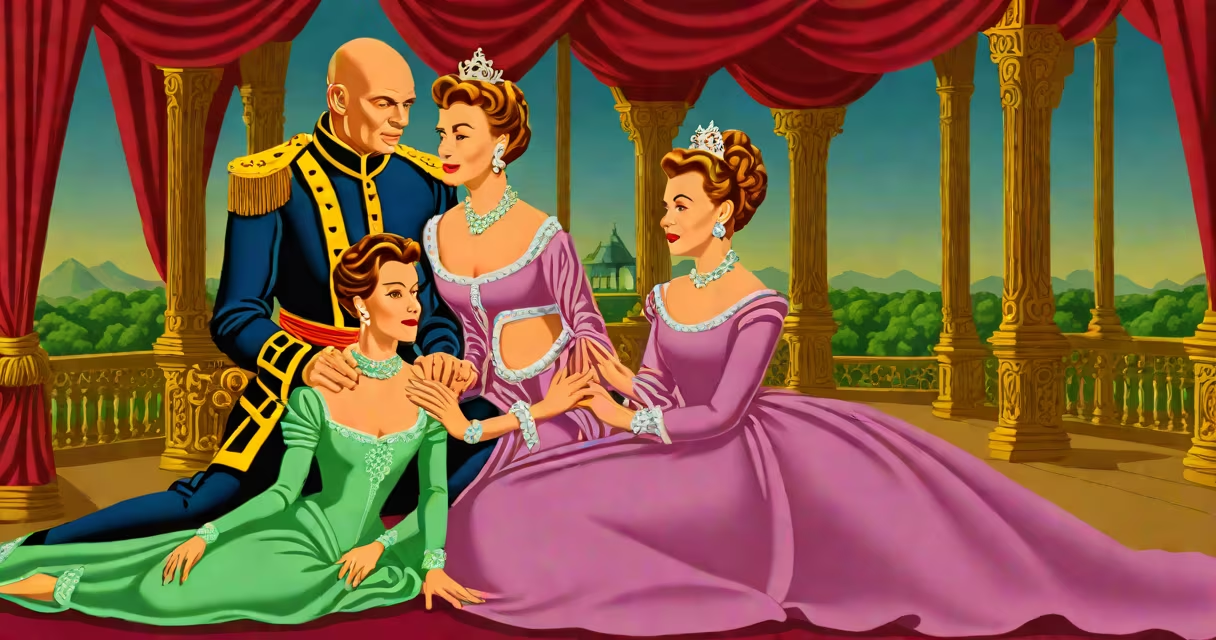
The King and I movie is a 1956 American musical film produced by Metro-Goldwyn-Mayer, based on the 1951 Rodgers and Hammerstein stage musical. It tells the story of British schoolteacher Anna Leonowens, who travels to Siam (modern-day Thailand) in 1862 to serve as a governess to the children of King Mongkut. The film blends historical fiction with theatrical songwriting, using music to explore cultural conflict, personal growth, and imperial tension.
Set during a period of rapid change in Siam, the film depicts the rigid hierarchy of the royal court and the evolving relationship between Anna, a woman shaped by Victorian ideals, and King Mongkut, a ruler going through Western influence while preserving tradition. The narrative unfolds through songs like "Getting to Know You," "Shall We Dance," and "Hello, Young Lovers," which drive emotional and thematic development. The film was directed by Walter Lang and features choreography by Agnes de Mille.
Anna Leonowens' real-life counterpart was a Canadian-born teacher and writer who served as a governess in the Siamese royal household from 1862 to 1867. Her memoirs, published in 1870, inspired the original stage play by Margaret Landon. The film adaptation expanded on her experiences, dramatizing her interactions with the king and the political realities of Siam under his rule. The portrayal of the king as both authoritarian and deeply human remains central to the film's enduring appeal.
The King and I movie uses musical numbers not as distractions but as narrative engines. Each song advances character development or underscores thematic tension. For example, "Getting to Know You" begins as a playful lullaby but evolves into a moment of mutual respect between Anna and the king's children. The song's gentle rhythm contrasts with the underlying power imbalance, highlighting Anna's growing influence despite her outsider status.
"Shall We Dance?" is structured as a formal waltz, performed in the royal palace. The dance sequence uses synchronized movement and precise blocking to reflect the tension between social ritual and personal desire. Anna hesitates at first, but her participation signals a shift in their changing-from teacher and student to equals in a shared moment of artistry. The camera circles the dancers slowly, emphasizing the formality of the setting and the intimacy of the gesture.
Another key device is the use of visual contrast. The film opens with sweeping shots of lush jungle and ornate temples, establishing Siam as a place of mystery and grandeur. Anna arrives in a Western-style dress, her posture stiff, her mannerisms unfamiliar. As she adapts, her clothing changes subtly-she begins wearing traditional Thai garments, symbolizing her integration into the culture. This visual arc mirrors her internal transformation from observer to participant.
The film combines several genres: historical drama, romantic comedy, and musical theater. Its structure follows a classic three-act arc: arrival, negotiation, resolution. The first act introduces Anna and establishes the cultural divide. The second act deepens the conflict-through misunderstandings, political intrigue, and personal vulnerability. The third act resolves both the romance and the political tension, culminating in a reconciliation between Anna and the king.
Three primary types of scenes define the film's pacing:
| Type | Description | Example |
|---|---|---|
| Dialogue-driven | Realistic exchanges showing power dynamics and cultural misunderstanding. | Anna arguing with the king about slavery and education. |
| Song sequences | Staged musical numbers advancing plot or emotion. | "Hello, Young Lovers" sung in a garden setting. |
| Visual spectacle | Grand set pieces emphasizing scale and symbolism. | Procession of elephants and royal guards entering the palace. |
Each type serves a distinct purpose. Dialogue scenes ground the story in historical plausibility. Song sequences allow emotional truths to surface beyond literal speech. Visual spectacles reinforce the film's sense of awe and otherness. Together, they create a layered storytelling experience that appeals to both intellect and feeling.
The King and I movie is frequently screened in educational settings, particularly in courses on musical theater, 20th-century American cinema, and cross-cultural studies. It appears in syllabi at institutions such as Yale University's Theater Studies program and the University of Southern California's School of Cinematic Arts. The film's blend of history, music, and performance makes it ideal for analyzing how art shapes public memory.
It is also used in cultural diplomacy contexts. The U.S. Department of State has referenced the film in programs promoting international understanding, citing its depiction of dialogue across difference. While the film contains inaccuracies-such as portraying Siam as isolated and backward-it also shows the potential for mutual learning. The U.S. Embassy in Bangkok has hosted screenings for local students, pairing the film with discussions on modern Thai history and U.S.-Thai relations.
A lesser-known fact: the film's original score was adapted from a 1951 Broadway production that ran for 1,246 performances. The 1956 film version won three Academy Awards: Best Art Direction, Best Costume Design, and Best Sound. It was also nominated for Best Picture and Best Actor (Yul Brynner). These accolades show its technical excellence and lasting impact on cinematic form.
Many assume the film portrays Siam as a feudal society locked in time. This is inaccurate. Historical records show King Mongkut actively modernized Siam's infrastructure, established diplomatic ties with Britain and France, and abolished slavery in 1870-three years after Anna left. The film simplifies this complexity for dramatic effect, focusing on personal conflict rather than statecraft.
Another misconception is that Anna Leonowens was a feminist pioneer. While she advocated for women's education and challenged gender norms in her writings, her views were shaped by 19th-century British colonialism. She supported British imperial interests and held racial hierarchies common among Europeans of her time. The film downplays these contradictions, presenting her as universally enlightened. A 2019 study by the University of Cambridge noted that her memoirs contain passages describing Siamese people as "childlike" and "superstitious," revealing biases that the film omits.
Perhaps most misleading is the idea that the film accurately represents Thai culture. The costumes, architecture, and language are stylized and often incorrect. For example, the royal court depicted in the film resembles Burmese or Cambodian design more than authentic Siamese. The dialogue includes phrases in English that sound like Thai but are nonsensical. The film's aesthetic is a product of Hollywood imagination, not ethnographic accuracy.
I once attended a screening at the UCLA Film & Television Archive where a Thai scholar corrected several errors in real time. During "A Puzzlement," a song where Anna tries to understand the king's behavior, the scholar pointed out that the lyrics reference "the moon in the sky," but in Thai culture, the moon symbolizes fertility and renewal-not confusion. The misrepresentation altered the emotional tone of the scene. That moment revealed how deeply cultural context shapes interpretation-and how easily films can mislead.