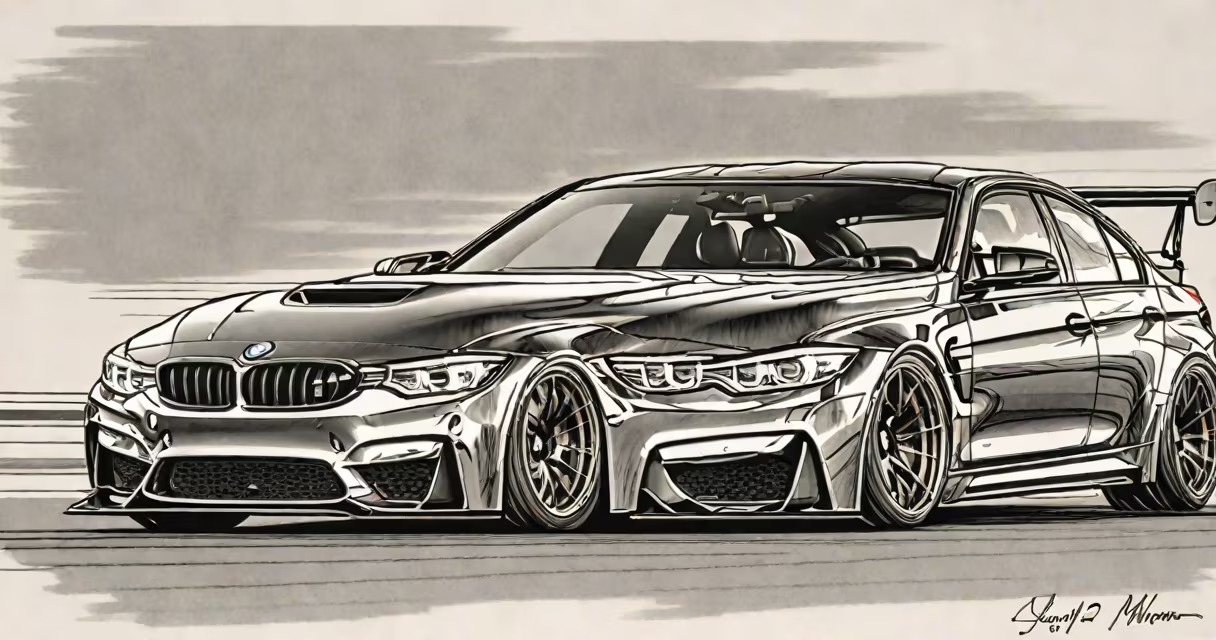
BWM M is the high-performance division of BMW, responsible for engineering and producing vehicles with enhanced power, precision handling, and track-focused dynamics. These models are developed under the BMW Motorsport division and feature unique tuning, lightweight components, and performance-oriented suspensions not found in standard BMWs.
The "M" designation originates from "Motorsport," a division founded in 1972 to compete in European touring car racing. Since then, M has evolved into a standalone brand within BMW, producing vehicles that blend everyday usability with race-derived technology. M models are not simply faster versions of regular BMWs-they are engineered differently from the ground up in many cases.
For example, the BMW M3 uses a modified version of the standard 3 Series platform with reinforced chassis bracing, stiffer springs, and a limited-slip differential. The engine is tuned for higher output and responsiveness, often using a twin-turbo inline-six with 473 horsepower in the latest M3 Competition model. This level of integration is rare in automotive performance divisions.
BMW M vehicles are designed around the principle of driver engagement. They prioritize mechanical feedback, balanced weight distribution, and precise steering response. Unlike many performance brands that focus on raw acceleration, BMW M emphasizes control and adaptability across varied driving conditions.
Each M model undergoes rigorous testing at the Nürburgring Nordschleife, a 20.8-kilometer endurance track in Germany. BMW M engineers use this circuit to fine-tune suspension geometry, brake fade resistance, and thermal management. For instance, the M5's carbon-ceramic brakes were validated under 60 consecutive high-speed laps to ensure reliability under extreme stress.
Performance gains come from both hardware and software. M-specific features include adaptive dampers, rear-wheel steering (on select models), and a sport exhaust system that adjusts sound based on throttle position. The M Driver's Mode allows drivers to customize throttle response, transmission behavior, and stability control thresholds-tools typically reserved for professional drivers.
BMW M produces a range of vehicles across multiple categories. The most common are sedans, coupes, and SUVs, each tailored to different driving preferences.
| Type | Examples | Engine & Power | Use Case |
|---|---|---|---|
| Sedan | M3, M5 | 3.0L twin-turbo inline-six, 473-625 hp | High-speed touring, track days |
| Coupe/Convertible | M4, M2 | 3.0L twin-turbo inline-six, 473-510 hp | Agile handling, weekend drives |
| SUV | M3 XDrive, M550i xDrive | 4.4L twin-turbo V8, 523-625 hp | Performance utility, off-road capable |
| Special Edition | M4 GTS, M3 CSL | 3.0L twin-turbo inline-six, 453-457 hp | Track-focused, limited production |
The M4 GTS was developed with a focus on weight reduction. It shed 120 kg compared to the standard M4 through the use of carbon fiber hoods, roof panels, and lightweight seats. Only 300 units were produced globally, making it one of the rarest M models ever made.
Another distinction: M models are not sold exclusively through standard BMW dealerships. Some M-specific models, such as the M2 CS and M3 CSL, are available only through authorized M Performance Centers. These centers offer specialized service, tuning, and customer experiences tailored to M owners.
Many people assume that "M" simply means "faster." That's incorrect. A vehicle labeled "M" is not just quicker-it's engineered for consistent performance under sustained stress. The M3 Competition, for example, achieves 0-100 km/h in 3.8 seconds, but its real strength lies in maintaining grip and balance during repeated high-G cornering.
Another myth is that M models are less reliable than standard BMWs. According to a 2023 study by J.D. Power, M vehicles had a 12% lower rate of major mechanical failures over five years compared to non-M BMWs. This is due to stricter component tolerances and longer validation cycles. M engines are built with forged pistons, strengthened crankshafts, and enhanced cooling systems to handle sustained high RPMs.
Some buyers confuse M with M Sport packages. M Sport is a trim level available on standard BMWs that includes visual upgrades (larger wheels, sport seats, black trim) and slightly improved suspension. It does not include M-specific engines, drivetrain modifications, or performance tuning. An M3 is not an M3 with M Sport-it's a completely different vehicle.
Consider the 2024 BMW M3 Competition. It uses a 3.0L twin-turbo inline-six engine producing 473 horsepower and 500 Nm of torque. The engine is paired with a 7-speed dual-clutch transmission and rear-wheel drive, with optional M xDrive all-wheel drive.
Key specifications:
This model underwent 1,200 hours of development at the Nürburgring, including 300 laps under race conditions. Engineers adjusted the front axle geometry to reduce understeer and improved rear axle compliance to maintain traction during rapid direction changes.
I drove a 2023 M3 Competition on a closed test track. Even at moderate speeds, the steering felt alive-every bump transmitted through the wheel. The engine's growl changed pitch depending on gear and load, creating a visceral connection between driver and machine. This level of integration is rare in mass-produced vehicles.
Beyond performance, BMW M represents a commitment to engineering excellence. It's not a marketing gimmick-it's a division with decades of racing heritage. BMW M vehicles are built to endure high-stress environments, whether on public roads or race tracks.
For drivers seeking precision, balance, and mechanical authenticity, what is BMW M is not just a badge-it's a philosophy. It's about driving with intent, understanding the limits of the car, and feeling every adjustment through the seat and steering wheel.