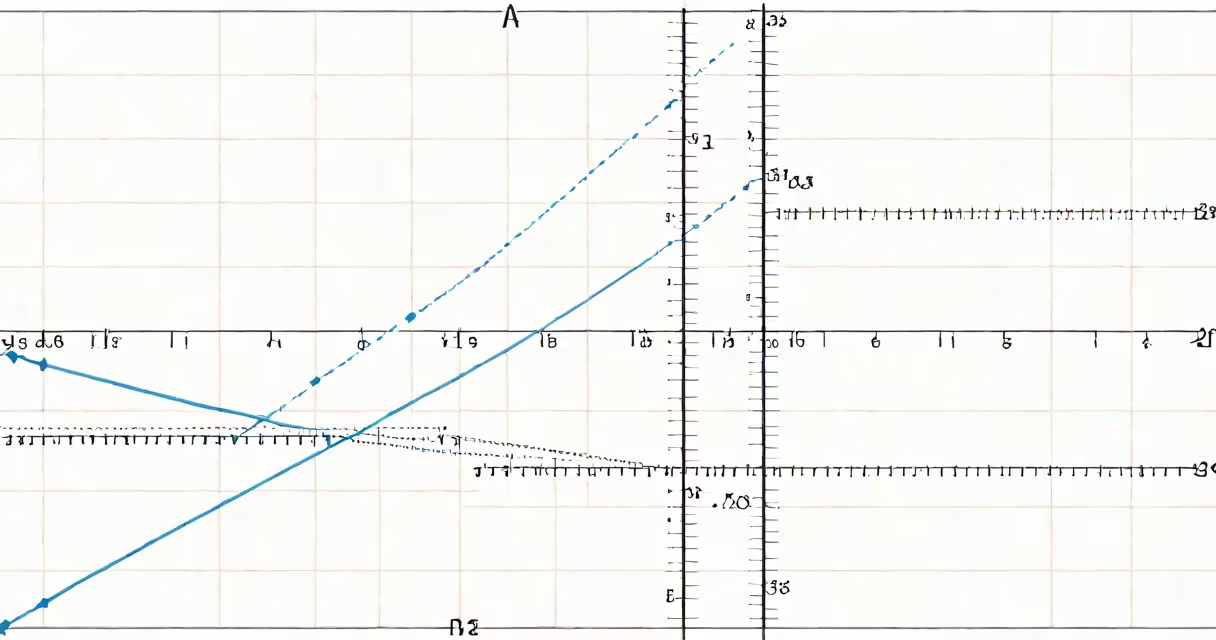
The slope definition in math describes the rate of change between two points on a line, calculated as the ratio of vertical change (rise) to horizontal change (run). It determines how steep a line is and whether it rises or falls as it moves left to right.
Slope is fundamental in algebra and coordinate geometry. It appears in linear equations like y = mx + b, where m represents slope. A positive slope means the line ascends from left to right; a negative slope descends. Zero slope indicates a flat horizontal line, while undefined slope occurs in vertical lines.
For example, a line passing through (1, 2) and (3, 6) has a slope of (6 - 2)/(3 - 1) = 4/2 = 2. This means for every 1 unit moved right, the line rises 2 units. The concept underpins functions in physics, engineering, and economics.
Slope quantifies direction and steepness. It's computed using two points (x₁, y₁) and (x₂, y₂) via the formula: m = (y₂ - y₁)/(x₂ - x₁). The result is a single number representing the average rate of change between those points.
When working with a graph, identify two clear points on the line. Count the vertical distance (rise) and horizontal distance (run) between them. For instance, if moving from (0, 0) to (4, 8), rise is 8 and run is 4, so slope = 8/4 = 2.
According to the National Council of Teachers of Mathematics (NCTM), understanding slope as a rate of change helps students interpret real-world scenarios such as speed (distance over time) or cost per unit. This connects abstract math to tangible situations.
Slope values fall into four categories based on direction and magnitude:
| Slope Value | Line Type | Visual Description | Real-World Example |
|---|---|---|---|
| Positive (> 0) | Rising | Line goes up from left to right | Electricity usage increasing over time |
| Negative (< 0) | Falling | Line goes down from left to right | Car fuel level decreasing during a trip |
| Zero (0) | Horizontal | Flat line | Constant temperature over hours |
| Undefined | Vertical | Stands straight up | Wall in a building |
A common misconception is that a slope of zero means "no line." In reality, it defines a perfectly flat line-like a level road or a steady income over time. Conversely, an undefined slope doesn't mean "no value"-it means the line is vertical, and the run is zero, making division impossible.
One non-obvious fact: slope remains constant along a straight line regardless of which two points you choose. Pick any two points on the same line, and the calculation will yield the same result. This consistency allows us to define a line uniquely using just one point and its slope.
Many confuse slope with intercept. The y-intercept is where the line crosses the y-axis (x = 0), while slope is how much y changes per unit of x. They're distinct components of the equation y = mx + b.
Another error is assuming slope must be a whole number. Slope can be a fraction, decimal, or irrational number. For example, a line from (0, 0) to (2, 1) has slope 1/2. A line from (-1, -3) to (3, 5) has slope (5 - (-3))/(3 - (-1)) = 8/4 = 2.
Some think slope only applies to straight lines. While slope is most straightforward for linear functions, calculus extends the idea to curves through instantaneous rate of change (derivative). But in basic algebra, slope refers strictly to straight lines.
Consider a line drawn on a coordinate grid passing through (-2, 1) and (4, 7).
This example shows how visual inspection confirms the calculation. The line rises steadily at a 45-degree angle, consistent with a slope of 1.
I once taught slope using a ramp model in a classroom. Students measured height and length of a wooden ramp and calculated slope manually. One group used a 3-foot ramp rising 1 foot-slope was 1/3. They realized that a steeper ramp meant higher slope, which matched their physical experience. That hands-on test reinforced the abstract formula.
Slope models real phenomena. In construction, roof pitch is expressed as slope-e.g., 6/12 means 6 inches rise per 12 inches run. In finance, slope of a trendline predicts stock movement. In weather science, temperature change over time is a slope.
Understanding slope helps decode data. A study by the American Mathematical Association of Two-Year Colleges found that students who grasp slope early perform better in later algebra and statistics courses. It's not just a formula-it's a mental model for change.