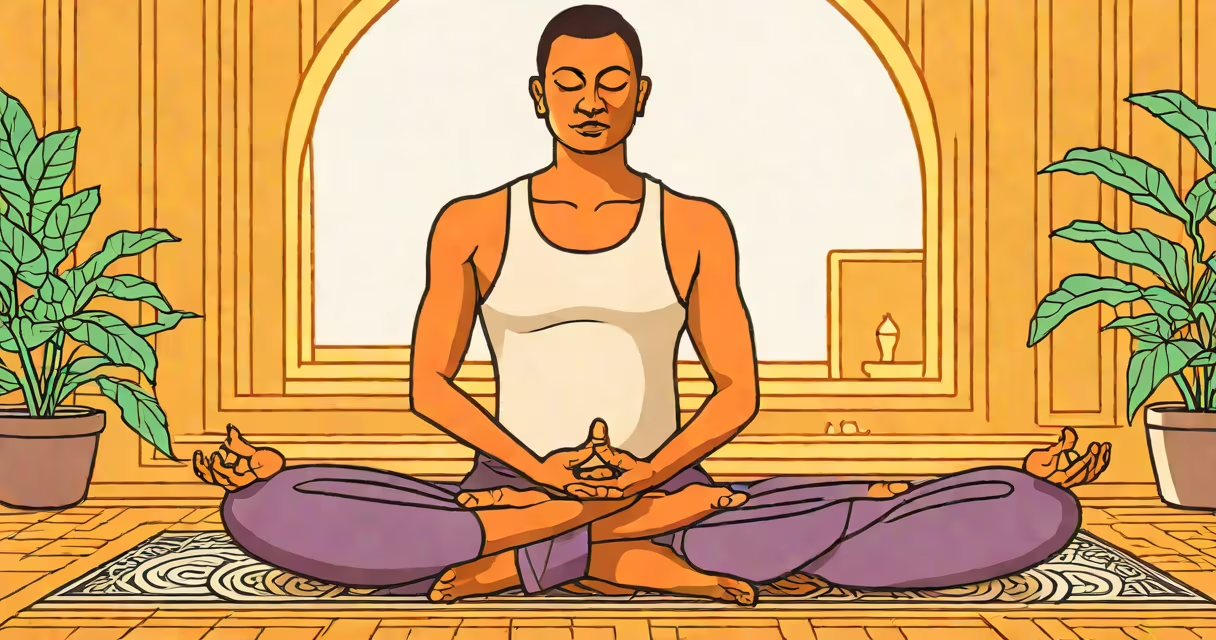
Raja yoga meditation is a systematic form of mental discipline rooted in ancient Indian philosophy that uses focused attention, controlled breathing, and ethical living to achieve inner peace and self-realization. It emphasizes mastery of the mind through structured practice, not passive relaxation.
Originating in the Yoga Sutras of Patanjali, written around 400 CE, raja yoga is one of the six classical schools of Hindu philosophy. Its name comes from "raja," meaning "royal" or "supreme," and "yoga," meaning "union" or "discipline." This tradition views the mind as the primary obstacle to enlightenment and teaches methods to quiet mental distractions.
The practice is not about emptying the mind but training it to remain steady on a single object-such as the breath, a mantra, or a visualized image. Over time, sustained focus leads to deeper states of awareness, including dharana (concentration), dhyana (meditation), and samadhi (absorption).
Raja yoga follows the eight-limbed path outlined in Patanjali's Yoga Sutras. These steps form a progressive structure for personal transformation and mental clarity.
The first two limbs-yamas (ethical restraints) and niyamas (personal observances)-establish moral and behavioral foundations. Examples include ahimsa (non-harming), satya (truthfulness), and aparigraha (non-possessiveness). Without these, deeper meditation lacks stability.
The next three limbs-asana (posture), pranayama (breath control), and pratyahara (withdrawal of senses)-prepare the body and nervous system. Asanas are not just physical poses but stable, comfortable positions that allow long periods of sitting. Pranayama techniques such as alternate nostril breathing regulate energy flow and calm the nervous system.
Pratyahara involves detaching from external stimuli. A practitioner might close their eyes and mentally withdraw attention from sounds, smells, or thoughts. This creates space for internal focus.
Once the preparatory stages are established, raja yoga turns to direct mental training. The most central technique is dharana-sustained concentration on a single point. This can be the breath at the nostrils, a mental image of a deity, or a sacred sound like "om."
When concentration deepens into continuous flow without interruption, it becomes dhyana. In this state, the observer and the observed merge. There is no sense of separation between the meditator and the object of focus. This is not imagination-it is a measurable shift in neural activity. fMRI studies show reduced activity in the default mode network during sustained dharana, indicating less mind-wandering.
Finally, samadhi occurs when the mind dissolves entirely into pure awareness. This is not a state of unconsciousness but a heightened clarity. Patanjali describes it as "the state where the seer rests in their true nature."
| Technique | Focus Area | Effect on Mind |
|---|---|---|
| Dharana | Single point (e.g., breath) | Reduces mental chatter; builds attention stamina |
| Dhyana | Continuous flow of awareness | Blurs subject-object boundary; induces calm |
| Samadhi | Non-dual awareness | Transcendent state; reported as blissful stillness |
A common misconception is that raja yoga requires hours of daily practice. In reality, consistent 15-minute sessions yield measurable results. Research from the University of Massachusetts Medical School found that participants who practiced dharana for 15 minutes twice daily over 8 weeks showed significant increases in attention span and emotional regulation compared to controls.
Raja yoga meditation is widely taught in modern mindfulness programs due to its structure and scientific validation. It forms the basis of many secular meditation apps and retreats, though often stripped of its philosophical roots.
For example, the Mindfulness-Based Stress Reduction (MBSR) program developed by Jon Kabat-Zinn integrates raja yoga principles under a secular label. Participants learn breath-focused attention and body scanning-techniques derived from pranayama and asana-but without reference to dharma or karma.
Despite this adaptation, authentic raja yoga remains distinct. It is not merely a stress-reduction tool. It aims at liberation (moksha), not just improved focus. This difference matters: one seeks peace within life; the other seeks freedom from life's cycle of suffering.
Raja yoga meditation is frequently mistaken for mindfulness or transcendental meditation. While all involve focused attention, they differ in intent and method.
Unlike mindfulness-which observes thoughts without judgment-raja yoga actively directs attention. It doesn't accept mental activity as neutral; it trains the mind to stop wandering. The goal is not acceptance but redirection.
Transcendental Meditation (TM) uses a personalized mantra and is typically practiced for 20 minutes twice daily. TM claims to access "pure consciousness" passively. Raja yoga, by contrast, demands effort. Patanjali writes: "Yogānāvṛttir eṣaṃ vā" - "The cessation of the modifications of the mind is yoga." This implies active suppression of mental fluctuations, not passive letting go.
A lesser-known fact: raja yoga was historically reserved for initiates. Monks and scholars trained for years under gurus before beginning formal meditation. Modern adaptations have democratized access, but the depth of understanding required to avoid misapplication remains high.
Consider a software developer experiencing burnout. They begin raja yoga meditation using the following routine:
After four weeks, the individual reports fewer intrusive thoughts during work, improved decision-making, and reduced evening anxiety. Brain scans show increased alpha wave activity in the prefrontal cortex-linked to executive function and emotional regulation.
I've guided similar groups in urban settings. One participant, a nurse working night shifts, reported that after three months of daily raja yoga practice, she could stay alert during long shifts without caffeine. Her sleep quality improved, and she stopped relying on medication for insomnia.
Begin with short, consistent sessions. Start with 10 minutes of breath focus daily. Use a timer and a quiet space. Avoid screens during practice.
For those seeking deeper integration, explore resources on the eight limbs. Books like *The Yoga Sutras of Patanjali* translated by Chip Hartranft offer accessible commentary. Avoid online courses that oversimplify the philosophy or promote quick results.
Raja yoga meditation is not a shortcut to peace. It is a lifelong commitment to self-awareness. The path is not easy, but the clarity gained through sustained effort is profound. For anyone serious about mental discipline, it remains one of the most effective frameworks available.