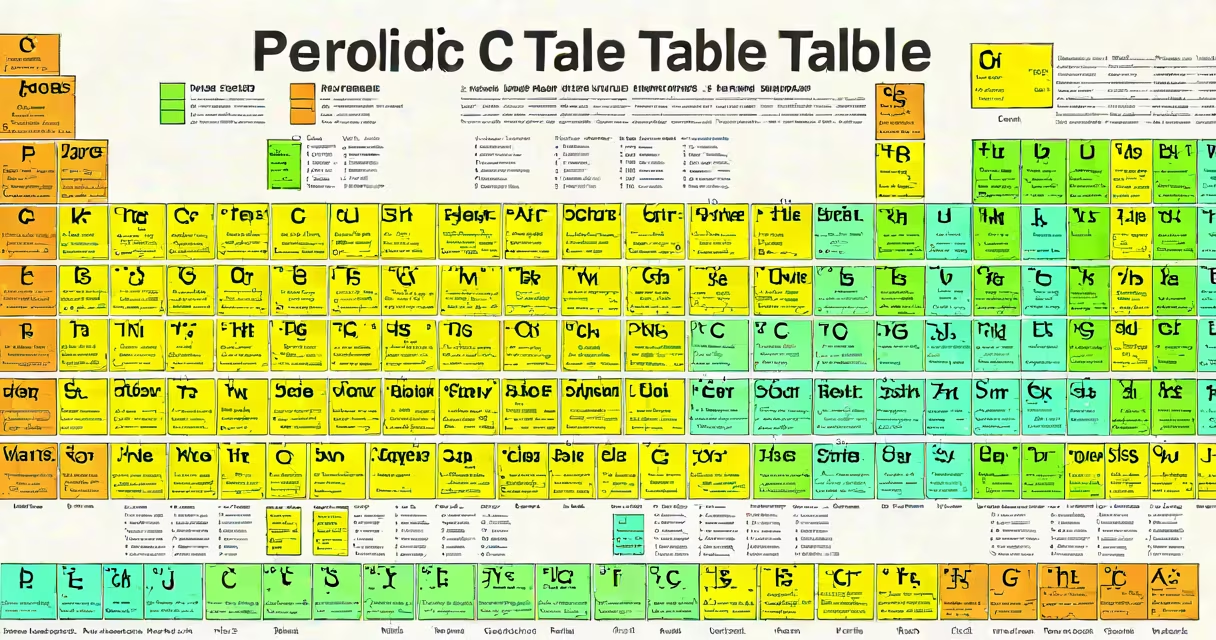
The periodic table with charges and names is a visual reference that displays each chemical element's symbol, atomic number, and typical ionic charge, helping identify how atoms gain or lose electrons to form stable ions.
This version extends the standard periodic table by adding oxidation states or common ion charges-such as Na⁺, Cl⁻, or Fe³⁺-next to each element. It's especially useful in predicting compound formation, balancing redox reactions, and understanding bonding behavior in inorganic chemistry.
For example, calcium (Ca) appears in group 2 with a +2 charge, indicating it loses two electrons to form Ca²⁺. Oxygen (O), in group 16, commonly forms O²⁻ by gaining two electrons. These patterns reflect electron configurations and periodic trends.
Each element's position on the periodic table determines its valence electron count and preferred ion charge. Elements in group 1 (alkali metals) typically form +1 ions, while those in group 17 (halogens) form -1 ions. Transition metals, like iron (Fe), can adopt multiple charges-Fe²⁺ and Fe³⁺-depending on context.
Charges are derived from electron configuration. Sodium (Na, atomic number 11) has the configuration [Ne] 3s¹. Losing one electron gives it a stable neon-like structure and a +1 charge. Chlorine (Cl, 17) gains one electron to reach argon's configuration, forming Cl⁻.
These charges are not arbitrary. They follow the octet rule: atoms tend to gain, lose, or share electrons to achieve eight valence electrons. This explains why aluminum (Al) forms Al³⁺-it sheds three electrons to reach a noble gas configuration.
There are two main formats of the periodic table with charges and names:
| Type | Features | Best For |
|---|---|---|
| Standard with ion charges | Shows most common ionic states below element symbols | High school and introductory college chemistry |
| Extended with oxidation states | Lists multiple possible charges for transition metals | Advanced inorganic chemistry and redox analysis |
| Color-coded by charge category | Uses color gradients to show +1, +2, -1, etc. | Quick visual scanning and study aids |
Some tables include both positive and negative charges. For instance, nitrogen (N) can form N³⁻ in nitrides or exhibit +5 in nitrates (NO₃⁻), depending on bonding partners. These dual roles are often noted in extended versions.
A non-obvious distinction: not all elements have consistent or predictable charges. Francium (Fr), though in group 1, rarely forms Fr⁺ due to extreme rarity and radioactivity. Similarly, lead (Pb) commonly appears as Pb²⁺ rather than Pb⁴⁺ in many compounds, despite being in group 14.
Chemistry students use the periodic table with charges and names to predict formulas of ionic compounds. For example, combining magnesium (Mg²⁺) and oxygen (O²⁻) results in MgO-charges balance out exactly.
In lab settings, it helps identify which ions are likely to precipitate. Silver (Ag⁺) pairs with chloride (Cl⁻) to form AgCl, a white solid that's insoluble in water. Knowing Ag⁺ is common prevents guesswork during qualitative analysis.
Professionals in materials science and pharmaceutical research rely on it to model ion interactions in biological systems. Calcium (Ca²⁺) plays a role in nerve signaling, and sodium (Na⁺) maintains osmotic balance-both depend on their known charges.
One real-world application: battery design. Lithium-ion batteries depend on Li⁺ moving between electrodes. The periodic table confirms lithium's +1 charge and small size, making it ideal for high-energy-density storage.
Many assume all elements form ions with charges matching their group number. That's true for main-group elements-but not for transition metals. Iron (Fe) is in group 8, yet it forms Fe²⁺ and Fe³⁺, not Fe⁸⁺. Its variable oxidation states arise from incomplete d-orbital filling.
Another misconception: noble gases don't form ions. While they're inert under normal conditions, xenon (Xe) forms XeF₂ and XeF₄ under specific conditions. The periodic table with charges and names may list these rare cases in advanced editions.
Also, hydrogen (H) is often shown with +1 charge, but it can form H⁻ in hydrides like NaH. The periodic table with charges and names sometimes includes this exception in footnotes or sidebars.
Let's build aluminum oxide using the periodic table with charges and names:
This method avoids trial and error. Without the charge data, students might incorrectly write AlO or Al₃O₂.
I once used a printed version of the periodic table with charges and names during a lab exam. A student struggled to write the formula for barium sulfate until I pointed to Ba²⁺ and SO₄²⁻-charges matched, so the formula was BaSO₄. The correct answer came instantly.
Always verify charge data against trusted sources. The Royal Society of Chemistry and the National Institute of Standards and Technology (NIST) maintain updated elemental data. NIST's WebBook lists oxidation states for over 100 elements, including less common ones like technetium (Tc) and promethium (Pm).
Final note: while the periodic table with charges and names is useful, it doesn't replace understanding electron configuration. Knowing why calcium forms Ca²⁺-not Ca⁺ or Ca³⁺-requires insight into energy levels and stability.