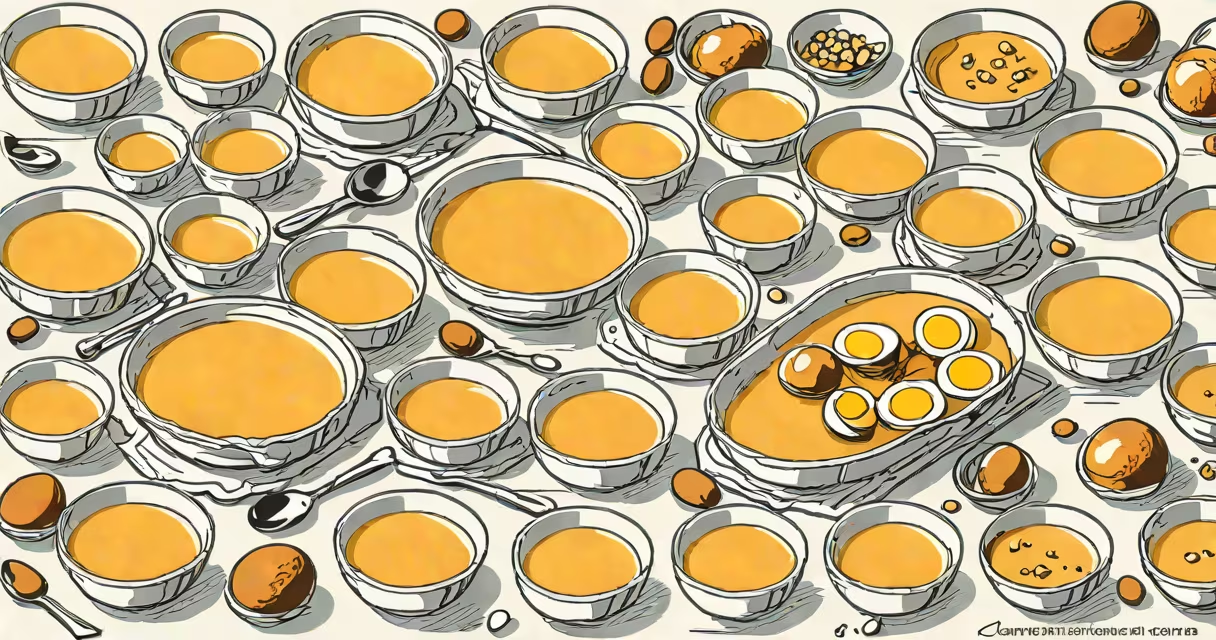
Oeufs au lait recette traditionnelle is a French custard dessert made by gently cooking whole eggs, milk, sugar, and vanilla until thickened. It's served warm or chilled, often with a caramelized top layer. This dish dates to at least the 17th century and remains a staple in French home kitchens.
The base relies on egg yolks and whole eggs to create a rich, velvety texture. Milk is heated slowly with sugar and vanilla, then poured into beaten eggs while stirring continuously. The mixture is then cooked over low heat until it coats the back of a spoon. Once set, it's cooled and optionally topped with a light caramel glaze.
Authentic versions avoid artificial thickeners. The consistency comes solely from egg proteins and prolonged gentle heating. A single batch typically serves four people and takes 30 minutes to prepare. The finished custard should hold its shape when lifted with a spoon but still yield slightly under pressure.
Heat causes egg proteins to denature and bond together, forming a gel-like matrix. This process begins around 60°C (140°F) and completes at 75-80°C (167-176°F). Overheating causes curdling, which ruins texture. The ideal temperature range is 70-75°C (158-167°F).
Stirring prevents hot spots and ensures even protein coagulation. Constant motion also reduces surface tension, minimizing air pockets. A wooden spoon or silicone spatula is preferred over metal to avoid scratching the pot and introducing micro-particles.
After cooking, the mixture is strained through a fine sieve to remove any lumps or bits of scorched egg. This step removes imperfections and ensures a silky finish. The custard is then poured into individual ramekins and cooled slowly to prevent cracking.
Traditional recipes call for:
Some regional versions substitute cream for part of the milk to increase richness. Others add a splash of rum or orange zest for aroma. The French version uses only whole milk and no cream unless specified.
A common mistake is using powdered sugar. Granulated sugar dissolves properly during heating. Powdered sugar introduces starch, which alters texture and can cause graininess. Always use granulated sugar unless the recipe specifies otherwise.
| Type | Milk Used | Sugar Type | Texture | Origin |
|---|---|---|---|---|
| Traditional | Whole milk | Granulated | Velvety, firm-set | France (17th c.) |
| Provençal | Half milk, half cream | Demerara | Rich, slightly runny | South France |
| Modern | Skim or plant-based | Powdered | Grainy, unstable | Global adaptation |
One non-obvious fact: the egg-to-milk ratio is critical. Too much egg leads to a rubbery texture. Too little results in a thin, soupy custard. The standard ratio is 1 egg per 100 ml milk. For 250 ml milk, four eggs are optimal.
Oeufs au lait recette traditionnelle is served at breakfast, dessert, or as a comfort food. It appears in French households during holidays, especially Christmas and Easter. Its mild sweetness makes it suitable for children and elderly eaters.
Restaurants serve it in small portions, often garnished with cinnamon or a sprinkle of nutmeg. Some chefs add a layer of caramelized sugar on top before serving, creating a crunchy contrast to the soft custard underneath.
When preparing for a group, make multiple batches in a water bath (bain-marie) to maintain consistent heat. Use a large oven-safe dish or several ramekins placed in a baking tray filled with hot water. This method prevents overheating and ensures even cooking.
Many confuse oeufs au lait with crème brûlée. Both are custards, but crème brûlée uses cream and is topped with burnt sugar. Oeufs au lait uses milk and lacks a hard crust. The textures differ: one is soft and yielding, the other firm with a brittle top.
Another error is boiling the milk before mixing. Boiling causes scalding, which damages proteins and creates a bitter taste. Heat milk only until steaming, around 70°C (158°F), then remove from heat before adding to eggs.
I once prepared this recipe during a family dinner in Lyon. Using eggs from a local farm, the custard set perfectly after 12 minutes of low heat. The flavor was deep and balanced-sweetness from sugar, richness from egg yolk, and warmth from vanilla. The texture held without crumbling when served cold.
Egg safety is essential. Use pasteurized eggs if serving to young children, pregnant individuals, or immunocompromised guests. Raw eggs carry Salmonella risk, though the cooking process eliminates most pathogens when done correctly.
For maximum safety, cook the custard to at least 75°C (167°F) internally. Use a thermometer inserted into the center of a ramekin. If the temperature doesn't reach 75°C, reheat in a 100°C (212°F) oven for five minutes.
Once cooled, store in the refrigerator for up to three days. Cover with plastic wrap touching the surface to prevent a skin from forming. Reheat gently in a microwave or oven at 150°C (300°F) for five minutes.
Oeufs au lait recette traditionnelle is more than a dessert-it's a cultural artifact. Its enduring presence in French homes reflects values of simplicity, patience, and respect for ingredients. The method requires attention, not speed. The result rewards care.