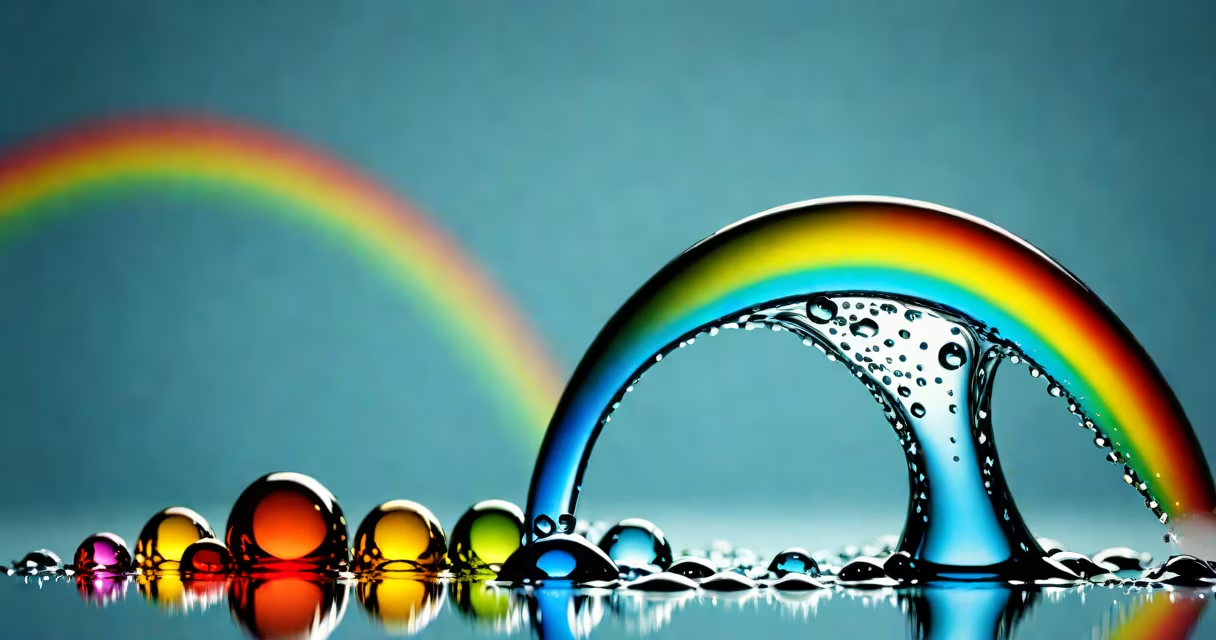
Rainbows form when sunlight enters a raindrop, bends (refracts), reflects off the inner surface, and exits at an angle that separates white light into its component colors. This process occurs in millions of suspended water droplets during or after rainfall.
The phenomenon relies on three optical principles: refraction, internal reflection, and dispersion. Sunlight, which appears white, is actually a mixture of all visible wavelengths. As it enters a spherical raindrop, each wavelength bends by a slightly different amount due to varying speeds in water. Red light bends less than violet, creating a spectrum.
After bending inward, the light hits the back of the drop and reflects. It then refracts again as it exits, further spreading the colors. The observer sees a circular arc of colors because only light reflected at approximately 42 degrees (for red) and 40 degrees (for violet) reaches their eyes from drops at specific angles.
When sunlight strikes a raindrop, it slows down and changes direction-this is refraction. The amount of bending depends on the wavelength: blue and violet light bend more sharply than red. This separation of colors is called dispersion.
Inside the drop, the light reflects off the inner surface. For a primary rainbow, this happens once. The angle of reflection determines how much the light spreads out. After reflection, the light exits the drop, undergoing a second refraction. This second bend amplifies the color separation.
Only light exiting at precise angles reaches the observer's eye. Red light emerges at about 42° from the original sun direction, violet at 40°. Because raindrops are spherical, they create a full circle of light-but the ground blocks most of it. The visible arc appears above the horizon, with red on the outer edge and violet on the inner.
Primary rainbows are the most common. They show red on the outside and violet on the inside. Secondary rainbows appear fainter and above the primary, with reversed colors due to a second internal reflection. These are rarer because more light escapes the drop during the extra bounce.
| Type | Reflections Inside Drop | Color Order | Visibility |
|---|---|---|---|
| Primary | 1 | Red outside, violet inside | Common |
| Secondary | 2 | Violet outside, red inside | Rare, dimmer |
| Supernumerary | 1 | Faint bands near primary | Requires small, uniform droplets |
Supernumerary arcs-faint, pastel-colored rings-appear close to the primary rainbow. They result from wave interference, where light waves reinforce or cancel each other. These arcs are only visible when raindrops are very small and evenly sized, such as in fog or mist.
Rainbows require sunlight and rain in opposite directions. The sun must be behind the observer, and raindrops must be in front. This typically happens in the late morning or afternoon when the sun is low. A rainbow's position shifts with the sun's elevation: higher suns produce lower arcs, and vice versa.
From the ground, only half the circle is visible. But from high altitudes-such as in an airplane-observers may see a complete circular rainbow. Pilots have documented full-rainbow rings around the shadow of their aircraft, known as a glory.
A notable example occurred in 2016 when a rainbow was photographed spanning nearly 100 degrees across the sky in northern England. It formed during a storm with consistent rain and intermittent sunlight, allowing the full arc to be captured.
Many assume rainbows are physical objects that exist in space. They are not. A rainbow is a visual effect created by the alignment of light, raindrops, and the observer's viewpoint. Each person sees a slightly different rainbow based on their location.
Another myth is that rainbows always appear after rain. While common, they can form in mist, spray, or even dew. Waterfalls generate rainbows regularly-Niagara Falls produces them daily under the right conditions. The Horseshoe Falls area reports rainbow sightings on average 150 days per year.
Some believe rainbows have seven distinct colors. In reality, the spectrum is continuous. The division into seven colors-red, orange, yellow, green, blue, indigo, violet-was popularized by Isaac Newton, who chose seven to match the musical scale. Modern optics shows no sharp boundary between hues.
I once stood at the base of a waterfall in Oregon during a brief sunbreak. As the mist rose, a vivid rainbow formed directly in front of me. I stepped forward and backward, watching the arc shift. It vanished when I moved too far-a demonstration that the rainbow exists only about my position.
Using a prism, you can replicate the effect. Shine white light through a glass prism, and the beam splits into a band of colors. This mimics what happens in a raindrop. The difference is that prisms don't reflect light internally-they only refract. Raindrops add the reflection step, making the rainbow visible at a specific angle.
The physics of rainbow formation is well-documented. According to the National Oceanic and Atmospheric Administration (NOAA), "rainbows are caused by the refraction, reflection, and dispersion of sunlight in water droplets." The explanation aligns with Rayleigh scattering theory and geometric optics.
The American Journal of Physics published a detailed analysis in 2018 confirming that the angular width of the primary rainbow is consistently around 2°, with red at 42.3° and violet at 40.3°-values matching observations in controlled experiments.
Understanding how rainbows are made reveals the elegance of natural optics. Light doesn't just pass through water-it dances within it, reshaping itself into a fleeting arc of color. The phenomenon is not magic, but a predictable outcome of physics.