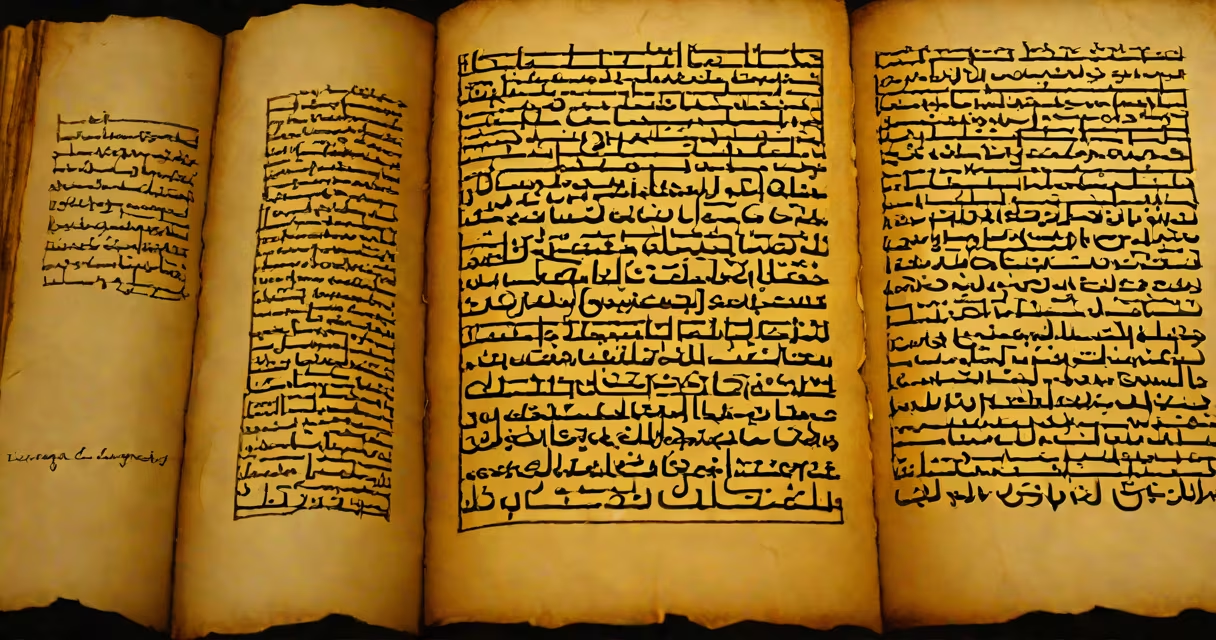
The Hebrew Israelite Scriptures are the sacred writings of ancient Israel, composed primarily in Biblical Hebrew and forming the core of Jewish religious tradition. These texts include the Torah, Prophets, and Writings-collectively known as the Tanakh-and serve as the theological and legal foundation for Judaism.
These scriptures were compiled over centuries, beginning around the 10th century BCE and finalized by the 2nd century CE. They are written in Classical Hebrew, with some portions in Aramaic, and have been preserved through meticulous copying traditions. The oldest surviving manuscripts, such as the Dead Sea Scrolls discovered in Qumran between 1947 and 1956, confirm textual continuity across millennia.
According to the Jewish Publication Society's Tanakh translation, the term "Tanakh" is an acronym derived from the three divisions: Torah (Teaching), Nevi'im (Prophets), and Ketuvim (Writings). This tripartite structure reflects both literary and theological organization, with each section contributing distinct themes: law, prophecy, and wisdom.
The Hebrew Israelite Scriptures are organized into three major sections: the Torah, the Prophets (Nevi'im), and the Writings (Ketuvim). Together, they form the Tanakh-a term first used in rabbinic literature during the late Second Temple period.
The Torah consists of five books: Genesis, Exodus, Leviticus, Numbers, and Deuteronomy. These contain foundational narratives such as the creation of the world, the covenant with Abraham, the Exodus from Egypt, and the giving of the Law at Sinai. The Torah is central to Jewish ritual life and is read aloud weekly in synagogues across the world.
The Prophets section includes historical books like Joshua, Judges, Samuel, and Kings, as well as the Latter Prophets-Isaiah, Jeremiah, Ezekiel, and the Twelve Minor Prophets. These writings blend history, divine judgment, and visions of restoration. For example, Isaiah 53 describes a suffering servant whose identity has been interpreted in multiple ways across Jewish, Christian, and Islamic traditions.
The Writings section contains poetic and philosophical texts: Psalms, Proverbs, Job, Song of Songs, Ruth, Lamentations, Ecclesiastes, Esther, Daniel, Ezra-Nehemiah, and Chronicles. These reflect diverse genres-from lyrical praise to existential reflection. Psalm 23, for instance, is one of the most widely recited passages in Jewish liturgy and personal prayer.
All Hebrew Israelite Scriptures were originally composed in Biblical Hebrew, a Semitic language closely related to Arabic and Aramaic. The language evolved over time, with early forms appearing in inscriptions like the Gezer Calendar (circa 10th century BCE) and later in the Masoretic Text, standardized by Jewish scribes known as the Masoretes between the 6th and 10th centuries CE.
The Masoretes introduced vowel points (niqqud) and cantillation marks to preserve pronunciation and musical intonation during public reading. Their work ensured consistent transmission across generations. The Aleppo Codex, dating to the 10th century CE, remains one of the most authoritative manuscripts of the Hebrew Bible.
A notable distinction often missed is that the Hebrew Israelite Scriptures were not compiled in a single event. Instead, they developed over centuries through oral tradition, scribal editing, and community consensus. The process of canonization-the formal acceptance of certain books as divinely inspired-was gradual and occurred in stages, particularly after the Babylonian exile (586 BCE).
Many assume the Hebrew Israelite Scriptures are synonymous with the Christian Old Proof. While they share content, the arrangement differs. The Christian Old Proof follows a different order-Law, History, Poetry, Prophecy-and includes additional books not found in the Hebrew canon, such as Tobit, Judith, and Maccabees. These are called deuterocanonical texts and are accepted in Catholic and Eastern Orthodox traditions but not in Judaism.
Another misconception is that the Hebrew Bible was translated only once. In reality, multiple translations exist. The Septuagint, a Greek translation made in Alexandria around 250 BCE, was used by Hellenistic Jews and later adopted by early Christians. The Latin Vulgate, completed by Jerome in the 4th century CE, became the standard in Western Christianity. However, the original Hebrew remains the authoritative version for Jewish communities.
Some confuse the Hebrew Israelite Scriptures with modern Israeli national documents. The term "Israelite" refers to the ancient people of Israel, not contemporary citizens of the State of Israel. The scriptures predate the modern nation-state by over two millennia and are rooted in religious identity, not political affiliation.
Today, the Hebrew Israelite Scriptures remain central to Jewish worship, study, and identity. Synagogue services follow a three-year cycle of Torah readings, with each portion (parashah) studied in depth. Religious schools teach the texts using traditional commentaries like Rashi (11th-century France) and Ibn Ezra (12th-century Spain).
For example, during Passover, families gather to read the Exodus narrative from the Torah, retelling the story of liberation with symbolic foods and rituals. The Haggadah, a liturgical text, guides this retelling, drawing directly from Exodus 12-13 and Deuteronomy 26.
I once attended a Shabbat service in Jerusalem where the congregation followed along in Hebrew while the cantor chanted the weekly Torah portion. The room fell silent during the reading of Exodus 20:1-14-the Ten Commandments-highlighting how deeply embedded these texts are in communal practice. The emotional weight of hearing ancient words spoken in a living language still resonates powerfully.
| Section | Books | Content Focus | Key Examples |
|---|---|---|---|
| Torah | Genesis, Exodus, Leviticus, Numbers, Deuteronomy | Laws, origins, covenant | Creation (Gen 1), Exodus (Exod 12), Decalogue (Exod 20) |
| Nevi'im | Joshua, Judges, Samuel, Kings, Isaiah, Jeremiah, Ezekiel, Twelve Minor Prophets | Prophecy, history, divine judgment | Isaiah 53, Jeremiah 31:31-34, Ezekiel 37:1-14 |
| Ketuvim | Psalms, Proverbs, Job, Song of Songs, Ruth, Lamentations, Ecclesiastes, Esther, Daniel, Ezra-Nehemiah, Chronicles | Wisdom, poetry, narrative, lament | Psalms 23, Proverbs 3:5-6, Ecclesiastes 3:1-8 |
One non-obvious fact: the Hebrew alphabet has no vowels. Readers rely on context and cantillation marks to interpret pronunciation. This system allows for flexibility in interpretation but also requires training. A single Hebrew word can have multiple meanings depending on vocalization and context-such as "shalom," which means peace but can also imply wholeness or completeness.
The Hebrew Israelite Scriptures endure not because they are static, but because they are lived. They are recited daily, studied yearly, and reflected upon across generations. Their survival through conquest, exile, and diaspora speaks to their enduring relevance in both faith and culture.