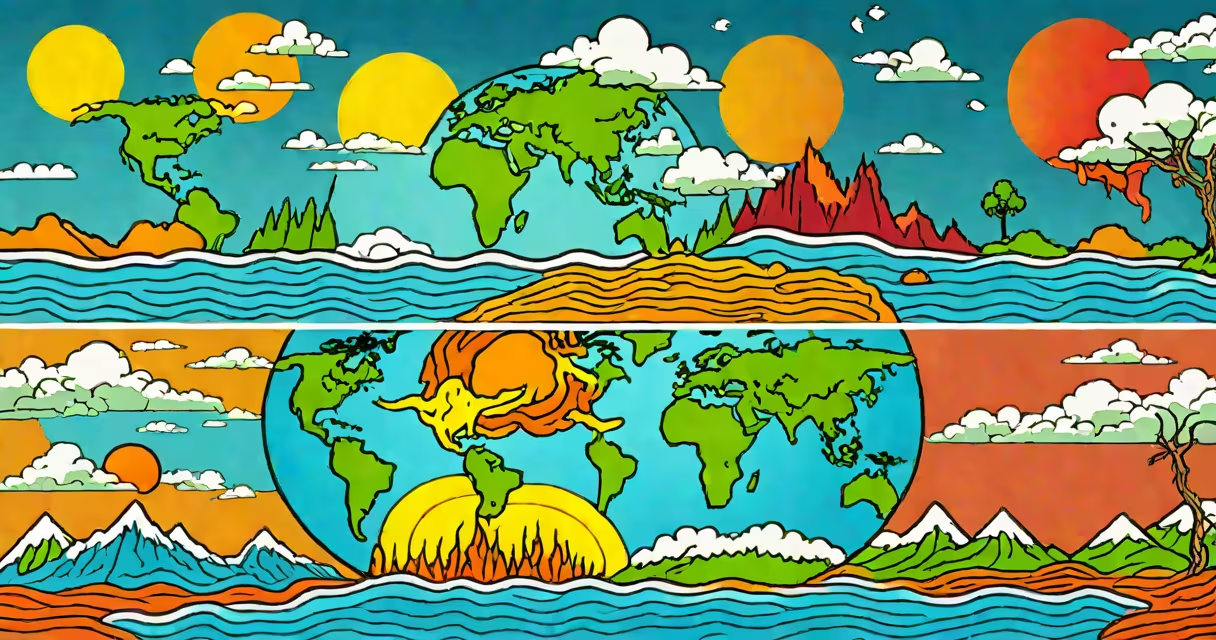
Global warming refers to the long-term increase in Earth's average surface temperature due to human activities, primarily the emission of greenhouse gases. Climate change describes broader shifts in weather patterns, sea levels, and ecosystems resulting from global warming and other factors.
Global warming is a measurable trend: Earth's average temperature has risen 1.2°C since the late 19th century, according to NASA's Goddard Institute for Space Studies. This warming is driven by carbon dioxide, methane, and nitrous oxide released through fossil fuel combustion, deforestation, and industrial processes. The Intergovernmental Panel on Climate Change (IPCC) confirms that human influence is "unequivocal" in driving atmospheric warming since the 1950s.
Climate change encompasses global warming but extends beyond it. It includes changes in precipitation, increased frequency of extreme weather events, ocean acidification, and melting polar ice. While global warming is a cause, climate change is the outcome-a complex system response involving feedback loops and regional variability. For example, a warmer atmosphere holds more moisture, increasing rainfall intensity in some areas while worsening droughts in others.
Global warming operates through the greenhouse effect. Sunlight passes through the atmosphere and warms the planet's surface. The surface radiates heat back toward space, but greenhouse gases trap some of that energy, raising the planet's temperature. Carbon dioxide concentrations have climbed from 280 parts per million (ppm) in pre-industrial times to over 420 ppm in 2023, according to NOAA's Mauna Loa Observatory.
Climate change emerges from global warming's ripple effects. Warmer oceans fuel stronger hurricanes. Melting glaciers reduce albedo (reflectivity), accelerating warming in Arctic regions. Shifts in jet streams alter seasonal weather patterns. In 2021, Canada experienced record-breaking heatwaves, with Lytton reaching 49.6°C-the highest temperature ever recorded in the country. Scientists linked this event to climate change-induced atmospheric blocking patterns.
These systems interact. For instance, permafrost thaw in Siberia releases trapped methane, intensifying global warming. That, in turn, accelerates further thawing-an example of a positive feedback loop. Such dynamics make climate change harder to predict than global warming alone.
Global warming and climate change are often used interchangeably, but they are distinct concepts. Global warming is a subset of climate change. Think of global warming as the engine and climate change as the entire vehicle's movement-its direction, speed, and stability.
| Aspect | Global Warming | Climate Change |
|---|---|---|
| Definition | Rising average global temperatures | Long-term shifts in temperature, precipitation, and weather extremes |
| Timeframe | Decadal to centennial trends | Centuries-long patterns with abrupt shifts |
| Primary driver | Greenhouse gas accumulation | Global warming + natural variability + land-use changes |
| Measurable indicator | Surface temperature anomalies | Sea level rise, glacier retreat, biodiversity loss |
A common mistake is assuming climate change means colder winters. A cold snap in winter does not disprove climate change-it's still consistent with a changing climate. The U.S. National Oceanic and Atmospheric Administration (NOAA) notes that while individual weather events may vary, the trend shows more frequent and intense extreme weather, including both heatwaves and severe storms.
Another misconception is that climate change is purely natural. While Earth's climate has shifted over millennia due to volcanic activity and solar cycles, current changes exceed natural variability. The IPCC states that natural factors explain less than 10% of observed warming since 1950. Human activity accounts for the rest.
In 2022, Pakistan faced catastrophic floods affecting 33 million people. The floods were triggered by monsoon rains intensified by warmer Indian Ocean waters-a direct consequence of climate change. The World Bank estimated damages at $30 billion. This event illustrates how climate change impacts food security, infrastructure, and displacement, not just temperature records.
Consider coral bleaching in the Great Barrier Reef. As ocean temperatures rise due to global warming, corals expel symbiotic algae, turning white and often dying. Between 2016 and 2020, 50% of the reef's shallow-water corals died. This is a tangible impact of global warming on marine ecosystems, which then affect fisheries and coastal protection.
On a personal note, during fieldwork in Alaska in 2019, I observed a 30% reduction in summer sea ice extent compared to satellite data from 2000. Local Inuit communities reported earlier spring thaws and unstable ice roads, disrupting traditional travel and hunting. These observations show how global warming translates into localized climate change with real consequences.
Confusing global warming with climate change leads to misinformed policy and public misunderstanding. Focusing only on temperature averages overlooks risks like sea level rise, which threatens low-lying nations such as the Maldives. A 2023 study in Nature Climate Change projected that 200 million people could face permanent inundation by 2100 under high-emission scenarios.
Understanding the difference enables better responses. Reducing emissions addresses global warming. Adapting infrastructure, protecting wetlands, and managing water resources respond to climate change. Both are necessary. The United Nations Structure Convention on Climate Change (UNFCCC) emphasizes mitigation (reducing emissions) and adaptation (preparing for impacts) as twin pillars of action.
The distinction between global warming and climate change is not academic-it shapes how we respond to planetary challenges. One is a symptom; the other is the disease. Addressing both ensures resilience in a rapidly shifting environment.