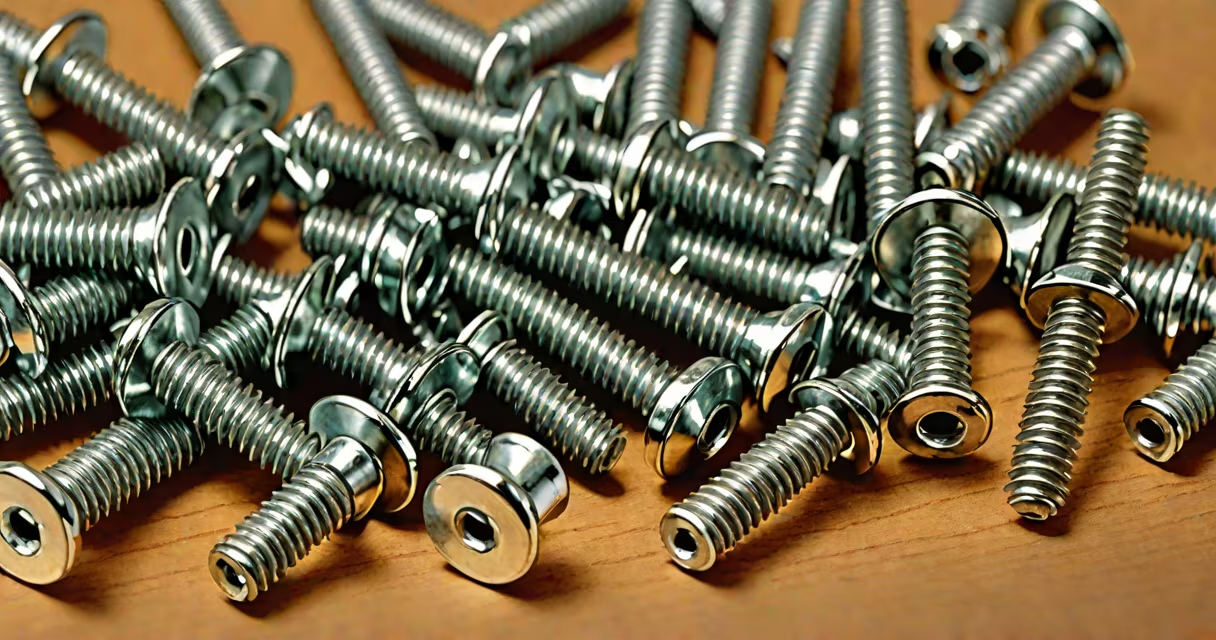
Flat head screws are machine screws with a conical, countersunk head designed to sit flush with the surface they're fastened into. They're used where a smooth, low-profile finish is needed, such as in cabinetry, furniture, and electronics enclosures.
These screws are engineered to fit into a countersunk hole-a drilled or milled depression that matches the angle of the screw's head. When installed, the head sits below the surface level, eliminating protrusions that could catch on clothing, tools, or interfere with adjacent parts. This makes them ideal for applications requiring both function and clean aesthetics.
Flat head screws come in standard sizes and thread pitches, typically measured in metric (e.g., M4 × 16 mm) or imperial (e.g., #8 × 1 inch). The head angle is standardized at 82°, which allows compatibility across most countersunk tools and drill bits. The drive type-such as slotted, Phillips, or hex-determines how torque is applied during installation.
When a flat head screw is driven into a countersunk hole, the conical head seats into the depression. As the screw tightens, the head presses against the angled walls of the hole, creating a secure, vibration-resistant joint. The friction between the screw threads and the material prevents loosening under normal load.
Proper installation requires a pilot hole slightly smaller than the screw's major diameter. For wood, this hole is often drilled to 75% of the screw's shank diameter. In metal, a tap may be used to cut threads. If the hole is too large, the screw won't grip properly. If too small, the material can split or the screw strip.
A common mistake is using a flat head screw in a blind hole without proper countersinking. Without the depression, the head remains proud (above the surface), defeating the purpose of flush mounting. Always verify the hole depth and angle match the screw's specifications.
Flat head screws fall into several categories based on head profile, drive type, and material. The most common variants include:
| Type | Head Profile | Drive Type | Best Use |
|---|---|---|---|
| Flat head cap screw | 82° conical, flat top | Phillips, hex socket | High-torque applications, machinery |
| Flat head sheet metal screw | Sharp-pointed, tapered | Slotted, Phillips | Thin metal sheets, roofing |
| Flat head wood screw | Round shank, tapered | Phillips, square drive | Furniture, trim, joinery |
Material choice affects strength, corrosion resistance, and cost. Steel is standard for general use-carbon steel offers high tensile strength, while stainless steel resists rust in damp environments. Aluminum flat head screws are lightweight and suitable for aerospace or automotive trim, though less durable under heavy stress.
One non-obvious detail: the term "flat head" refers only to the external shape. Internally, the screw may have a flat or rounded underside. A flat-bottomed screw creates a tighter seal against the surface, reducing wobble. A rounded base allows slight movement, useful in thermal expansion scenarios.
Flat head screws are essential in applications where appearance matters. In cabinetmaking, they provide a smooth look-no visible fasteners. In consumer electronics, they allow panels to close flush without gaps. In automotive interiors, they secure trim pieces without snagging seatbelts or fingers.
For example, when building a custom bookshelf with ¾-inch birch plywood, a #8 × 1¼-inch flat head wood screw with a Phillips drive is appropriate. Drill a 3/16-inch pilot hole, then countersink to 1/8-inch depth using a 90° bit. Drive the screw until the head is flush. The result is a sturdy shelf with no protruding heads.
They're also preferred in structural joints where shear loads are minimal but surface integrity is critical. In contrast, round head screws are better for high-vibration areas because their domed shape resists loosening through impact.
Many assume flat head screws are interchangeable with pan head or round head screws. They are not. Pan heads have a rounded top and higher profile-ideal for visibility and ease of access. Flat heads are meant to disappear into the surface.
Another misconception: flat head screws don't require special tools. While a countersink bit is needed for drilling, the screw itself can be driven with a standard screwdriver or power drill. However, using a torque-limiting driver prevents stripping the head or cracking the material.
Some users think all flat head screws are self-tapping. That's false. Only certain types-like sheet metal screws-can cut their own threads. Wood screws rely on pre-drilled holes. Using a self-tapping screw in soft material without a pilot hole risks splitting the wood.
I once installed flat head screws in a walnut desk frame. I used a 60° countersink bit and a 1/8-inch pilot hole. After driving each screw, I filled the dimple with wood filler and sanded it smooth. The final surface looked continuous-no fastener marks. That's the advantage of choosing the right tool and technique.
Flat head screws remain a staple in woodworking, manufacturing, and assembly due to their balance of function, durability, and visual integration. Understanding their design, correct application, and material options ensures long-term performance and professional results.