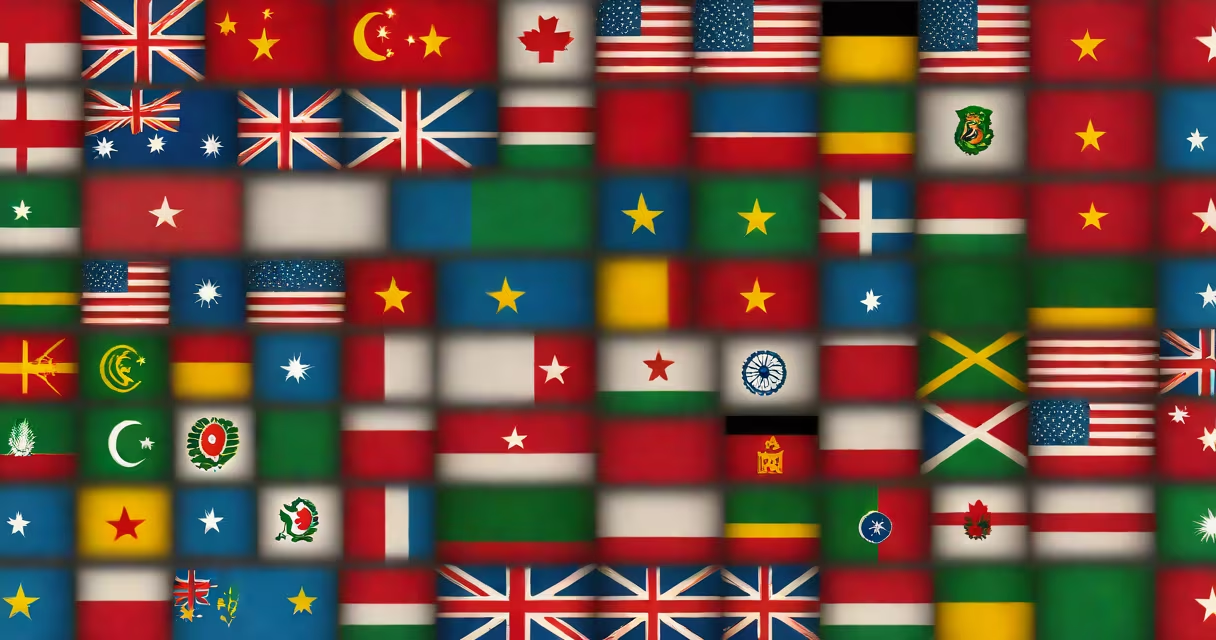
Flags of all countries are official symbols representing a nation's identity, history, and values through standardized colors, shapes, and emblems. Each flag is a visual declaration of sovereignty, adopted through government decree or constitutional process.
Every national flag consists of a combination of elements-colors, geometric forms, and symbolic imagery-arranged according to design principles established by national tradition or international norms. These elements serve as visual shorthand for a country's political ideology, cultural heritage, or historical events. For example, the red, white, and blue tricolor of France reflects the ideals of liberty, equality, and fraternity from the French Revolution.
The United Nations recognizes 193 member states and two observer states (Vatican City and Palestine), each with a distinct flag. The design of each flag is codified in law or official documentation. The flag of Japan, for instance, is defined by the Japanese Constitution as a white field with a red circle centered-the sun symbolizing the nation's origin in ancient myth.
Flag design follows a set of principles rooted in visibility, simplicity, and symbolism. The U.S. Department of State notes that effective flags use bold, contrasting colors and avoid complex details that may blur when flown at a distance. A flag must be recognizable from 100 meters away, even in low light or wind.
Designers often draw from national history, religious beliefs, or geographic features. The flag of New Zealand incorporates the Southern Cross constellation, reflecting its location in the southern hemisphere. The Union Jack of the United Kingdom merges the crosses of St. George (England), St. Andrew (Scotland), and St. Patrick (Ireland), symbolizing centuries of political union.
Some flags follow strict rules. The flag of Nepal is the only national flag that is not a rectangle or square-it is a double-pentagon shape, designed to represent the Himalayan mountains and the country's unique cultural identity. This deviation from standard geometry is protected by Nepalese law.
While every flag is unique, certain motifs recur across continents. Red often signifies courage or revolution; white stands for peace or purity; blue represents loyalty or the sky and sea. Green appears frequently in Islamic nations, symbolizing paradise and fertility.
Emblems such as stars, crescents, animals, and shields carry specific connotations. The five-pointed star on the flag of China represents the four social classes united under the Communist Party. The eagle on the Mexican flag, derived from Aztec mythology, holds a snake in its beak-a reference to the founding legend of Tenochtitlán.
| Country | Primary Colors | Key Symbol | Meaning |
|---|---|---|---|
| France | Blue, White, Red | Tricolor | Liberty, Equality, Fraternity |
| Nepal | Red, Blue, Gold | Double-Pentagon | Himalayan heritage, spiritual unity |
| Mexico | Green, White, Red | Eagle holding a serpent | Mythological foundation of Tenochtitlán |
| South Africa | Black, Green, Gold, Red, White, Blue | Y-shaped design | Unity of diverse cultures and people |
A lesser-known fact: the flag of Ghana was the first African flag to feature a black star. Designed by Kwame Nkrumah in 1957, the star symbolizes African unity and freedom from colonial rule. This design influenced later flags in West Africa, including those of Mali and Senegal.
Flags appear in formal settings-government buildings, embassies, military installations-and informal ones: sports events, school classrooms, and public celebrations. They mark national holidays, such as Independence Day in the United States, where the Stars and Stripes fly from rooftops and parade floats.
International organizations also use flags to denote membership. The European Union displays the EU flag-12 gold stars on a blue field-at all official meetings. The UN flag features a white map of the world centered on the North Pole, surrounded by olive branches, symbolizing peace and global cooperation.
Flags are also used in diplomacy. When a foreign minister visits another country, the host nation flies the guest's flag at half-mast during state funerals or at full mast during official receptions. The placement and orientation of a flag convey respect and protocol.
People often confuse national flags with regional or organizational banners. The flag of the European Union is not the flag of any single country. Similarly, the rainbow flag is not a national flag-it is a symbol of LGBTQ+ pride, adopted globally since the 1970s.
Another misconception is that all flags must have a central emblem. The flag of Switzerland, for example, is a white cross on a red field-its design is symmetrical and lacks a dominant symbol. Yet it remains one of the most recognizable national flags due to its stark contrast and historical continuity.
Some flags change over time. The flag of Russia evolved from a tricolor of white, blue, and red (used from 1883 to 1917) to the current design with a white, blue, and red horizontal layout-adopted in 1991 after the fall of the Soviet Union. The colors were retained, but their arrangement was reversed to reflect a return to imperial traditions.
In 2019, while attending a youth diplomacy camp in Geneva, I observed delegates from 30 nations presenting their country's flag during a workshop. One participant from Palau described how the flag's blue field represented the Pacific Ocean, the white disk stood for the moon, and the yellow triangle symbolized the island's equatorial position. The group debated whether the triangle should be inverted-some argued it would better reflect the nation's location near the equator. The final design remained unchanged, illustrating how national symbols are both fixed and subject to interpretation.
Flags of all countries are more than fabric and thread-they are living documents of national memory, political aspiration, and collective identity. Each design tells a story, visible at a glance to anyone who knows how to read it.