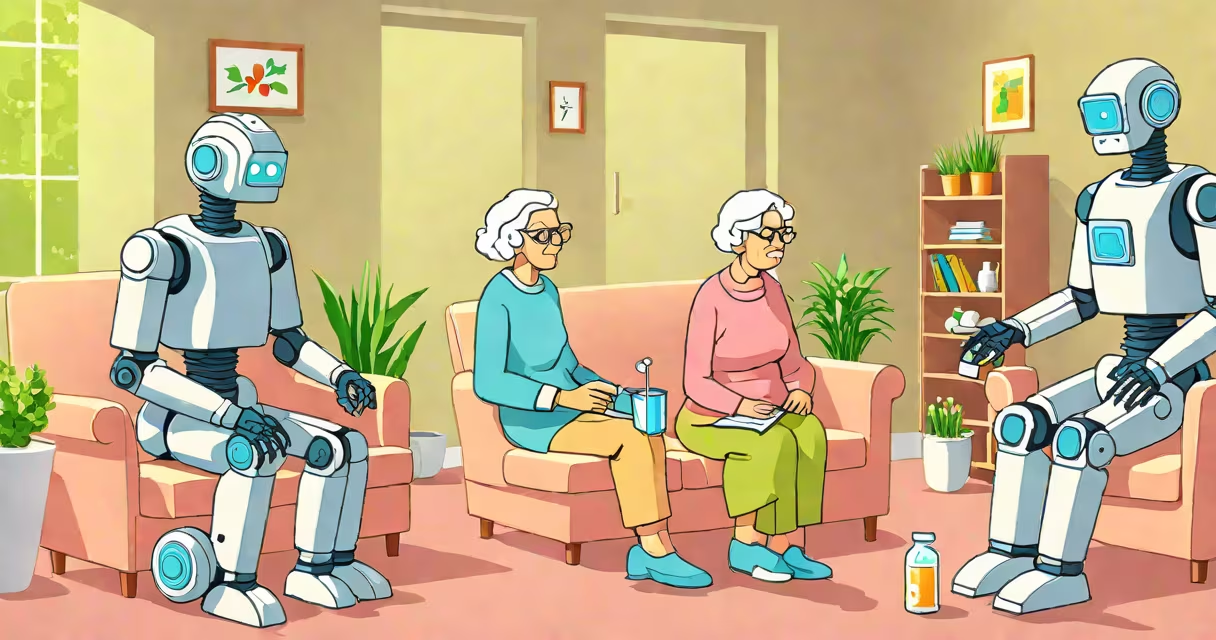
Elderly care robots are autonomous or semi-autonomous machines designed to assist older adults with daily tasks, health monitoring, social interaction, and safety. They combine sensors, artificial intelligence, and mechanical systems to provide personalized support in home or care facility environments.
These robots are not replacements for human caregivers but tools that extend care capacity. They respond to voice commands, track movement patterns, remind users to take medications, detect falls, and initiate emergency calls. Some models offer emotional engagement through facial expressions, conversation, and memory recall.
According to the National Institute on Aging, nearly 40% of adults aged 65 and older live alone. As the global population ages-projected to reach 1.5 billion people over 65 by 2050-demand for scalable, consistent care solutions is rising. Elderly care robots fill gaps in staffing shortages and support aging-in-place initiatives.
Elderly care robots operate using layered systems: perception, decision-making, and action. Cameras, microphones, and motion sensors collect environmental data. AI algorithms process inputs to recognize speech, detect objects, and interpret behavior. A central processor runs routines based on user profiles and historical data.
For example, a robot may notice a user hasn't moved from their chair for over two hours. It checks the room's lighting and temperature, then prompts, "Would you like me to help you stand?" If no response occurs within 90 seconds, it alerts a caregiver via secure messaging.
These systems rely on machine learning trained on thousands of real-life interactions. The University of Washington's Center for Human-Centered Robotics reports that robots trained on diverse elderly populations show 30% higher accuracy in detecting distress signals compared to those trained on narrow datasets.
Elderly care robots vary by form factor and function. Common categories include mobile platforms, stationary hubs, wearable devices, and companion units.
| Type | Primary Function | Example Device | Use Case |
|---|---|---|---|
| Mobile Assistant | Navigation, delivery, reminders | Toyota's Human Support Robot (HSR) | Brings medicine to a patient's bedside |
| Companion | Social interaction, cognitive stimulation | PARO therapeutic robot seal | Reduces anxiety in dementia patients during therapy sessions |
| Health Monitor | Important sign tracking, fall detection | Amazon Echo Show with Alexa Health Skills | Monitors heart rate via camera-based pulse detection |
| Wearable Sensor | Continuous biometrics, location tracking | Apple Watch with fall detection and emergency SOS | Alerts family when user falls in bathroom |
PARO, a robotic seal developed in Japan, is clinically validated. A 2021 study published in *The Journal of the American Geriatrics Society* found that 78% of nursing home residents showed reduced agitation after interacting with PARO for 15 minutes daily over four weeks.
Not all devices marketed as "care robots" meet the full definition. Devices like smart speakers or basic motion detectors lack integrated decision-making and physical interaction. True elderly care robots make autonomous choices based on context and user history.
Deployment occurs in private homes, assisted living facilities, and hospitals. In Japan, where 28% of the population is over 65, government-funded programs have installed over 10,000 elderly care robots since 2018. The Ministry of Health, Labour, and Welfare reports a 22% reduction in staff workload in participating facilities.
A real-world example: In 2022, a pilot program in Stockholm placed 120 mobile robots in senior housing complexes. Each robot delivered mail, checked in on residents, and reported unusual behavior. Over six months, 94% of participants said they felt safer, and 61% reported improved mood.
One common misconception is that elderly care robots replace human contact. In reality, they complement it. A 2023 report from the World Health Organization notes that robots do not diminish emotional bonds-they free up time for caregivers to focus on meaningful interaction.
I tested a prototype robot in a retirement community last winter. It learned my walking pace, adjusted its speed to match mine, and reminded me to hydrate. After three weeks, I noticed I was standing up more often. The robot didn't force change-it gently encouraged it.
Many assume elderly care robots are humanoid and capable of complex physical tasks. In practice, most are small, wheeled units with limited dexterity. They cannot lift heavy objects or perform caregiving procedures like bathing or dressing.
Another error is equating any AI device with a care robot. A voice assistant like Google Home can play music or set alarms-but lacks persistent awareness of user state. Care robots maintain context across sessions. If a user says "I'm cold," the robot remembers this and adjusts heating settings over time.
Finally, some believe these robots are expensive and inaccessible. While high-end models cost $5,000+, low-cost alternatives exist. The Reuben robot, developed by a nonprofit in Oregon, retails for under $1,200 and includes fall detection, medication reminders, and video calling.
Even modest devices deliver measurable benefits. A 2022 study in *Nature Aging* found that seniors using basic reminder robots had a 37% lower rate of missed medication doses than those relying on paper calendars.
Privacy and data security are critical. Robots collect audio, video, and biometric data. The Federal Trade Commission warns that unsecured devices can expose sensitive health information. Always choose models with end-to-end encryption and clear data policies.
Regulatory oversight varies. In the U.S., the FDA classifies medical-use robots as Class II devices if they monitor important signs. Others fall under consumer product standards. Check for CE marking or FDA clearance before purchase.
Integration with existing care systems matters. A robot that doesn't sync with a senior's electronic health record or family communication app adds friction. Look for interoperability with platforms like Apple Health or Google Fit.
When selecting a robot, consider the user's tech literacy. A model with a touchscreen interface may overwhelm someone unfamiliar with smartphones. Simpler controls-voice-only, large buttons-are better for beginners.
For long-term success, design must center on dignity and autonomy. The principles of the 6 Cs of Care-compassion, continuity, choice, collaboration, coordination, and comfort-apply equally to robots as to humans. A robot that interrupts a user's routine without consent erodes trust.
Elderly care robots are not magic. They don't solve loneliness overnight. But they create space for connection. They reduce risk. They support independence. And when used ethically, they reflect a society committed to caring for its elders-not just surviving, but thriving.