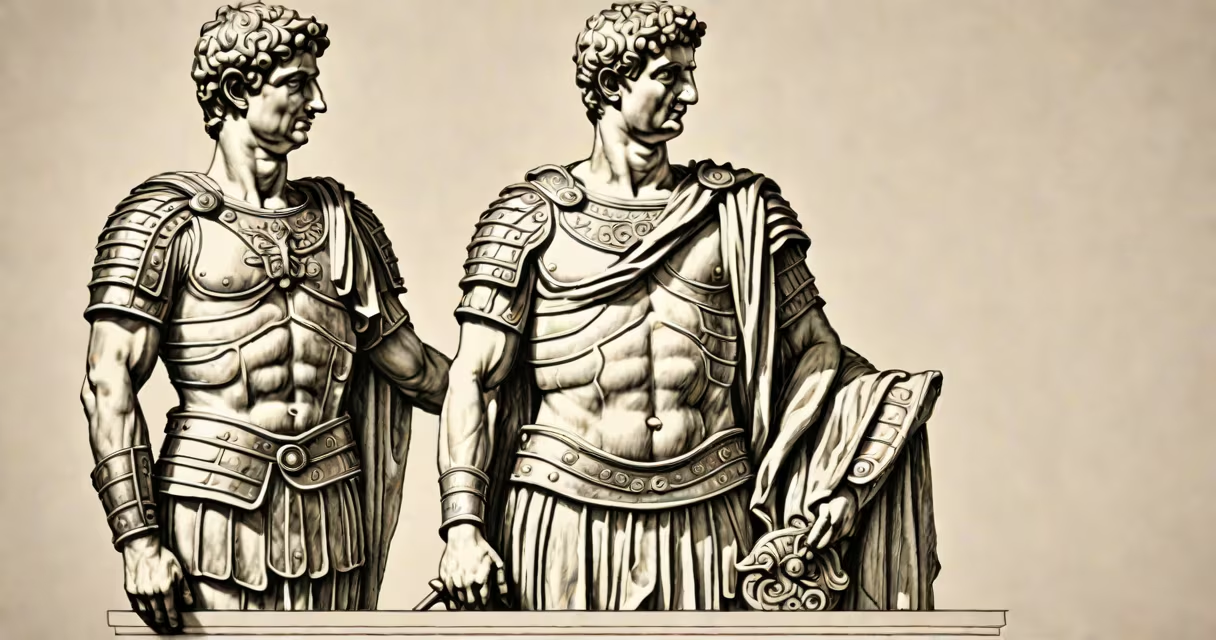
The Augustus Prima Porta is a life-sized Roman marble statue of Emperor Augustus, created circa 20 CE, depicting him in military regalia with symbolic imagery reinforcing his political and divine legitimacy.
Unearthed in 1863 near Rome's Via Flaminia, in the gardens of the Villa of Livia, the statue was discovered in fragments and later reconstructed. It stands 2.03 meters tall and is carved from fine white Carrara marble. The figure wears a cuirass (breastplate) adorned with complex reliefs, including scenes of diplomatic peace and military victory. His posture is calm, one hand raised in gesture of oratory, the other holding a scepter or globe-signs of leadership and imperial control.
Augustus Prima Porta exemplifies the Augustan artistic program: blending Greek ideals of beauty with Roman political messaging. The statue's face reflects a youthful, idealized version of Augustus, not his actual aging features. This stylization served to project strength, virtue, and divine favor-key pillars of his rule. The figure's right foot rests slightly forward, suggesting movement and purpose, while his gaze remains fixed on the horizon, embodying authority and foresight.
The statue's cuirass is the most complex element. Its relief panels depict multiple narratives. On the left side, a scene shows the return of Roman standards captured by Parthia in 20 BCE-symbolizing Augustus's diplomatic success. On the right, a battle scene with Roman soldiers confronting enemy forces, emphasizing military dominance. These images were not literal records but carefully curated propaganda. They communicated Augustus's role as restorer of peace and protector of Rome.
At the center of the cuirass, a female figure represents Roma, the personification of Rome. She holds a spear and shield, symbolizing the city's strength. Her presence reinforces Augustus's identity as Rome's guardian. Above her, a winged Victory hovers, bearing a laurel wreath-another nod to triumph and divine approval.
A lesser-known detail: the statue's left arm originally held a scroll or tablet, likely inscribed with the Res Gestae Divi Augusti-the emperor's own account of his achievements. Though missing today, its absence underscores how the statue functioned as a visual equivalent of written propaganda, accessible to citizens who could not read.
The statue is carved from Carrara marble, quarried in northern Italy. This material was preferred for elite Roman sculpture due to its durability and luminous finish. The choice of Carrara marble signals high status-only imperial commissions could afford such material.
While the original statue is believed to have been produced in Rome, copies circulated throughout the empire. At least five known copies exist, including one in the Vatican Museums and another in the Louvre. These replicas differ in scale and detail but share the core iconography. The original remains in the Vatican Museums' Braccio Nuovo gallery.
Some scholars debate whether the statue was intended for public display or private devotion. Its discovery in a villa garden suggests it may have been part of a domestic collection, possibly displayed to convey the owner's loyalty to Augustus. However, the size and craftsmanship indicate it was meant for wide visibility. The statue's placement in a prominent gallery today confirms its enduring cultural weight.
Augustus Prima Porta was not merely decorative-it was a tool of statecraft. Augustus used art to reshape public perception. After decades of civil war, he needed to project stability, continuity, and moral superiority. The statue's blend of martial readiness and peaceful resolve communicated that Rome's strength came from unity under one leader.
Modern historians cite the statue as evidence of Augustus's "image management." According to Mary Beard in SPQR: A History of Ancient Rome, "Augustus didn't just rule-he performed rule." The statue is a physical manifestation of that performance. Its pose, costume, and symbolism were designed to be instantly recognizable to Romans across provinces.
Today, the statue appears in textbooks, museum exhibitions, and academic debates. It is frequently referenced in discussions about Roman imperial ideology. For example, in 2018, the British Museum included a cast of the statue in its "Power and Identity" exhibition, highlighting how visual culture shaped Roman governance.
Many assume the statue depicts Augustus in battle. He is not shown wielding a weapon. Instead, his stance is ceremonial. The raised hand is not a command to attack but a gesture of speech-reminiscent of Greek statues of philosophers or orators. This misreading overlooks the statue's emphasis on rhetoric and diplomacy over violence.
Another error: the idea that the statue is purely Greek in style. While it draws from Classical Greek models-especially the Doryphorus by Polykleitos-the composition is distinctly Roman. The inclusion of Roma and Parthian surrender scenes adds narrative depth absent in Greek sculpture. Roman art fused idealism with historical specificity.
A less obvious correction: the statue's facial features are not based on Augustus's actual appearance. He was balding and had a pronounced nose. The statue's smooth forehead and refined features reflect the tradition of *imago*-idealized likenesses used to improve rulers above mere mortals. This was not deception but a standard practice in Greco-Roman portraiture.
Consider the relief on the right side of the cuirass. It shows Roman troops marching through a field, facing a group of enemies. The figures are not labeled, but the scene includes a woman being led away by a soldier. This is not a random event-it references the Parthian campaign of 20 BCE.
Historical context: In 20 BCE, Parthia returned Roman military standards lost during Crassus's defeat in 53 BCE. Augustus celebrated this as a major diplomatic win. The scene on the cuirass shows Roman soldiers reclaiming the standards, symbolizing restoration of honor. The woman represents Parthia itself-subdued but not destroyed. This nuance matters: Augustus presented himself as a peacemaker, not a conqueror.
Even the clothing is symbolic. The soldier's cloak is red-a color associated with power and sacrifice in Roman culture. The belt around his waist bears a knot tied in a specific way, known as the *fascia*. This detail was worn by generals and signified command. The artist included these elements to communicate rank and authority without words.
When viewed together, the symbols on the cuirass form a coherent narrative: Rome's strength lies in discipline, unity, and divine favor. Augustus is not just a ruler-he is the embodiment of Roman order.
My first encounter with the original statue was in 2015 at the Vatican Museums. Standing beneath its polished surface, I noticed how light caught the folds of the robe and the edge of the cuirass. The craftsmanship was so precise that individual threads in the fabric were visible. That moment confirmed what scholars have long argued: this was not just a statue-it was a statement.
The Augustus Prima Porta remains one of the most studied artworks from antiquity. It continues to inform our understanding of how power was visualized in the ancient world. Its blend of realism and symbolism offers a window into Augustus's strategy-not just to rule, but to be seen as worthy of ruling.