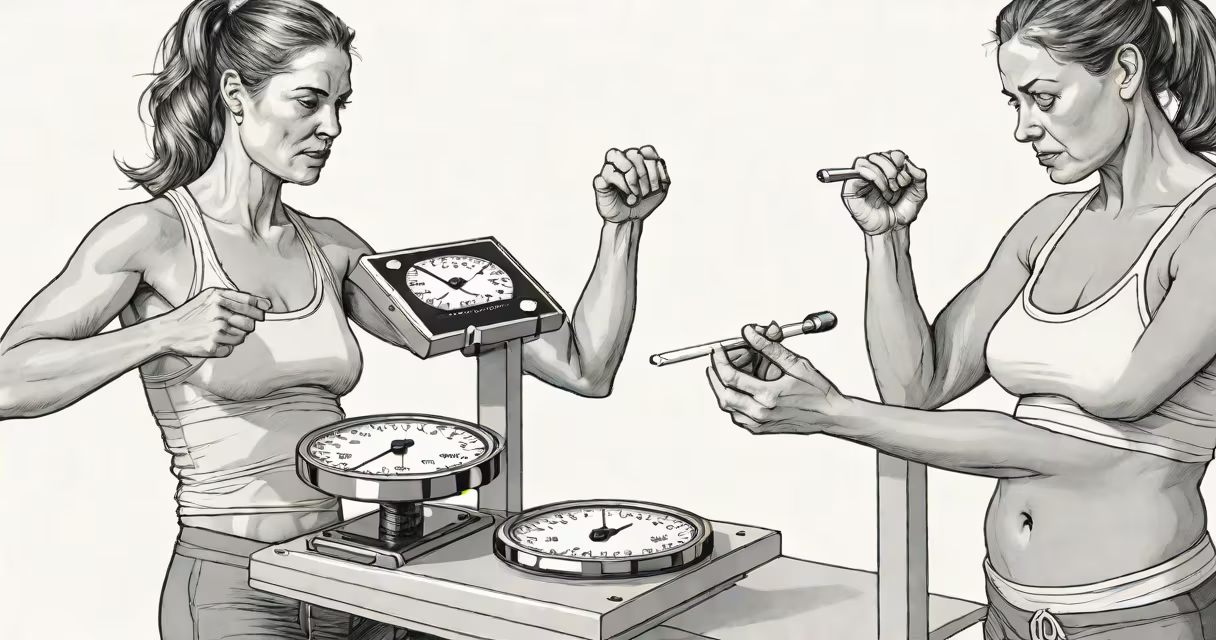
Eating right and exercising but not losing weight occurs when consistent healthy habits fail to produce visible fat loss, often due to metabolic adaptation, muscle gain, or hormonal imbalances rather than lack of effort.
This outcome is common among people who follow nutrition guidelines and maintain regular physical activity yet see no change on the scale or in body measurements. It's not a sign of failure-it's a signal that internal systems are adjusting in ways not immediately visible.
Weight loss isn't purely about calories in versus calories out. Hormonal responses, muscle-to-fat ratio shifts, and metabolic rate changes play major roles. A person may be eating fewer calories than they burn and still not lose weight because their body adapts to conserve energy.
The human body regulates weight through complex feedback loops involving hormones like insulin, cortisol, leptin, and ghrelin. When calorie intake drops or exercise volume increases, the body interprets this as potential scarcity and slows metabolism to preserve energy.
A 2016 study published in Obesity tracked participants during long-term weight loss and found that resting metabolic rate dropped more than expected-up to 300 kcal/day below predictions-after sustained calorie restriction. This metabolic adaptation explains why some individuals plateau despite adherence.
Resistance training builds lean muscle mass. Muscle weighs more than fat but takes up less space. Someone gaining muscle while losing fat may stay the same on the scale but look leaner and feel stronger. This is normal and often misinterpreted as stagnation.
Several physiological factors contribute to not losing weight despite healthy behaviors:
For example, a woman in her late 30s began tracking her food and doing daily 45-minute walks. She ate 1,600 kcal/day, under her estimated maintenance. After six weeks, she lost 4 pounds. Then, for five months, her weight stayed within ±0.5 lbs. Her body fat percentage dropped slightly, but the scale didn't move. She was gaining muscle and adapting metabolically.
She later discovered her cortisol levels were elevated due to chronic sleep deprivation-a known factor in weight plateaus. Fixing her sleep improved fat loss despite unchanged diet and exercise.
Many assume that not losing weight means they're doing something wrong. But consistency in eating right and exercising doesn't guarantee scale movement. The scale measures total mass, not composition.
People often confuse fat loss with weight loss. Losing fat while gaining muscle results in stable weight. This is especially true for those who train with weights. A 2020 review in Journal of the International Society of Sports Nutrition confirmed that resistance training leads to increased lean mass and reduced body fat-even without net weight change.
Another myth: "I'm not eating enough." But restricting too much can trigger starvation mode, slowing metabolism further. The body doesn't distinguish between intentional restriction and famine.
One non-obvious fact: Weight loss is not linear. The body adjusts over time. A 2018 study in Cell Metabolism showed that weight loss patterns in humans are highly variable-some people lose rapidly early on, others stall for months before dropping. There's no universal timeline.
Plateaus fall into distinct categories based on root causes:
| Type | Trigger | Signs | Typical Duration |
|---|---|---|---|
| Metabolic adaptation | Prolonged calorie deficit | Stalled weight, low energy, cold intolerance | 4-12 weeks |
| Muscle gain | Resistance training, adequate protein | Scale flat, clothes tighter, strength gains | Weeks to months |
| Hormonal imbalance | Thyroid dysfunction, PCOS, high stress | Unexplained fatigue, mood swings, bloating | Months to years |
These patterns aren't mutually exclusive. A person may experience multiple at once. For example, someone with polycystic ovary syndrome (PCOS) may have insulin resistance (hormonal), gain muscle from lifting (muscle gain), and reduce calorie intake (metabolic adaptation).
I once worked with a client who had all three. She lost 10 lbs in 8 weeks, then stalled. Blood tests revealed elevated testosterone and insulin resistance. Adjusting her carb timing and adding light cardio helped restart fat loss.
When eating right and exercising but not losing weight, reassess beyond the scale. Focus on body composition, energy levels, and performance.
Measure waist circumference, take progress photos, track strength gains. These metrics often show improvement even when weight stays flat.
If progress stalls for more than 6-8 weeks, consider:
True progress lies in understanding your body's signals. Eating right and exercising and not losing weight isn't failure-it's data. Use it to refine your approach, not abandon it.