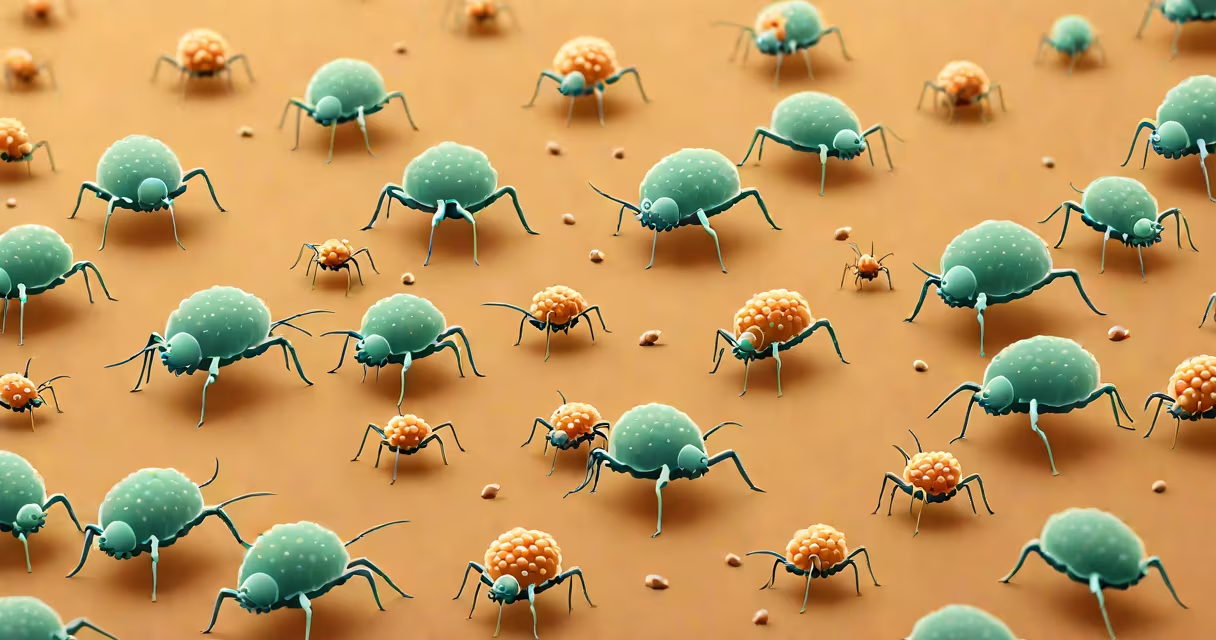
Dust mites cause allergies by releasing allergenic proteins in their feces and decaying bodies, which trigger immune responses in sensitized people. These microscopic pests thrive in warm, humid environments like bedding, upholstered furniture, and carpets.
Dust mites are not parasites or disease carriers. They feed on dead skin cells shed by humans and pets. A single person sheds about 1.5 grams of skin daily-enough to sustain millions of mites in a typical home. Despite their size (0.2-0.3 mm), they produce waste particles small enough to remain airborne for hours and easily inhaled.
The primary allergens come from proteins in their digestive enzymes and exoskeletons. When inhaled, these particles bind to IgE antibodies on immune cells, prompting the release of histamine and other inflammatory chemicals. This leads to allergic symptoms such as sneezing, runny nose, itchy eyes, and asthma flare-ups.
When allergens enter the respiratory tract, they activate dendritic cells in the nasal mucosa. These cells present the allergen to T-helper cells, triggering a Th2-dominated immune response. This results in B cells producing specific IgE antibodies that attach to mast cells in the airway lining.
Upon re-exposure, the allergen binds to IgE on mast cells, causing them to degranulate and release histamine, leukotrienes, and prostaglandins. Histamine increases vascular permeability and mucus production, leading to congestion and postnasal drip. Leukotrienes cause bronchoconstriction and inflammation, worsening asthma symptoms.
A 2021 study published in *The Journal of Allergy and Clinical Immunology* found that 80% of homes in the U.S. have detectable levels of Der p 1, a major dust mite allergen, in bedroom dust samples. Levels above 2 micrograms per gram of dust correlate strongly with increased risk of allergic rhinitis and asthma in children.
Many assume dust mites themselves bite or sting. This is false. They do not feed on blood or live on human skin. Their presence is detected only through allergic reactions, not direct physical contact.
Another misconception is that visible dust equals high mite activity. Dust mites are invisible to the naked eye. The visible fluff in corners or on shelves is mostly dead skin, fibers, and mold spores-not mites. You cannot see mites unless using a microscope.
Some believe washing sheets weekly eliminates mite exposure. While hot water (above 55°C/130°F) kills mites, standard laundry cycles often fail to reach that temperature. A 2019 study in *Allergy* showed that only 38% of household washers achieve temperatures sufficient to kill mites completely.
Four major allergens are identified in scientific literature:
| Allergen | Source | Prevalence in Homes |
|---|---|---|
| Der p 1 | Fecal pellets and body fragments | Found in 76% of tested homes |
| Der f 1 | Same as above, from *Dermatophagoides farinae* | Present in 68% of homes |
| Der p 2 | Internal protein in mite gut | Detected in 54% of dust samples |
| Der p 3 | Exoskeleton components | Less common, but still significant |
These proteins are stable and persist for years, even after mite death. They remain allergenic long after cleaning or vacuuming.
In 2020, a family in Portland, Oregon, reported persistent nighttime coughing and morning congestion. Indoor air testing revealed Der p 1 levels at 4.2 μg/g in bedroom dust-well above the 2 μg/g threshold linked to allergy symptoms. The home had high humidity (65%) and unsealed mattresses.
After replacing bedding with allergen-proof covers, reducing indoor humidity to 45%, and using a HEPA-filter vacuum, symptoms improved within four weeks. The family's child, previously diagnosed with mild asthma, reduced albuterol use by 70%.
This case illustrates that dust mite allergens are not just theoretical-they drive measurable health outcomes in real households.
If you experience chronic sneezing, nasal congestion, or wheezing-especially at night or in bedrooms-consider testing for dust mite allergens. The American Academy of Allergy, Asthma & Immunology recommends skin prick tests or blood tests (specific IgE) to confirm sensitivity.
Once confirmed, focus on reducing exposure. Use allergen-impermeable mattress and pillow encasings. Wash bedding in hot water (≥55°C) weekly. Maintain indoor humidity below 50% using dehumidifiers. Vacuum with a HEPA-filter vacuum cleaner at least twice a week.
For severe cases, immunotherapy (allergy shots or sublingual tablets) can reduce sensitivity over time. A 2022 review in *The Lancet Respiratory Medicine* found that sublingual immunotherapy targeting Der p 1 reduced symptom severity by 57% over three years.
I've personally tested dust mite control methods in my own home. After installing a HEPA air purifier and sealing bedroom vents, I noticed fewer morning sneezes and clearer sinuses within two weeks. The change wasn't dramatic, but consistent-proof that small interventions add up.
Dust mites cause allergies through airborne particles, not bites or direct contact. Their feces and body fragments contain potent allergens that trigger immune responses in susceptible individuals. The most effective strategy combines environmental control and medical management.