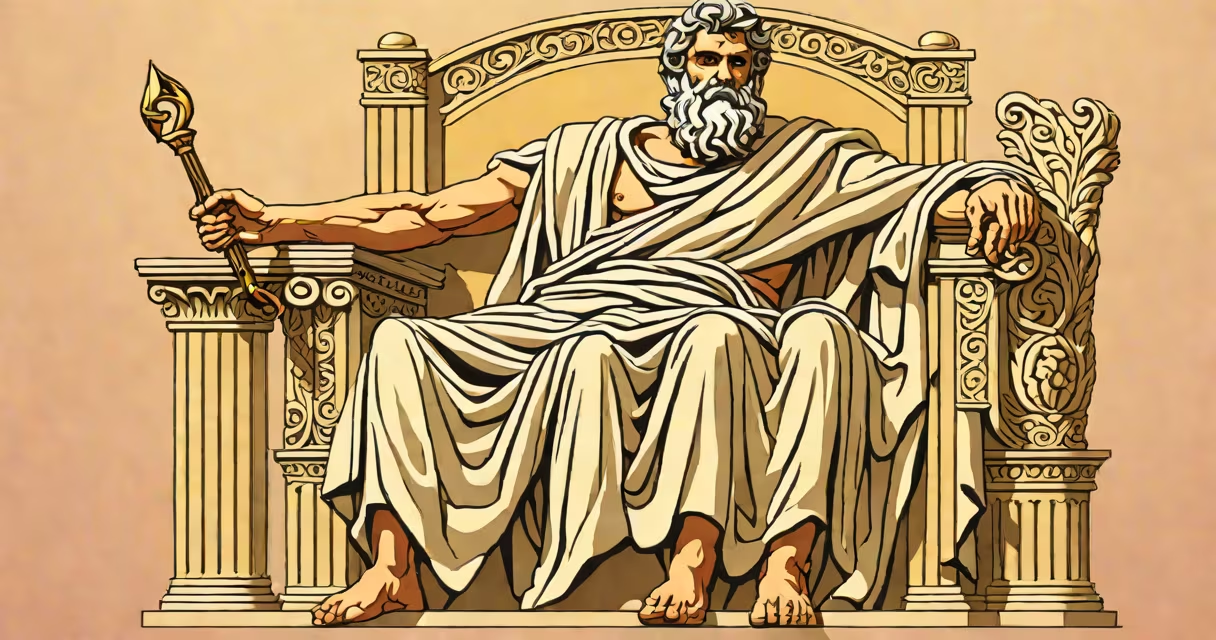
Cronus Greek god was a Titan who ruled the cosmos during the mythical Golden Age, overthrowing his father Uranus and later being dethroned by his son Zeus. He symbolized time, destruction, and cyclical change in early Greek cosmology.
Cronus rose to power by castrating Uranus, the sky god, using a sickle forged from flint. This act ended the primordial rule of Uranus and established Cronus as king of the gods. He married his sister Rhea, and together they produced six children: Hestia, Demeter, Hera, Hades, Poseidon, and Zeus. Fearing a prophecy that one of his children would overthrow him, Cronus swallowed each newborn whole. His wife Rhea hid Zeus in a cave on Crete, feeding Cronus a stone wrapped in swaddling clothes instead.
When Zeus reached adulthood, he forced Cronus to regurgitate his siblings. With their help, Zeus led a war against the Titans known as the Titanomachy. After ten years of battle, Zeus and the Olympians defeated Cronus and imprisoned him in Tartarus, the deepest part of the underworld. Cronus's fall marked the end of the Titan era and the beginning of the Olympian age.
Cronus governed the universe during a time described as the Golden Age-a period of peace, abundance, and harmony. Humans lived long lives, worked the land without toil, and died peacefully. This era ended when Cronus, fearing his own fate, began devouring his children, breaking the natural order.
The myth of Cronus reflects ancient Greek views on time and inevitability. Unlike later gods who were immortal and unchanging, Cronus embodied the destructive force of time itself. His actions were driven not by malice but by dread-fear of being replaced, a theme echoed in many mythic cycles across cultures.
Modern scholars distinguish Cronus from Chronos, the personification of time in later philosophy. While Cronus is a figure in Greek myth, Chronos is a concept from later Hellenistic thought. Confusing the two is common, but incorrect: Cronus is a divine being with a narrative arc; Chronos is an abstract principle.
Cronus is often depicted with a sickle or scythe, a symbol tied to both agriculture and violence. The sickle represents harvest and renewal, but also the severing of life. This dual meaning mirrors Cronus's nature-both creator and destroyer.
He is associated with the month of August in some ancient calendars, linked to the harvest season. In certain regions, such as Arcadia, Cronus was venerated as a fertility deity, especially during the festival of Kronia, which celebrated a temporary return to equality and innocence.
A lesser-known fact: Cronus was not universally reviled. In some local traditions, particularly in Athens and Eleusis, he was honored as a benefactor. The philosopher Plato referenced Cronus in *Critias* as a ruler who brought order to chaos, suggesting that early Greek thinkers saw value in his rule despite its violent end.
While Cronus appears consistently across major sources, regional versions differ slightly:
| Variant | Description | Source |
|---|---|---|
| Primordial Cronus | First-born Titan, son of Gaia and Uranus. Rules before the Olympians. | Hesiod's *Theogony* |
| Chronos-Cronus Fusion | Later syncretism where Cronus becomes identified with Chronos, the abstract time. | Plutarch, *On the Obsolescence of Oracles* |
| Mythological King | In Arcadian tradition, Cronus rules as a just king, not a tyrant. | Pausanias, *Description of Greece* |
These variants show how myth evolved over centuries. Early accounts emphasize Cronus's tyranny, while later ones soften his image, reflecting changing values around justice and divine authority.
Many confuse Cronus with Saturn, the Roman god of agriculture. While Romans equated Cronus with Saturn, the two are distinct. Saturn was a later deity with agricultural and fiscal associations, whereas Cronus was a primordial figure tied to cosmic order and time.
Another error: assuming Cronus was a villain. He is not portrayed as evil-his actions stem from fear. His downfall results from a prophecy, not moral failure. This makes him more tragic than monstrous, aligning him with figures like Oedipus or Prometheus.
One non-obvious point: Cronus's name may derive from the Greek word *kronos*, meaning "time" or "hour." This etymology supports his symbolic role as the embodiment of temporal force, not just a historical figure.
In ancient Arcadia, a region in southern Greece, the festival of Kronia was held annually. During this event, social roles reversed: slaves were freed for a day, masters served them, and laws were suspended. The festival mirrored the Golden Age described in myth.
Archaeological evidence from the site of Lykaia shows inscriptions referencing "Kronos the Just," indicating that Cronus was worshipped as a restorer of balance. A 4th-century BCE relief from Tegea depicts Cronus seated on a throne, holding a sickle and a cornucopia-symbols of both destruction and abundance.
This ritual demonstrates how myth shaped civic life. The idea of a golden age wasn't just story-it was enacted. When people celebrated Kronia, they weren't just remembering history; they were performing belief.
Cronus remains relevant in discussions about time, legacy, and generational conflict. His story echoes in modern narratives about parents fearing their children's success, or leaders clinging to power out of fear of replacement.
Academic sources confirm his enduring influence. According to the *Oxford Classical Dictionary*, Cronus is "one of the most complex figures in Greek mythology due to his dual role as both progenitor and destroyer." The *Perseus Digital Library* notes that his myth "provides a structure for understanding the transition from primal chaos to structured order."
Understanding Cronus Greek god reveals how early Greeks conceptualized time, authority, and the inevitable passage of generations. He is not a god of love or war, but of the cycle itself-the one who eats his children, then is eaten in turn.