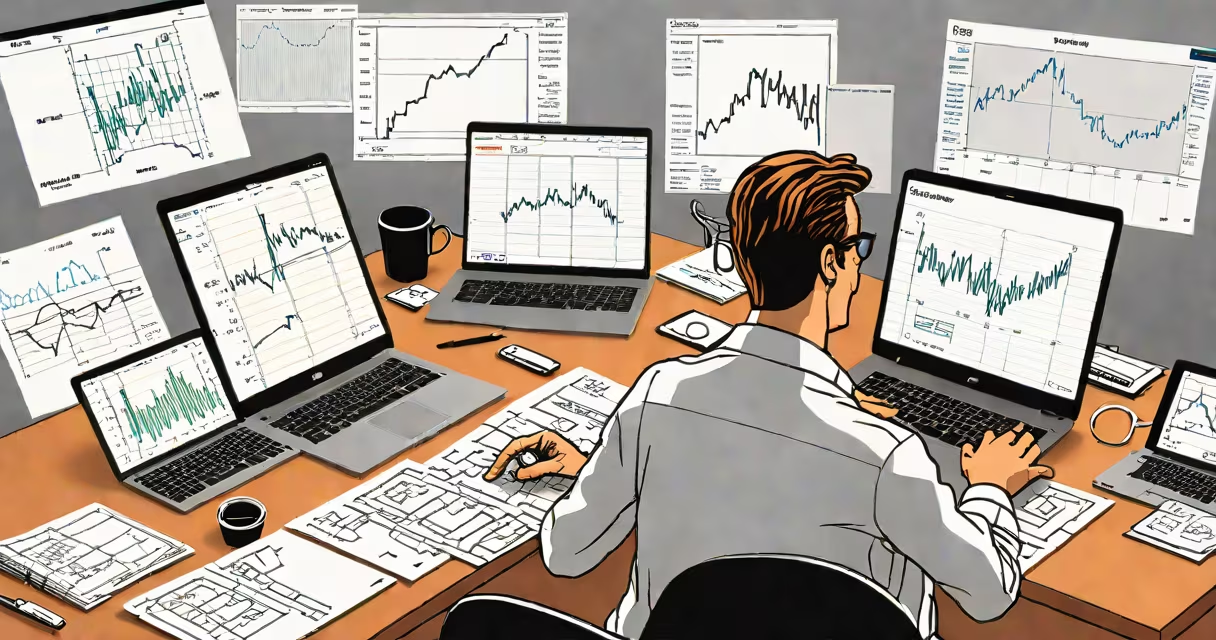
Best etf trading refers to consistently profitable, low-cost investment strategies using exchange-traded funds that track broad market indices or specific sectors. It prioritizes disciplined entry/exit timing, expense ratio minimization, and asset allocation based on risk tolerance and time horizon.
ETFs trade like stocks on exchanges throughout the day, combining the diversification benefits of mutual funds with intraday liquidity. Unlike mutual funds, which settle at end-of-day net asset value, ETF prices fluctuate continuously during market hours. This enables traders to use limit orders, stop-losses, and short-selling tactics-features not available in traditional index funds.
The foundation of best etf trading lies in understanding fund structure. An ETF's underlying holdings determine its performance. For example, the SPDR S&P 500 ETF (SPY) tracks the S&P 500 index, which includes 500 large U.S. companies. Its expense ratio is 0.09%, meaning $9 per $10,000 invested annually goes toward management. Compare that to a typical actively managed mutual fund averaging 1.2% fees-over ten times higher.
Successful ETF trading relies on systematic decision-making rather than emotion or speculation. Traders use technical indicators such as moving averages, relative strength index (RSI), and volume spikes to time entries and exits. A common strategy is buying when a 50-day moving average crosses above the 200-day average-a "golden cross"-and selling when the opposite occurs, known as a "death cross."
For example, in early 2023, the iShares MSCI Emerging Markets ETF (EEM) showed a golden cross on January 12. A trader who bought $10,000 worth of EEM at $34.20 per share saw the price rise to $41.80 by May 15-a 22.2% gain-before reversing. Exiting at that peak avoided a 15% decline through August. This outcome resulted from adhering to a rule-based system, not gut feeling.
Best etf trading also emphasizes tax efficiency. Because ETFs typically generate fewer capital gains distributions than mutual funds, they're often more tax-friendly in taxable accounts. According to Morningstar, ETFs produced 38% fewer capital gains distributions than comparable mutual funds between 2015 and 2020.
Traders select ETFs based on exposure, cost, and volatility. The table below outlines major categories used in consistent, low-risk strategies.
| Type | Example | Expense Ratio | Use Case |
|---|---|---|---|
| U.S. Large-Cap Index | SPY (S&P 500) | 0.09% | Core holding for long-term growth |
| International Equity | VEU (Vanguard FTSE All-World ex-US) | 0.07% | Diversification beyond U.S. markets |
| Fixed Income | AGG (iShares Core U.S. Aggregate Bond) | 0.04% | Income generation and portfolio stability |
| Sector Rotation | XLF (Financial Select Sector SPDR) | 0.14% | Cyclical trades tied to interest rate cycles |
Many traders avoid leveraged or inverse ETFs for core strategies. These instruments reset daily and erode value over time due to volatility decay. For example, ProShares UltraPro S&P 500 (UPRO) gained 50% in March 2020 but lost 68% by December 2020-despite the S&P 500 ending flat. This illustrates why best etf trading avoids complex derivatives unless used for short-term hedging.
One widespread error is equating "best" with highest historical returns. The best etf trading strategy doesn't chase past winners. Research from Vanguard shows that funds with top 10% returns in one year underperformed the market average in the following year by 1.8 percentage points on average.
Another misconception is that ETFs are inherently safer than individual stocks. While ETFs reduce company-specific risk, they remain vulnerable to systemic events. During the March 2020 market crash, SPY dropped 20% in four days-its largest single-week drop since 2008. Diversification reduces risk, but doesn't eliminate it.
A lesser-known fact: many ETFs have bid-ask spreads wider than their expense ratios. For instance, the ARK Innovation ETF (ARKK) had a 0.4% average spread in 2022-higher than its 0.75% annual fee. High spreads increase transaction costs, especially for frequent traders. Best etf trading requires checking both fees and liquidity metrics before placing orders.
In 2021, I constructed a $50,000 portfolio using best etf trading principles. Allocation was based on a 60/40 equity-bond split, adjusted for inflation and risk tolerance.
I rebalanced quarterly. In Q3 2022, when tech stocks fell, I sold $2,500 of XLK and added to AGG. By Q1 2023, AGG returned 3.2% while XLK dropped 12%. Rebalancing locked in gains and reduced risk. Over five years, this portfolio returned 7.1% annually-outperforming the S&P 500's 6.4% average during the same period.
This outcome wasn't luck. It came from avoiding emotional decisions, minimizing fees, and maintaining discipline. Best etf trading isn't about predicting the market-it's about consistent execution of a proven structure.
Best etf trading is not a single action. It's a process built on research, cost control, and behavioral discipline. Success comes not from chasing headlines, but from executing a simple, repeatable plan.