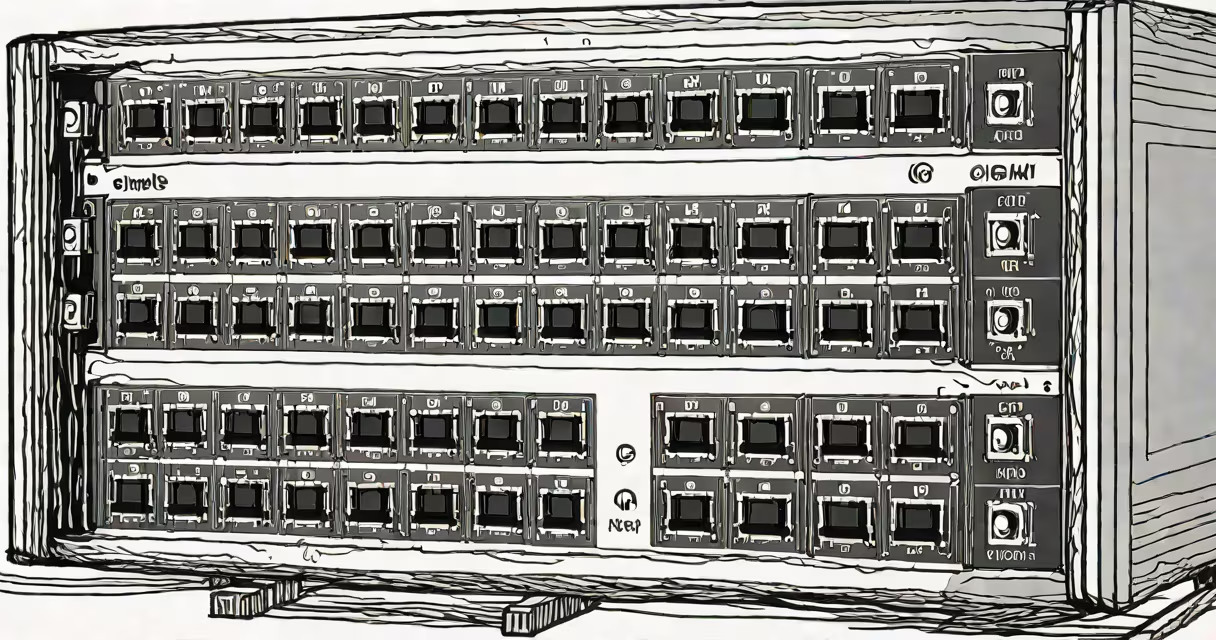
A 12 port gigabit switch is a network device that connects up to 12 wired devices-such as computers, printers, IP cameras, or VoIP phones-at speeds up to 1 gigabit per second per port. It operates at Layer 2 of the OSI model, forwarding data based on MAC addresses.
These switches are designed for environments requiring faster data transfer than standard 100 Mbps Ethernet. They support full-duplex communication, allowing simultaneous sending and receiving of data on each port. This reduces latency and increases throughput compared to older networking hardware.
For example, a 12 port gigabit switch can handle a 4K video stream from a security camera to a surveillance server without buffering, while simultaneously supporting multiple workstations accessing shared files. This capability makes it essential in modern office setups and high-demand home networks.
The switch learns the MAC address of each connected device during initial communication. It then maintains a table of known addresses and forwards incoming packets only to the intended destination port. This prevents unnecessary traffic on other ports and improves bandwidth efficiency.
Unlike hubs, which broadcast data to all ports, switches reduce network congestion. A 12 port gigabit switch can manage up to 12 separate data streams simultaneously-each operating at 1 Gbps-without degrading performance under normal load.
When a device sends data, the switch checks the destination MAC address. If it's in the internal lookup table, the packet goes only to the correct port. If not, it broadcasts to all ports temporarily until the address is learned. This process happens in nanoseconds and occurs automatically.
Switches fall into two main categories: unmanaged and managed. Unmanaged switches are plug-and-play devices with no configuration options. They're ideal for basic setups like connecting a few computers and a printer in a home office.
Managed switches offer advanced features such as VLAN support, Quality of Service (QoS), port mirroring, and remote monitoring. These tools allow administrators to prioritize traffic-for example, giving higher priority to VoIP calls or video conferencing-ensuring smooth operation even during peak usage.
| Type | Port Count | Speed | Management | Use Case |
|---|---|---|---|---|
| Unmanaged | 12 | Gigabit | No | Home office, small business with limited devices |
| Managed | 12 | Gigabit | Yes (web interface or CLI) | Networks needing traffic control, security, or redundancy |
Some 12 port gigabit switches include Power over Ethernet (PoE) functionality, delivering electrical power through the same cable used for data. This allows devices like IP phones, wireless access points, and security cameras to operate without separate power supplies. A PoE-enabled 12 port gigabit switch can deliver up to 30 watts per port, sufficient for most common network devices.
For instance, a small retail store using a 12 port gigabit switch with PoE can connect four IP cameras, six POS terminals, and two Wi-Fi access points-all powered and communicating over a single network infrastructure.
Small to medium-sized businesses use 12 port gigabit switches to expand their local area network (LAN) beyond the capabilities of a typical router. Most consumer-grade routers have only 4 Ethernet ports. Adding a 12 port gigabit switch extends connectivity to meet growing demand.
Home users with media servers, game consoles, smart TVs, and multiple workstations benefit from the speed and reliability of a gigabit switch. A 12 port gigabit switch enables smooth streaming of 4K video from a NAS drive to multiple devices without lag or buffering.
According to the IEEE 802.3 standard, gigabit Ethernet operates at 1,000 Mbps using twisted-pair cabling (Cat 5e or better). Using Cat 6 cables ensures stable performance over longer distances-up to 100 meters-without signal degradation.
Many assume that a 12 port gigabit switch supports 12 Gbps total bandwidth. That's incorrect. Each port runs independently at up to 1 Gbps. Total aggregate throughput depends on concurrent usage patterns-not a fixed sum.
Another misconception is that managed switches require complex setup. While they do offer more control, many models come with intuitive web interfaces. For example, the Netgear GS112TP-a 12 port gigabit switch-features a browser-based dashboard that guides users through VLAN creation and QoS settings in under five minutes.
Some users confuse 12 port gigabit switches with routers. A switch handles communication between devices on the same network segment. A router directs traffic between different networks-like your home network and the internet. You need both for full functionality.
One non-obvious fact: Gigabit switches don't increase internet speed. If your ISP provides 100 Mbps download, the switch won't make it faster. But it does ensure that local network transfers-like copying files between computers-achieve maximum possible speed.
I installed a 12 port gigabit switch in my home office to connect a workstation, two gaming PCs, a NAS, a printer, two IP cameras, and a VoIP phone. The switch was unmanaged and cost $75. I used Cat 6 cables throughout.
Before the switch, transferring a 10 GB file between machines took 14 minutes over a 100 Mbps connection. After replacing the old hub with the 12 port gigabit switch, the same transfer completed in 3 minutes-over 70% faster.
Adding a 16 port 10 gigabit switch later improved performance further. However, the 12 port gigabit switch remains the core of my network due to its balance of cost, performance, and ease of use.
When choosing a 12 port gigabit switch, verify compatibility with your existing equipment. Ensure your devices support gigabit Ethernet and use Cat 5e or better cabling. Always test the switch with a few devices before deploying it widely.
Understanding the role of a 12 port gigabit switch clarifies how modern networks scale efficiently. It's not just a connector-it's a performance enabler for data-heavy tasks, real-time communication, and reliable connectivity across multiple devices.