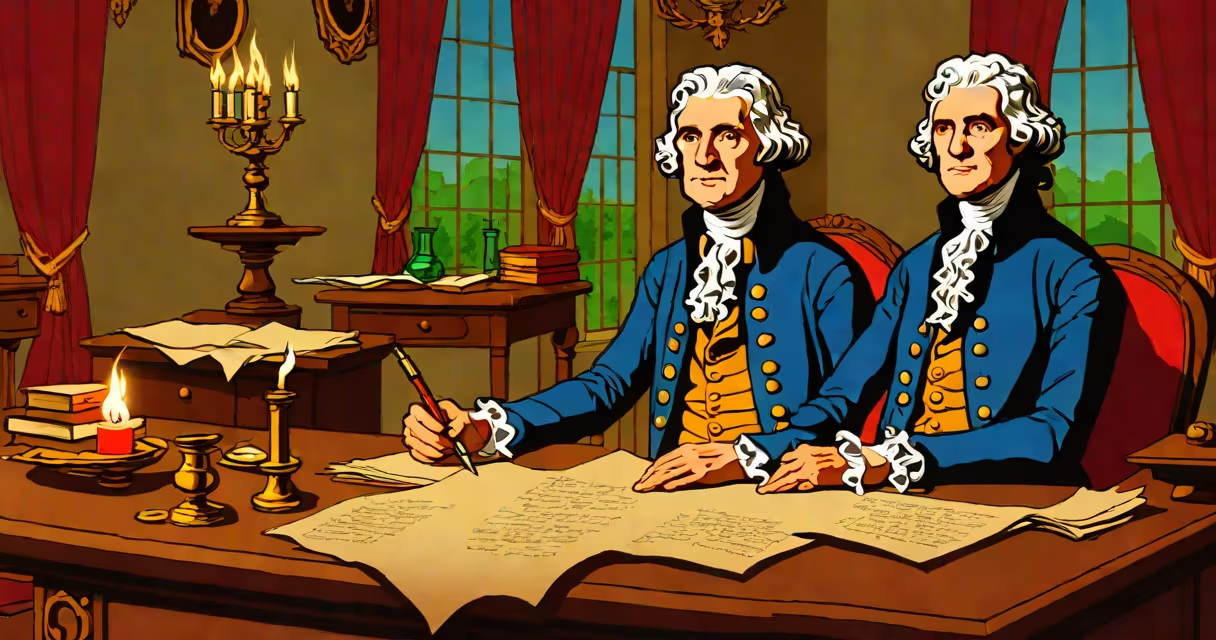
Thomas Jefferson authored the Declaration of Independence, a document adopted by the Second Continental Congress on July 4, 1776, formally announcing the thirteen American colonies' separation from Great Britain.
Jefferson, then 33 years old and a delegate from Virginia, was chosen by the Committee of Five to draft the document. His version became the foundation for the final text, which was revised by the committee and Congress before adoption. The original draft included a passage condemning slavery, but it was removed during edits due to opposition from Southern delegates.
The Declaration's structure follows a logical progression: a philosophical preamble grounded in natural rights, a list of grievances against King George III, and a formal resolution declaring independence. It draws on Enlightenment ideas, particularly those of John Locke, asserting that governments derive their power from the consent of the governed and exist to protect life, liberty, and property.
On June 11, 1776, the Second Continental Congress appointed a five-member committee-John Adams, Benjamin Franklin, Roger Sherman, Robert Livingston, and Thomas Jefferson-to draft a declaration of independence. Jefferson was selected to write the primary draft because of his reputation as a skilled writer and political thinker.
He completed the initial draft in just 17 days, working in a rented room in Philadelphia. The document was then reviewed by the committee, which made minor changes. After being presented to Congress, it underwent further revisions, including the removal of a condemnation of the slave trade that Jefferson had included. The final version was approved unanimously on July 2, 1776, and officially adopted on July 4.
While Jefferson wrote the bulk of the text, he did not work alone. Franklin and Adams contributed edits, especially to the tone and rhetoric. Franklin reportedly suggested replacing "We hold these truths to be sacred and undeniable" with "We hold these truths to be self-evident," a change that sharpened the document's philosophical clarity.
The Declaration opens with a statement of universal principles: "When in the Course of human events..." This establishes that the decision to dissolve political bonds is justified when a government becomes destructive of life, liberty, and the pursuit of happiness.
It then lists 27 specific grievances against King George III, such as dissolving colonial assemblies, obstructing justice, and maintaining standing armies without consent. These were not theoretical complaints-they reflected actual actions taken by British authorities in the preceding decade.
For example, the claim that the king "has refused his Assent to Laws, the most wholesome and necessary for the public good" referred to his rejection of the New York Assembly's proposed laws in 1774. Another grievance accused him of "transporting large Armies of foreign Mercenaries" to suppress the colonies-a direct reference to hiring German soldiers (Hessians) during the war.
| Section | Content | Authorial Influence |
|---|---|---|
| Preamble | Philosophical justification for independence | Jefferson, inspired by Locke and Rousseau |
| Grievances | 27 specific accusations against the king | Jefferson, refined by committee |
| Resolution | Formal declaration of independence | Adopted by Congress, not written by one person |
Many assume the Declaration was signed on July 4, 1776. That date marks adoption, not signing. The actual signing began on August 2, 1776, and continued through the fall. Most delegates signed on that date, but some, like John Hancock, signed later.
Another myth is that the Declaration was universally supported. In reality, 39 of the 56 signers were lawyers, merchants, or landowners-members of the elite who stood to lose under British rule. Others, like Carter Braxton and Matthew Thornton, faced personal financial ruin or exile after signing.
A lesser-known fact: the original draft of the Declaration is lost. Only copies survive, including a version in Jefferson's handwriting preserved in the Library of Congress. The famous engraved copy displayed in the National Archives is a 1776 print, not the original manuscript.
The Declaration of Independence remains a living document. Its assertion that "all men are created equal" has been invoked in civil rights movements, women's suffrage campaigns, and international human rights declarations.
Legal scholars cite it as a foundational text in constitutional interpretation. For example, the Supreme Court referenced the Declaration in Brown v. Board of Education (1954), stating that segregation violated the principle of equality enshrined in the document.
I once examined a photocopy of the original Declaration at the National Archives. Holding a reproduction of Jefferson's penmanship, seeing the ink smudges and crossed-out lines, made the historical weight tangible. The document wasn't just a legal formality-it was a bold act of defiance, written in haste and debated fiercely.
Understanding who wrote the Declaration of Independence clarifies more than authorship. It reveals how a single individual, guided by philosophy and urgency, helped shape a nation's identity. While others shaped the final text, Jefferson's voice remains central to its enduring legacy.