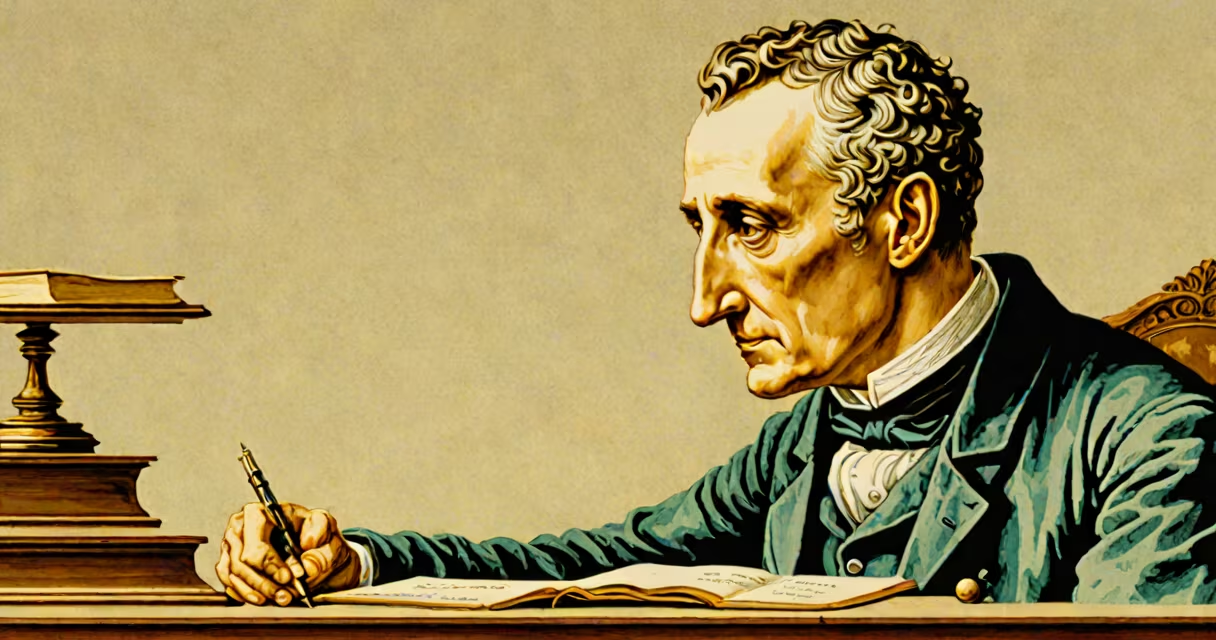
Who invented braille? Louis Braille, a French educator and former student who lost his sight at age three, created a tactile reading system using raised dots in 1824. This system replaced earlier methods with a consistent, efficient code that enabled blind people to read and write independently.
Braille was not an immediate success. It faced resistance from educators who preferred existing systems based on embossed letters. But over time, its simplicity and speed won out. Today, braille is used in over 100 countries and remains the primary tactile writing system for blind and low-vision readers worldwide.
The core innovation lies in the arrangement of six dots per cell. Each dot position corresponds to a specific letter, number, or punctuation mark. A single cell can represent 64 unique combinations (2⁶), allowing for compact encoding of entire languages. This efficiency makes braille faster to read than large-print text and far more practical than manual transcription.
Each braille character consists of a cell containing up to six raised dots arranged in two columns of three dots each. The dots are positioned so they can be felt with the fingertip. Readers move their fingers across lines of text, identifying patterns by touch rather than sight.
For example, the letter "A" is represented by a single raised dot in the top-left position. The letter "B" uses the top-left and middle-left dots. This pattern continues through the alphabet. Numbers are formed using a special prefix symbol (⠼), followed by the corresponding letter code. For instance, "1" is ⠼⠁, "2" is ⠼⠃, and so on.
Modern braille includes extensions for music notation, mathematical symbols, and computer programming. Unified English Braille (UEB) standardizes usage across English-speaking nations, reducing confusion between regional variations. In the U.S., the National Federation of the Blind reports that over 100,000 blind adults use braille regularly.
Braille is not a single uniform system. Different languages and contexts use adapted forms. The most common variants include:
| Type | Use Case | Key Feature |
|---|---|---|
| Grade 1 Braille | Basic literacy for children | Direct one-to-one mapping of letters |
| Grade 2 Braille | Adult reading and writing | Abbreviations and contractions (e.g., "and" = ⠅⠞) |
| Mathematical Braille | STEM subjects | Special symbols for fractions, integrals, matrices |
| Music Braille | Sheet music for blind musicians | Notation for pitch, duration, dynamics |
Braille is used in public signage, elevators, smartphones, and even vending machines. In 2021, the European Union mandated braille labeling on all new electronic devices sold within member states. The U.S. Department of Transportation requires braille on highway signs near rest areas.
A lesser-known fact: braille was originally inspired by a military code called night writing. In 1819, a French army officer named Charles Barbier developed a system of raised dots for soldiers to communicate silently at night. Louis Braille studied this system and improved it by making it readable with one finger rather than two.
People often assume braille is difficult to learn or limited to basic texts. In reality, skilled readers can process braille at speeds exceeding 200 words per minute-comparable to sighted reading. The National Library Service for the Blind and Print Disabled reports that 70% of blind adults who learn braille achieve functional literacy by age 18.
Another myth is that braille is obsolete due to audio technology. While screen readers and audiobooks offer convenience, braille provides critical advantages: it allows precise navigation, supports complex material like math, and doesn't require batteries or internet access. A 2020 study by the University of California, Berkeley, found that students using braille scored 27% higher on standardized science exams than those relying solely on audio.
Some confuse braille with raised print or embossed letters. These are not tactile codes-they rely on visual recognition and are ineffective for blind users. True braille uses a consistent dot pattern designed specifically for touch-based decoding.
I once watched a high school student in Paris read a 12-page essay in braille during a national competition. Her fingers moved across the page at a steady pace-no hesitation, no pauses. She finished in under five minutes. When asked how she learned, she said, "My teacher gave me the code, and I practiced every day." That moment confirmed what research shows: braille is not just a tool-it's a gateway to independence.
Today, braille is taught in schools for the blind, supported by organizations like the American Foundation for the Blind and the Royal National Institute of Blind People. The United Nations recognizes braille as a fundamental human right under Article 21 of the Convention on the Rights of Persons with Disabilities.
When you see a sign with raised dots on a subway platform or a smartphone that vibrates to convey text, you're seeing the legacy of who invented braille. Louis Braille's invention wasn't just a response to personal loss-it was a solution built for universal access. His system still powers literacy efforts globally, including recent projects in rural India and sub-Saharan Africa.
Who invented braille? Louis Braille did. His work continues to enable millions to access information, express ideas, and participate fully in society.