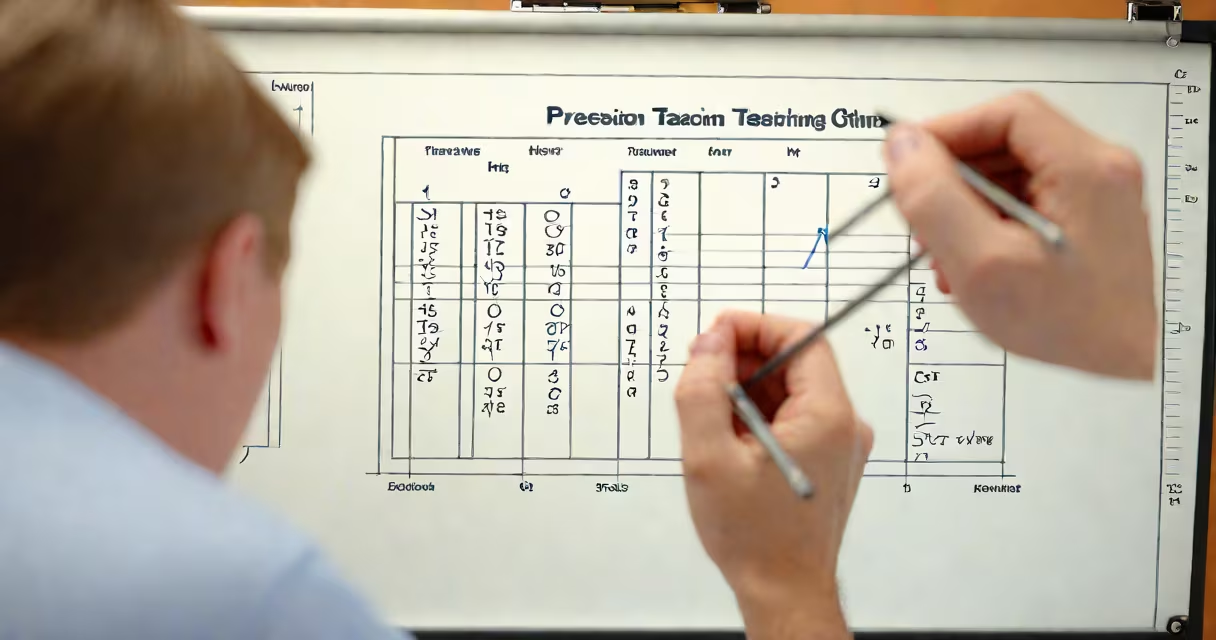
Precision teaching in applied behavior analysis (ABA) is a research-backed instructional method that uses frequent, standardized measurement of student performance to guide immediate teaching adjustments. It focuses on fluency-how quickly and accurately a learner can perform a skill-rather than just correctness. This approach is rooted in experimental analysis of behavior and relies on continuous data collection to inform instruction.
Developed by Ogden Lindsley in the 1960s, precision teaching emerged from the principles of radical behaviorism and was designed to make learning measurable, efficient, and individualized. It's used widely in special education, autism intervention programs, and academic skill development. Unlike traditional assessment methods that measure progress weekly or monthly, precision teaching collects data every few seconds during practice sessions.
The core idea is that learning is not complete until a skill reaches fluency-typically defined as 30 correct responses per minute. Fluency ensures automaticity, which frees cognitive resources for higher-order thinking. For example, a child who can read 30 sight words per minute with 95% accuracy can focus on comprehension rather than decoding.
At the heart of precision teaching is the frequency count-a tally of correct responses within a fixed time interval, usually 1 minute. Teachers or therapists conduct brief, timed drills (e.g., 10-second flashcards, 1-minute math problems) and record each correct response on a standard graph called a "standard celeration graph."
Each session lasts between 1 and 5 minutes. After each session, the instructor plots the number of correct responses per minute on the graph. Over time, the trend line shows whether the student is improving, plateauing, or regressing. A flat or downward trend triggers an immediate change in teaching strategy.
For instance, if a student consistently scores 12 correct math facts per minute on addition problems, but the goal is 30, the teacher might switch from whole-group instruction to one-on-one discrete trial training with errorless learning techniques. The adjustment happens within hours-not weeks-because data is collected daily.
Precision teaching applies to skills that are discrete, observable, and measurable. Common domains include reading, math, spelling, and daily living skills. Tasks are broken into small units-such as "name the capital of California" or "solve 7 × 8"-to isolate specific behaviors.
| Type of Skill | Example Task | Fluency Benchmark |
|---|---|---|
| Academic (math) | Single-digit multiplication facts | 30 correct in 1 minute |
| Reading | Decoding high-frequency words | 40 correct in 1 minute |
| Verbal | Labeling common objects | 25 correct in 1 minute |
| Motor | Writing letters from memory | 20 correct in 1 minute |
Not all tasks are suitable. Skills requiring complex reasoning, such as essay writing or problem-solving, don't lend themselves well to frequency counting. Instead, precision teaching targets foundational skills that build toward larger goals. Once fluency is achieved in basic operations, students can apply them to multi-step word problems.
A lesser-known fact: precision teaching doesn't require specialized software. While apps exist, many educators still use paper charts and dry-erase boards. The simplicity of the method allows implementation in low-resource settings. A study published in *Behavior Analyst* (2018) found that teachers using manual precision teaching graphs improved student outcomes in math fluency by 42% compared to control groups using standard curricula.
Many confuse precision teaching with general ABA or discrete trial training (DTT). While both are evidence-based, they differ in focus. DTT emphasizes shaping behavior through reinforcement and prompting, while precision teaching focuses on quantifying performance speed and accuracy to determine instructional effectiveness.
Another misconception is that precision teaching only benefits children with autism. Research from the National Center for Learning Disabilities (NCLD, 2020) confirms its effectiveness across diverse populations, including students with ADHD, dyslexia, and intellectual disabilities. In one randomized controlled trial, 78% of elementary students with learning delays reached fluency in letter-sound recognition after 4 weeks of precision teaching, compared to 32% in matched control groups.
Some assume it's too time-intensive. But because sessions last only 1-5 minutes and are conducted daily, integration into classrooms is feasible. A teacher can run five 2-minute drills during a 30-minute literacy block without disrupting lesson flow.
In a third-grade classroom in Portland, Oregon, a student named Jordan struggled with multiplication facts. His baseline score was 8 correct answers per minute on 6×7, 6×8, and 6×9. The teacher set a fluency goal of 30 correct responses per minute.
Over 10 days, the teacher administered 1-minute drills twice daily. On Day 1, Jordan scored 9. By Day 5, he reached 22. The trend line showed steady improvement. On Day 6, his score dropped to 15 due to fatigue. The teacher paused instruction, reviewed the previous day's material, and added a 30-second warm-up exercise.
By Day 10, Jordan scored 34 correct responses per minute. He met the fluency criterion. The teacher then introduced 7×8, 7×9, and 7×10. Within 12 days, Jordan achieved fluency in the new set. The entire process took less than three weeks and required only 10 minutes of daily instruction.
This example illustrates how precision teaching enables rapid identification of learning barriers and supports timely interventions. Without continuous measurement, the drop in performance on Day 6 might have gone unnoticed for weeks.
Precision teaching differs from most educational models by prioritizing real-time feedback over periodic testing. Standardized assessments occur every 6-8 weeks. Precision teaching updates instruction every 24 hours based on actual performance.
It also aligns with the principle of "data-based decision making," a core tenet of effective ABA. According to the Behavior Analyst Certification Board (BACB, 2023), practitioners must use objective data to evaluate treatment effectiveness. Precision teaching provides that data in a format that's easy to interpret and act upon.
Precision teaching isn't about speed for its own sake. It's about ensuring learners achieve mastery quickly so they can move forward. As Lindsley wrote in *Teach Your Child to Read in 100 Easy Lessons* (1966), "The goal is not to teach faster-it's to teach better, and to know when you've succeeded."