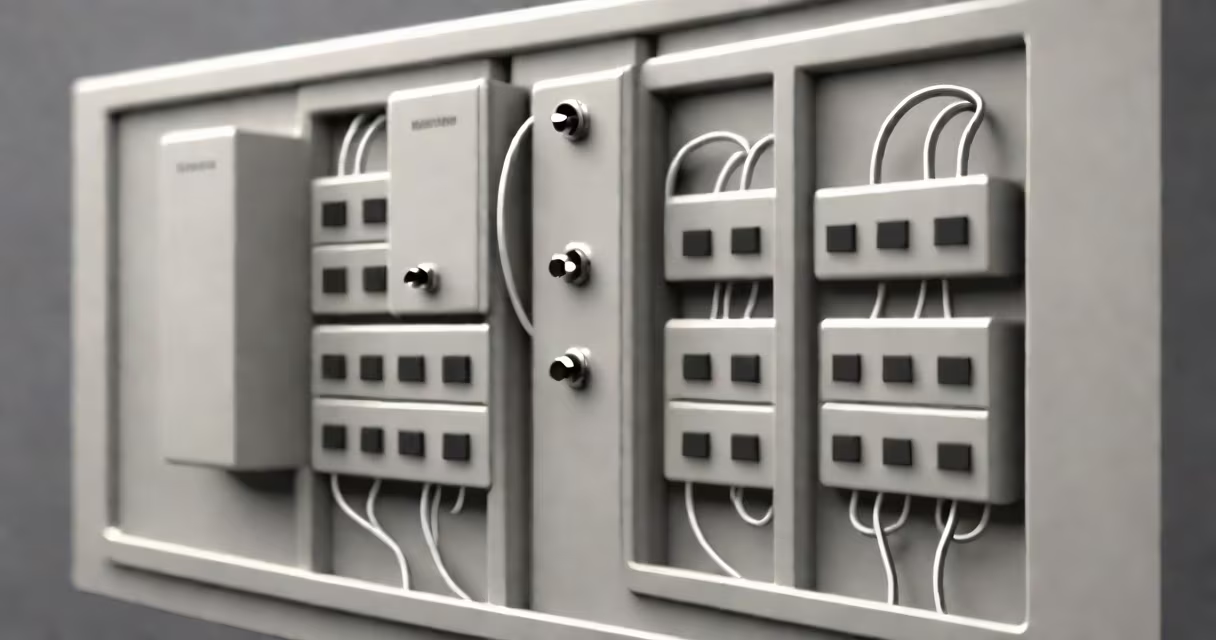
Branch circuit wiring is the electrical system that delivers power from a building's main panel to individual outlets, switches, and lighting fixtures. It operates at standard household voltages-typically 120V in North America-and includes protective devices like circuit breakers or fuses.
This system forms the final leg of a building's electrical distribution. After power enters through the service entrance and passes through the main disconnect, it splits into branch circuits. Each circuit serves a specific zone-kitchen, bathroom, living room-limiting load and preventing overloads.
The National Electrical Code (NEC) defines branch circuit wiring standards. Article 210 governs how circuits are sized, protected, and routed. A single circuit can serve multiple outlets or lights, but only within the capacity specified by the wire gauge and breaker rating.
Power flows from the main electrical panel through a circuit breaker rated for a specific amperage-commonly 15A or 20A. The breaker protects the circuit from overheating due to excessive current. Once the breaker trips, it cuts off power to prevent damage or fire.
From the breaker, hot wires (usually black or red) carry current to outlets and switches. Neutral wires (white) return current to the panel. Ground wires (bare copper or green) provide a safe path for fault current, reducing shock risk.
For example, a 15A circuit using 14/2 NM cable (14-gauge wire with ground) can safely handle up to 1,800 watts of continuous load. This limits the number of devices plugged into outlets on that circuit. Overloading causes heat buildup, which the NEC requires to be mitigated by proper overcurrent protection.
Branch circuits fall into categories based on function and load. Common types include general-purpose, dedicated, and special-use circuits.
| Type | Typical Load | Wire Gauge | Breaker Size | Use Case |
|---|---|---|---|---|
| General-Purpose | Lighting, small appliances | 14 AWG | 15A | Kitchen counters, living rooms |
| Dedicated | Large appliances | 12 AWG | 20A | Refrigerator, microwave |
| Special-Use | High-demand equipment | 10 AWG | 30A | Electric water heater, HVAC |
Each circuit must match the wire size to the breaker rating. Using 14 AWG wire with a 20A breaker violates NEC Article 240.4(D), creating a fire hazard. The wire cannot safely carry the current, leading to insulation melting and potential arc faults.
Grounding is non-negotiable. All branch circuits must include a grounding conductor. Even if a device doesn't use it-like a lamp with a two-prong plug-the ground wire remains in the cable to protect against electrical faults.
Many assume that adding extension cords or power strips extends a circuit's capacity. This is false. A 15A circuit cannot support more than 1,800 watts continuously. Plugging in a space heater (1,500W) and a hair dryer (1,200W) exceeds that limit, tripping the breaker or causing overheating.
Another error is daisy-chaining GFCI outlets. While GFCIs protect against ground faults, connecting multiple GFCIs in series can cause nuisance tripping. The NEC allows only one GFCI per circuit unless the downstream units are wired correctly with a "load" terminal.
A non-obvious rule: branch circuits must not run through attics or crawl spaces without proper conduit if exposed to physical damage. In unfinished areas, NM cable (Romex) must be secured every 4.5 feet and protected from punctures. Failure to do so risks short circuits from nails or sharp objects.
Consider a kitchen with six outlets along a counter. The NEC requires at least two 20A branch circuits for countertop receptacles under Article 210.52(C)(1). A single 15A circuit would overload under normal use.
Install two 20A circuits using 12/2 NM cable. Each circuit feeds three outlets. Breakers are double-pole 20A in the panel. Outlets are GFCI-protected, as required by Article 210.8(A)(6) for kitchens.
When a toaster draws 1,200W and a blender draws 800W, the total load is 2,000W. At 120V, this equals 16.7 amps-within the 20A limit. The circuit remains stable. If a third appliance is added, the breaker trips, preventing overheating.
I once observed a homeowner replacing a broken outlet with a piggyback adapter. The device drew 1,600W, exceeding the 15A circuit's capacity. The outlet smoked, and the breaker tripped. Replacing the adapter with a dedicated 20A circuit resolved the issue.
Improper branch circuit wiring causes 13% of home electrical fires, according to the U.S. Fire Administration. Faulty wiring accounts for over 50,000 structure fires annually. Correct design reduces risk by ensuring current stays within safe limits.
Electrical inspectors verify branch circuits meet NEC requirements during inspections. They test continuity, polarity, and ground integrity. A failed inspection delays occupancy permits. Even minor errors-like reversed hot and neutral wires-can create shock hazards.
For maintenance, always turn off the breaker before working. Use a multimeter to confirm no voltage is present. Never bypass a GFCI or install a larger breaker than the wire can handle.
Understanding branch circuit wiring ensures safety, compliance, and reliability. It's not just about powering devices-it's about protecting people and property.