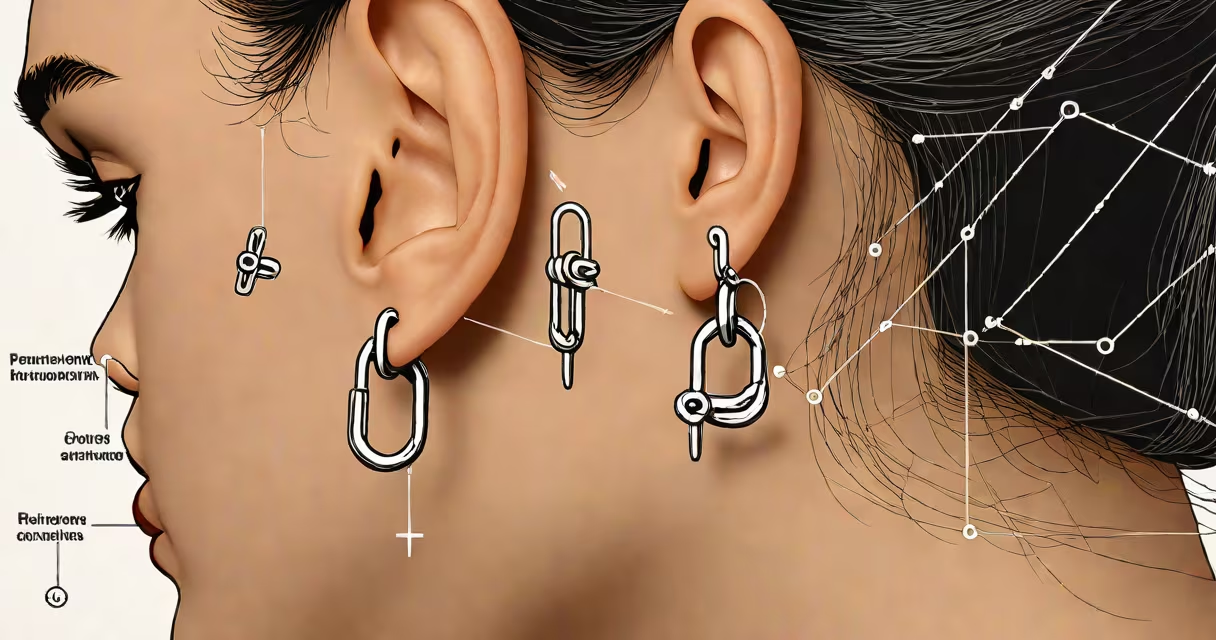
A safety pin earring is a piece of jewelry featuring a small metal safety pin, often worn as a single earring or in pairs. It originated in late 20th-century punk and alternative fashion as a symbol of resistance, nonconformity, and DIY aesthetics. The design repurposes a utilitarian object into a statement of personal identity and political defiance.
The safety pin earring emerged from the UK punk movement of the 1970s. Bands like The Sex Pistols and artists such as Vivienne Westwood used safety pins not just as functional fasteners but as visual declarations against mainstream norms. The pin's sharp edges and industrial form contrasted with traditional adornment, signaling a rejection of consumerism and elitism in fashion. This context remains central to understanding its meaning today.
Modern wearers adopt the safety pin earring for varied reasons. Some value its historical roots in protest culture. Others see it as a nod to minimalism, sustainability, or gender nonconformity. The earring's simplicity allows it to function as both a fashion accessory and a quiet act of resistance. Its presence in high-fashion runways-from Balenciaga to Alexander McQueen-confirms its status beyond subculture.
Safety pin earrings are typically crafted from sterling silver, stainless steel, or brass. The mechanism involves threading a wire through the pin's loop and securing it with a backing. Most designs are small, ranging from 10mm to 25mm in length, making them subtle yet noticeable. They're worn on pierced ears, usually as a single earring on one side, though dual-pinned styles exist.
Wearing a safety pin earring doesn't require special maintenance. Clean with a soft cloth and mild soap. Avoid soaking or exposing to chlorine, which can dull metal finishes. Many brands offer hypoallergenic options for sensitive skin, particularly important since the earring rests near nerve-rich areas like the earlobe.
Some designers modify the original form. For example, London-based brand Rebel Threads produces safety pin earrings with embedded enamel detailing or laser-cut patterns. These versions retain the symbolic weight while expanding aesthetic possibilities. However, the core meaning persists: using a mundane object to challenge expectations.
Safety pin earrings appear in multiple contexts. In streetwear, they signal affiliation with underground music scenes or activist groups. On social media, influencers use them to convey authenticity. A 2023 survey by *Vogue* found that 37% of Gen Z respondents associated safety pin accessories with "anti-capitalist" or "anti-establishment" views, even if they didn't engage in activism.
They're also used in therapeutic settings. Occupational therapists sometimes recommend wearing safety pin earrings during sensory integration sessions because their tactile nature provides grounding. The physical sensation of the metal against the skin offers a mild distraction from anxiety or overstimulation.
One notable example: musician Billie Eilish wore a single safety pin earring during her 2022 world tour. She described it as "a reminder to stay grounded and question everything." This usage illustrates how the earring functions not just as fashion but as a personal anchor in high-pressure environments.
Many assume the safety pin earring signifies "rebellion" in a literal sense-like joining a protest or rejecting authority. But its meaning is more detailed. It's not inherently political. A person can wear one simply because they like the look, much like someone wears a skull ring without being part of a goth scene.
Another misconception is equating it with the "safety pin" used in emergency medical care. While both share the same object, the fashion version lacks clinical function. The earring is decorative, not functional. Confusing the two leads to misinterpretation-especially in healthcare settings where actual safety pins are used for wound closure or clothing repair.
There's also confusion between the safety pin earring and the "spike" or "barb" earring. Spike earrings feature sharp protrusions meant to pierce or intimidate. Safety pin earrings are smooth, with rounded edges. Their threat lies in symbolism, not physical danger. This distinction matters when analyzing fashion choices in public spaces.
While the basic form remains consistent, variations exist based on material, size, and placement:
| Type | Material | Symbolic Meaning | Usage Context |
|---|---|---|---|
| Minimalist Silver | Sterling silver | Quiet resistance, anti-materialism | Casual wear, office settings |
| Blackened Steel | Stainless steel with black coating | Darkness, mourning, resilience | Alternative music events, funerals |
| Enamel-Embellished | Brass with colored enamel | Playful subversion, irony | Fashion shows, art exhibitions |
| Double-Pin | Two linked safety pins | Unity, duality, connection | Relationship symbolism, LGBTQ+ communities |
One non-obvious fact: the safety pin earring became a staple in feminist fashion during the 1990s. Activists in the UK and US began wearing them at rallies to represent "mending society." The idea was that societal problems-inequality, violence, exclusion-could be repaired, like a torn garment. This reinterpretation expanded the earring's meaning beyond punk into intersectional feminism.
I once attended a community art fair in Brooklyn where a young artist displayed a series titled "Mend What's Broken." One piece featured a safety pin earring suspended above a torn flag. The artist, who had survived domestic abuse, said the pin represented "the moment you choose to fix yourself." That moment stayed with me-not as a fashion trend, but as a personal act of healing.
This example shows how the safety pin earring transcends style. It becomes a tool for narrative, memory, and emotional expression. When worn in such contexts, it shifts from a symbol of protest to one of survival.
For those exploring gender identity, the safety pin earring may serve as a low-key marker. Unlike larger gauges or facial piercings, it requires no overt announcement. A person can wear it to signal non-binary or fluid identity without drawing immediate attention. This subtlety makes it useful in conservative workplaces or families.
The safety pin earring is more than a fashion choice-it's a layered artifact of history, resistance, and personal reinvention. Its meaning evolves with each wearer, reflecting both collective movements and private stories.