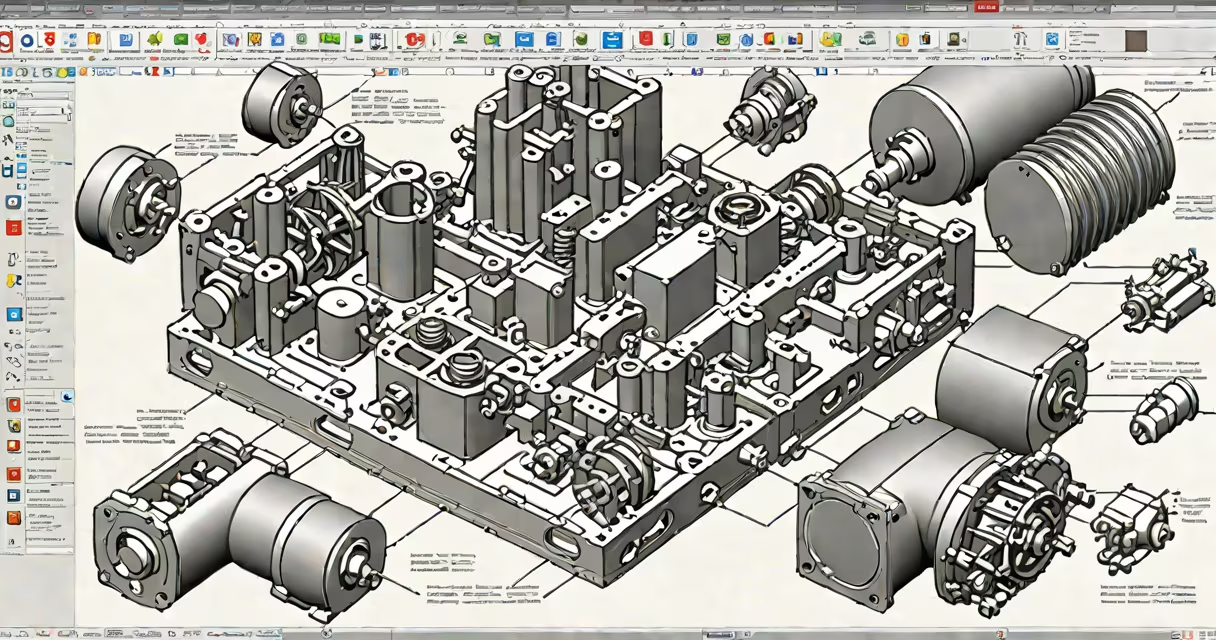
A mechanical design engineer develops physical products by applying physics, materials science, and manufacturing principles to create safe, efficient, and cost-effective designs. They translate concepts into detailed technical plans using CAD software and validate performance through simulation and prototyping.
These professionals work across industries including automotive, aerospace, medical devices, consumer electronics, and industrial machinery. Their role spans concept ideation, detailed design, testing, and collaboration with manufacturing teams to ensure a product can be built at scale.
According to the U.S. Bureau of Labor Statistics, mechanical engineers held about 262,000 jobs in 2022, with median annual pay of $95,300. The field requires a bachelor's degree in mechanical engineering or a related discipline, along with proficiency in design tools such as SolidWorks, AutoCAD, or CATIA.
Design begins with identifying a problem or need-such as reducing friction in a gear system or improving heat dissipation in a power supply. The engineer then defines functional requirements, constraints (like weight, material cost, or environmental exposure), and performance targets.
Using 3D modeling software, they build digital prototypes. These models include precise dimensions, tolerances, surface finishes, and material specifications. A single component may require dozens of views and annotations to guide fabrication.
Once modeled, engineers run simulations to test behavior under load, temperature changes, vibration, or fatigue. For example, a car suspension arm is analyzed for stress distribution under 10,000 cycles of road impact. Results inform iterative refinements before physical prototyping.
Computer-aided design (CAD) is central to the workflow. SolidWorks, widely adopted in industry, allows engineers to create parametric models-where changing one dimension automatically updates linked features. This reduces errors during redesigns.
Finite element analysis (FEA) software integrates with CAD to simulate how parts deform under pressure. Computational fluid dynamics (CFD) predicts airflow around components, critical for cooling systems in electric vehicles.
Manufacturing considerations are embedded early. Design for Manufacturing (DFM) ensures parts can be machined, injection molded, or assembled efficiently. A bolt hole placed too close to an edge may crack during drilling-this is flagged during DFM checks.
| Tool/Method | Purpose | Example Application |
|---|---|---|
| SolidWorks | 3D modeling and assembly design | Designing a robotic gripper with moving joints and precise tolerances |
| FEA Simulation | Stress and deformation analysis | Testing a bicycle frame under rider weight and terrain shock |
| DFM Guidelines | Ensuring manufacturability | Adjusting wall thickness in a plastic housing to prevent warping during molding |
Many assume mechanical design engineers spend most of their time drawing parts. In reality, only 20-30% of their time involves direct modeling. The rest goes into problem-solving, reviewing standards, coordinating with cross-functional teams, and validating results.
Another misconception is that design is purely creative. While innovation matters, every decision must comply with safety codes (e.g., ASME Y14.5 for geometric tolerancing), industry regulations (ISO 13485 for medical devices), and cost targets.
For example, a designer might propose a titanium bracket for a drone motor mount due to strength-to-weight ratio. But after evaluating lifecycle costs and production volume, they switch to aluminum with a structural optimization algorithm-reducing material cost by 40% while maintaining performance.
Consider a team designing a handheld water filter for outdoor use. The goal: remove bacteria, sediment, and heavy metals while weighing less than 1.2 pounds and lasting 10,000 uses.
The lead mechanical design engineer starts by defining requirements: maximum flow rate of 1 liter per minute, resistance to drops from 6 feet, and compatibility with standard 1-liter bottles. They use SolidWorks to model a modular cartridge with replaceable filters and a spring-loaded seal.
FEA shows high stress near the cap threads under repeated tightening. The engineer revises the thread geometry and adds a chamfer. They then run CFD to verify water flows evenly through the filter media, avoiding dead zones.
After prototyping, field tests reveal condensation buildup inside the housing. The team adds a small vent with a hydrophobic membrane-preventing moisture ingress while allowing air exchange. This change was not in the original design but emerged from real-world feedback.
This cycle-design, simulate, prototype, test, refine-is typical. The final product passes durability, leak, and filtration efficiency tests before entering production.
Mechanical design engineers often collaborate closely with electrical engineers, especially in mechatronic systems. A coffee machine's heating element, pump, and control board all interface mechanically. The mechanical engineer ensures the housing fits the PCB, the motor shaft aligns with the gear train, and thermal expansion doesn't crack solder joints.
They also coordinate with manufacturing engineers. A part designed with thin walls may warp during injection molding. The mechanical designer adjusts draft angles and adds ribs for rigidity-changes that affect both function and cost.
There's a common confusion between mechanical design engineers and general mechanical engineers. The former focus on creating specific products. The latter may work in maintenance, energy systems, or HVAC. A mechanical design engineer specializes in product creation, not system operations.
I once reviewed a student project where a team designed a solar-powered ventilator for rural clinics. Their initial model had a fan blade shaped like a helicopter rotor-high efficiency but impossible to mold. After consulting a manufacturing specialist, they redesigned it with curved, castable fins. The revised version reduced tooling costs by 60% and passed field trials in Uganda.
Join engineering clubs, enter design competitions like the ASME Student Design Contest, or contribute to open-source hardware platforms such as Open Source Ecology. These experiences demonstrate initiative and technical ability to employers.
Understanding what a mechanical design engineer does is essential for anyone aiming to enter product development. Their work bridges imagination and reality, turning ideas into functional objects that people rely on daily.
Whether designing a prosthetic limb, a wind turbine gearbox, or a smartphone hinge, the core mission remains: solve problems through intelligent, practical engineering.