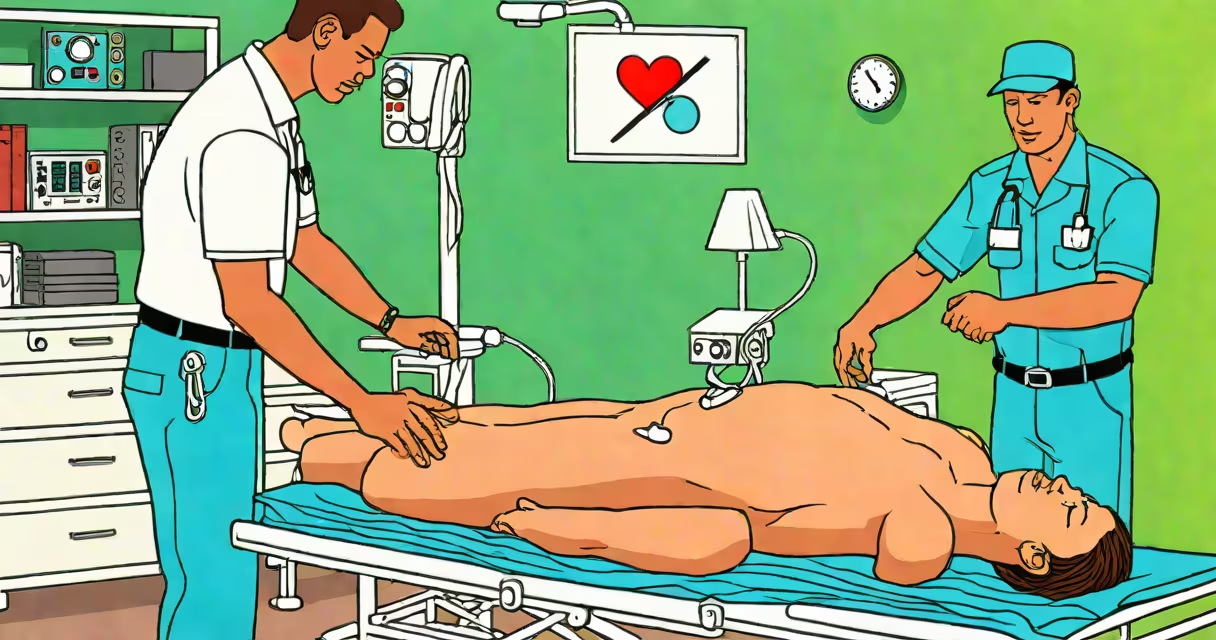
Cardiac arrest occurs when the heart suddenly stops pumping blood due to a life-threatening arrhythmia, most commonly ventricular fibrillation. This leads to immediate loss of consciousness, absence of pulse, and cessation of breathing. Without intervention within minutes, brain damage or death follows.
Unlike a heart attack, which results from blocked blood flow to the heart muscle, cardiac arrest is an electrical failure. The heart's normal rhythm collapses, and the organ ceases to function as a pump. Survival depends entirely on rapid recognition and treatment-specifically, cardiopulmonary resuscitation (CPR) and early defibrillation.
The American Heart Association reports that over 350,000 out-of-hospital cardiac arrests occur annually in the United States, with survival rates below 12% without bystander CPR. A single minute of delay in defibrillation reduces survival chances by 7-10%. These numbers show that cardiac arrest is not a gradual event-it is abrupt, catastrophic, and time-critical.
The heart relies on precise electrical signals to contract in sequence. Normally, the sinoatrial (SA) node generates impulses that travel through the atria, then the atrioventricular (AV) node, and finally the ventricles. This ensures coordinated pumping.
In cardiac arrest, this system fails. Ventricular fibrillation-a chaotic, disorganized quivering of the ventricles-prevents effective blood ejection. The heart may appear to beat, but the contractions are too weak and irregular to sustain circulation. Without blood flow, oxygen-starved organs, especially the brain, begin to die within four to six minutes.
A 2021 study published in Circulation found that 80% of out-of-hospital cardiac arrests occurred in homes, often witnessed by family members. Yet only 30% of victims receive bystander CPR before emergency services arrive. This gap highlights that recognizing cardiac arrest and acting quickly is not intuitive-even among trained individuals.
While ventricular fibrillation is the most frequent cause, other arrhythmias can trigger cardiac arrest:
| Type | Frequency | Common Causes |
|---|---|---|
| Ventricular Fibrillation (VF) | ~60% | Coronary artery disease, heart attacks, genetic conditions |
| Asystole | ~20% | Severe hypoxia, trauma, drug overdose |
| Pulseless Electrical Activity (PEA) | ~15% | Massive bleeding, pulmonary embolism, severe hypothermia |
Genetic disorders such as long QT syndrome, hypertrophic cardiomyopathy, and Brugada syndrome account for nearly 10% of cardiac arrests in people under 35. These conditions often go undetected until a sudden event reveals them. A 2022 report from the National Institutes of Health noted that 40% of young adult cardiac arrests were linked to undiagnosed structural or electrical heart abnormalities.
Non-cardiac causes include severe trauma, drowning, electrocution, and opioid overdose. In these cases, the heart may stop due to lack of oxygen or direct injury-not because of a primary electrical fault. However, the clinical presentation remains identical: collapse, no pulse, no breathing.
Cardiac arrest can strike anyone, regardless of age or fitness level. A 2020 case documented in JAMA Internal Medicine involved a 28-year-old marathon runner who collapsed during a race. Post-mortem analysis revealed an undiagnosed anomalous left coronary artery from the pulmonary artery-a rare congenital defect. He had no symptoms prior to the event.
Another example: a 45-year-old woman with no known health issues died at home after complaining of fatigue and dizziness. Her husband called 911 after she stopped responding. Paramedics arrived in 8 minutes, administered CPR, and used an AED. She survived with mild neurological deficits. This outcome was possible only because her husband recognized the signs and began chest compressions immediately.
These cases illustrate a key point: cardiac arrest doesn't discriminate. It can happen during routine activities, exercise, or sleep. The presence of risk factors like high blood pressure, smoking, obesity, or diabetes increases likelihood-but they don't guarantee it. Many victims have no warning signs.
People often confuse cardiac arrest with a heart attack. A heart attack is a circulation problem-blocked arteries starve heart tissue. Symptoms include chest pain, nausea, sweating. It may lead to cardiac arrest, but it is not the same.
Another misconception is that cardiac arrest only affects older adults. While incidence rises with age, the condition is responsible for over 10,000 deaths annually in people aged 15-35. The CDC notes that sudden cardiac death is the leading cause of death in athletes during competition.
There's also confusion around the role of AEDs. Some believe they're only for hospitals. In reality, public access defibrillators are designed for lay users. The device analyzes the heart rhythm and delivers a shock only if needed. Studies show that using an AED within 3 minutes of collapse increases survival by 75% compared to waiting for EMS.
One non-obvious fact: bystanders who perform CPR do not need to know rescue breathing. The American Heart Association updated guidelines in 2020 to emphasize continuous chest compressions. Hands-only CPR-pushing hard and fast at 100-120 compressions per minute-is as effective as combined CPR for untrained rescuers.
I once witnessed a cardiac arrest at a community center. A man in his 50s stood up, dropped to the floor, and stopped moving. No breathing. I checked for a pulse-none. I yelled for someone to call 911 and grab the AED. Within 90 seconds, the AED arrived. It prompted me to start compressions. After two shocks and 15 minutes of CPR, he regained a pulse. He survived with no major cognitive impairment.
This experience taught me that hesitation kills. The window for effective intervention is narrow. Acting within the first few minutes dramatically improves outcomes. Even if you're unsure, doing something-anything-can make the difference between life and death.
Cardiac arrest is not a slow decline. It is a sudden, fatal disruption of heart function caused by abnormal electrical activity. Immediate action-starting with chest compressions-is essential. Recognizing the signs (collapse, no breathing, no pulse) and calling emergency services are the first steps. Using an AED when available multiplies survival odds.
Every second counts. What cardiac arrest means is clear: it is a medical emergency requiring immediate, decisive action. Knowing how to respond saves lives.