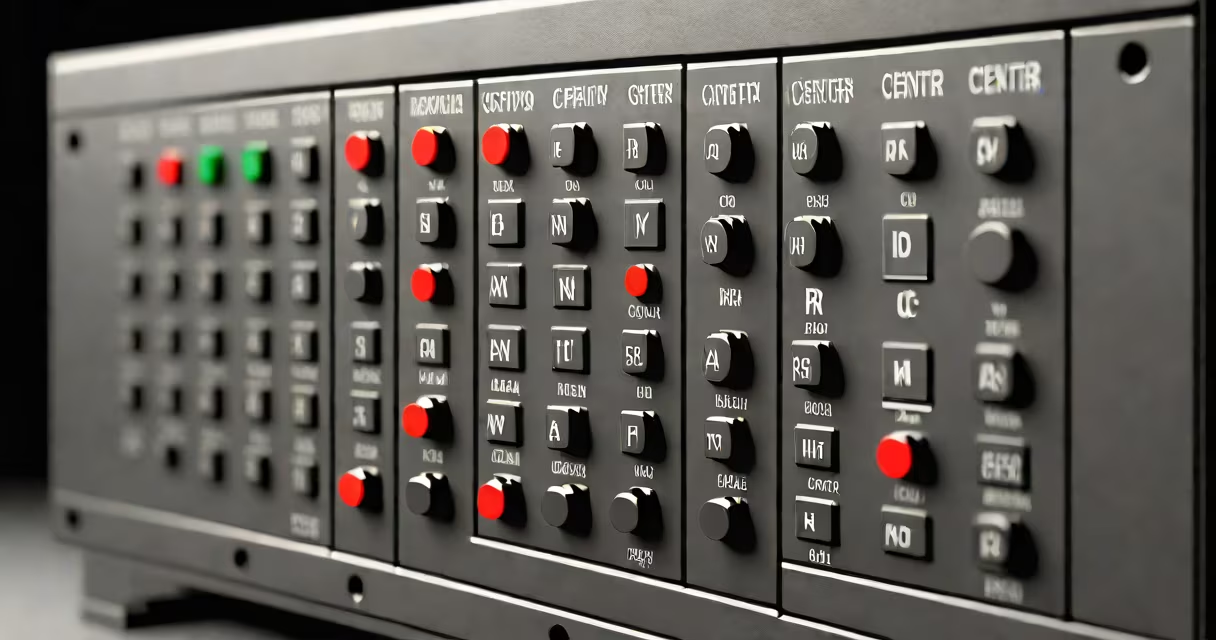
Motor control centers (MCCs) are industrial electrical enclosures that house multiple motor starters, overload protection devices, and control circuits, enabling centralized monitoring and control of electric motors in manufacturing, processing, and utility facilities.
MCCs serve as the nerve center for motor-driven equipment in factories, water treatment plants, and HVAC systems. They consolidate power distribution, overload protection, and remote control into a single, modular unit. Each section within an MCC contains a motor starter-a combination of a contactor and overload relay-that safely turns motors on and off based on signals from pushbuttons, sensors, or PLCs.
The National Electrical Code (NEC) Article 409 governs the design and installation of MCCs. According to the NEC, MCCs must be designed for continuous duty, include proper arc flash protection, and allow for safe maintenance access. The International Electrotechnical Commission (IEC) standard 61439-1 provides additional global guidelines for low-voltage switchgear and controlgear assemblies, including MCCs.
An MCC receives high-voltage power from a main distribution panel and distributes it through busbars to individual motor feeder units. Each feeder unit includes a main disconnect switch, a motor starter, and overload protection. When a start command is issued-via a local pushbutton, a remote signal, or a programmable logic controller (PLC)-the contactor closes, allowing current to flow to the motor.
Overload protection continuously monitors current draw. If the motor draws excessive current for longer than a set time, the overload relay trips, de-energizing the contactor and stopping the motor. This prevents damage from overheating due to mechanical binding or phase imbalance. The system resets automatically after cooling or manually via a reset button.
Modern MCCs integrate with building management systems (BMS) and supervisory control and data acquisition (SCADA) networks. For example, a conveyor belt in a bottling plant may be monitored through an MCC that sends alarms to a central dashboard when a motor stalls or overheats. This integration reduces downtime and improves operational efficiency.
MCCs consist of several standardized components arranged in vertical sections. The core elements include:
There are three primary types of MCCs based on construction and application:
| Type | Design | Typical Use | Example Application |
|---|---|---|---|
| Standard MCC | Modular, bolted-together sections | General industrial use | Conveyor systems in food processing |
| Integral MCC | Pre-assembled, factory-wired units | High-reliability environments | Water pumping stations in municipal infrastructure |
| Remote MCC | Mounted away from the motor, connected via cables | Harsh or hazardous locations | Oil refinery pump controls in explosion-proof zones |
A common misconception is that MCCs are interchangeable with distribution boards. While both distribute power, MCCs are specifically engineered for motor control, with features like motor-specific overload settings and coordinated trip curves. A distribution board handles lighting and general outlets, not motor starting.
Many assume MCCs are only used in large factories. In reality, they appear in small-scale operations too. A 2022 study by the U.S. Department of Energy found that 68% of medium-sized manufacturing facilities with more than five motors use MCCs, even when production volumes are under 10,000 units/month.
Another misunderstanding is that MCCs require constant manual oversight. Modern MCCs use digital monitoring modules that log start-stop cycles, fault events, and temperature readings. These logs can be accessed remotely via SCADA software. For example, a textile mill in North Carolina reduced unplanned downtime by 37% after installing an MCC with predictive maintenance alerts.
I once observed a maintenance team at a paper mill troubleshoot a stalled roller motor using an MCC's built-in diagnostic interface. The system displayed a "phase imbalance" error. After checking the wiring, they found a loose connection in the motor's junction box. The MCC had prevented a burnout by tripping before thermal damage occurred-proof that its protective role extends beyond basic switching.
MCCs are essential in any facility where multiple motors operate simultaneously. They improve safety by isolating faults, reduce wiring complexity, and simplify troubleshooting. Without an MCC, each motor would require a separate control panel, increasing space, cost, and failure points.
They are especially critical in environments with high electrical demand. A single MCC can manage 20 or more motors, each with different voltage, current, and protection requirements. Engineers configure each section with the correct overload setting, contactor size, and auxiliary contacts for status feedback.
For example, a wastewater treatment plant in Atlanta uses a 30-section MCC to control lift pumps, aerators, and sludge compressors. Each section is labeled with a unique ID and assigned to a specific process stage. During a storm event, the control system automatically ramps up pump motors via the MCC based on sensor inputs, preventing overflow.
When selecting an MCC, consider the environment. NEMA 4X enclosures resist corrosion and are suitable for coastal areas. Explosion-proof (Class I, Division 2) models are required in chemical plants. Always verify compliance with NEC Article 409 and IEC 61439-1.