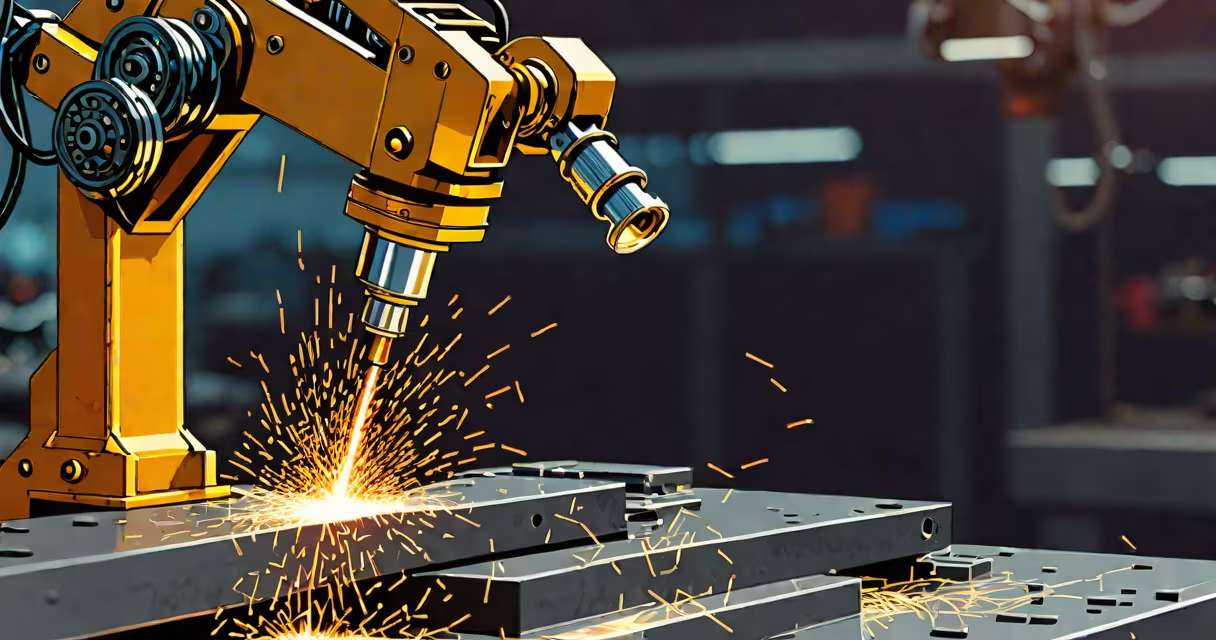
welding engineering technology is the systematic application of materials science, mechanical design principles, and quality assurance protocols to create structurally sound welded joints in industrial and construction environments. It helps welded components meet performance, safety, and durability requirements under load, temperature, and environmental stress.
This field integrates material behavior, joint geometry, process selection, and inspection methods into a cohesive structure. Engineers apply these principles to design and validate welds in structures ranging from offshore oil platforms to automotive chassis. The goal is not just to join metal, but to ensure the joint performs as well as or better than the base material.
For example, a pipeline carrying high-pressure gas must withstand cyclic thermal expansion and internal pressure. A failure at a weld joint could lead to catastrophic rupture. Welding engineering technology determines the optimal weld configuration-such as a double-V butt weld with root pass-based on material thickness, joint accessibility, and service conditions. This decision is guided by standards like ASME BPVC Section IX and AWS D1.1.
Welding engineering technology begins with selecting the correct welding process-such as shielded metal arc welding (SMAW), gas metal arc welding (GMAW), or laser beam welding-based on material type, thickness, and production volume. For instance, GMAW is preferred in automated automotive assembly due to its speed and consistency, while SMAW remains common in field repairs where portability matters.
Once the process is chosen, engineers define the joint design using geometric parameters such as root gap, included angle, and weld reinforcement. These values are derived from fatigue life calculations and fracture mechanics models. The American Welding Society's (AWS) Structural Welding Code provides detailed tables for allowable weld sizes based on load type and member thickness.
After fabrication, non-destructive testing (NDT) validates integrity. Methods include ultrasonic testing (UT) to detect internal flaws, radiographic testing (RT) for volumetric defects, and dye penetrant inspection (DPI) for surface cracks. A weld that passes UT with no indications of porosity or lack of fusion is deemed acceptable per ASME Section V.
The discipline rests on four pillars: materials compatibility, process control, design compliance, and inspection verification. Each contributes to predictable performance under operational loads.
| Type | Best For | Typical Applications | Key Standard |
|---|---|---|---|
| SMAW (Stick Welding) | Field repair, outdoor work | Pipeline joints, ship hulls | AWS D1.1 |
| GMAW (MIG) | High-volume production | Automotive frames, HVAC ducts | ASME B31.3 |
| GTAW (TIG) | High-purity or thin-section welds | Aerospace components, medical devices | ASTM A516 |
| Laser Beam Welding | High-precision, automated systems | Electric vehicle battery packs, turbine blades | ISO 15614 |
One non-obvious requirement is preheat and interpass temperature control. For carbon steel above 1 inch thick, failing to preheat to 250°F before welding increases the risk of hydrogen-induced cracking during cooling. This detail is often overlooked in early training but is mandatory in API 1104 for pipeline construction.
Industries rely on welding engineering technology to prevent failures that cause downtime, injury, or environmental damage. In offshore oil rigs, welds must endure saltwater corrosion, wave loading, and extreme temperatures. A single flawed weld in a riser pipe can lead to a release of hydrocarbons, triggering explosions or ecological harm.
Pressure vessels in chemical plants require welds that maintain integrity over decades. The ASME Boiler and Pressure Vessel Code mandates that each weld procedure specification (WPS) be qualified through a procedure qualification record (PQR). This involves testing actual weld samples under simulated service conditions to verify strength and ductility.
In aerospace, titanium alloys used in jet engine casings demand precise heat input control. Excessive energy causes grain coarsening and reduced fatigue resistance. Engineers use finite element analysis (FEA) to model thermal gradients during welding and adjust travel speed accordingly.
Many assume welding engineering technology is interchangeable with basic welding certification. That's incorrect. A certified welder can produce visually sound beads but may not understand residual stress distribution or crack propagation mechanisms. Only a trained engineer applies the science behind joint design and failure prediction.
Another misconception is that automation eliminates human oversight. Robotic welders follow programmed paths, but they still require setup validation. During a 2018 incident at a wind turbine factory, a robot produced 300 defective tower welds because the operator failed to verify fixture alignment. The error was caught only after ultrasonic testing revealed subsurface voids. This event underscored that technology enhances precision but doesn't replace engineering judgment.
I once observed a team installing a bridge support structure where field welders used a low-hydrogen electrode without proper drying. The resulting welds showed microfissures upon fractography analysis. The fix required removing and re-welding over 20 joints. The root cause was not poor technique-it was a breakdown in material handling procedures, which falls squarely within welding engineering technology.
Welding engineering technology is not a standalone skill. It requires collaboration between materials scientists, mechanical designers, and safety auditors. Its value lies in preventing failure-not just detecting it after the fact. Every weld in a nuclear containment vessel, every joint in a spacecraft, and every connection in a high-speed rail system is governed by this discipline.