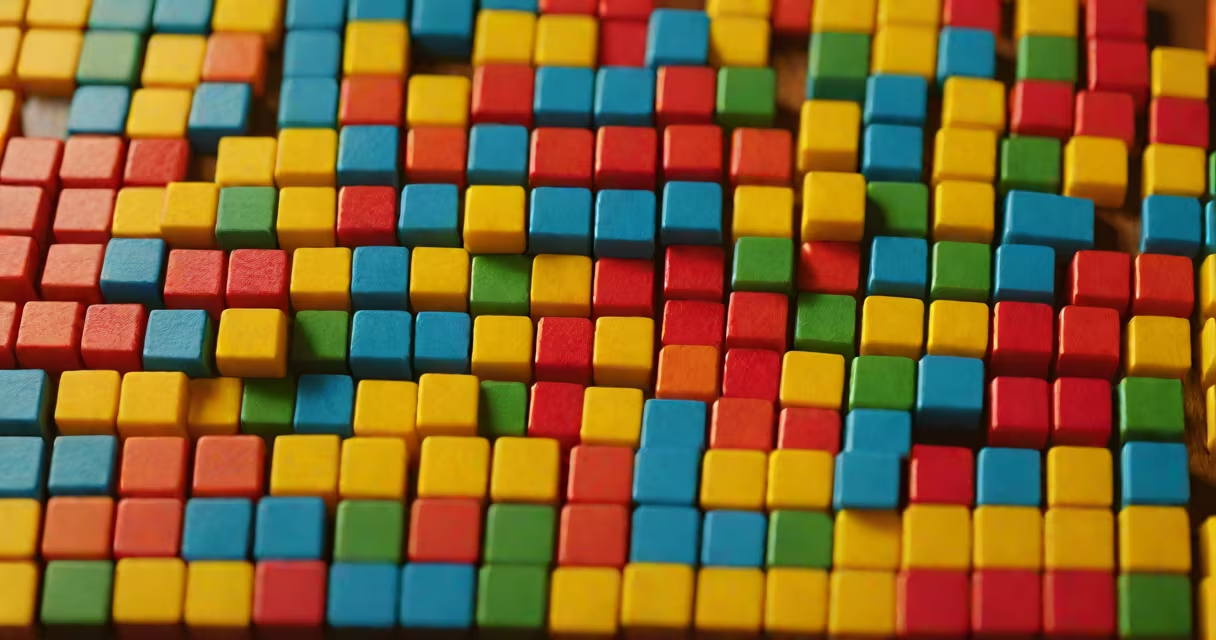
Teaching patterns to preschoolers involves using visual sequences-like red-blue-red-blue-to develop early logic, prediction, and problem-solving skills. Children learn to recognize, extend, and create repeating sequences through play and routine-based activities.
Pattern recognition is a core cognitive skill linked to later success in math and reading. By age 3, most children can identify simple AB patterns (e.g., circle-square-circle-square). By age 4, they begin to understand more complex sequences like AAB or ABC. These aren't just games-they're neural training wheels for mathematical thinking.
Research from the National Council of Teachers of Mathematics (NCTM) confirms that early exposure to patterns strengthens working memory and attention control. Children who engage with patterns regularly show improved performance in number sense tasks by kindergarten. The brain treats pattern identification as a form of mental modeling-predicting what comes next based on prior structure.
When a child sees a red block followed by a blue block, then another red block, their brain compares the current element to previous ones. This comparison triggers a prediction: "The next one should be blue." That act of anticipation is the foundation of logical reasoning.
Neuroscience shows that pattern processing activates the prefrontal cortex-the area responsible for planning and decision-making. Even toddlers as young as 2 years old show measurable brain activity in this region when shown repeating sequences, according to a 2021 study published in *Child Development*.
Patterns don't have to be visual. Auditory patterns-clapping rhythms, spoken rhymes-also build the same skills. Saying "ta-ta-tum" three times in a row teaches rhythm and sequencing, which supports phonological awareness and reading readiness.
Simple patterns are the best starting point. Here's a breakdown of common types and the materials used to teach them:
| Pattern Type | Example Sequence | Common Materials | Developmental Level |
|---|---|---|---|
| AB | Red, Blue, Red, Blue | Colored blocks, beads, toy animals | Age 3+ |
| AAB | Blue, Blue, Red, Blue, Blue, Red | Buttons, paper shapes, colored tiles | Age 4+ |
| ABC | Circle, Square, Triangle, Circle, Square, Triangle | Shape sorters, foam cutouts, stickers | Age 4-5 |
| Repeating Motion | Jump, clap, jump, clap | Body movements, songs, dance | Age 2.5+ |
Use familiar, tactile items. A child is more likely to engage with a sequence made from their favorite stuffed animal and a spoon than with abstract symbols on paper. Real-world connections deepen learning.
One non-obvious point: children often skip the "middle" of a pattern when extending it. For example, they may place a green block after a red and blue pair, instead of following the correct sequence. This isn't failure-it's exploration. They're testing their hypothesis. Correcting gently by asking, "What came before this?" reinforces the loop.
Preschool classrooms integrate pattern work into daily routines. Morning circle time might include a song with a repeating chorus ("The wheels on the bus go round and round"). Snack time uses color-coded plates to teach AB patterns: red apple, green apple, red apple.
Pattern work also supports social-emotional development. Following a group rhythm during a game builds turn-taking and listening. When a child correctly predicts the next step, they gain confidence. This is especially helpful for children with developmental delays or language differences.
Many adults assume that teaching patterns means showing perfect, rigid sequences. But children learn best through variation and error. A child who places a yellow block in a red-blue sequence isn't wrong-they're experimenting. The goal isn't accuracy, it's engagement.
Another mistake: introducing too many variables at once. A four-color, five-step pattern overwhelms a 3-year-old. Start small. Focus on one attribute-color, size, shape-and repeat it consistently.
One example from my own classroom: I placed a row of red and blue paper clips on a table. A boy picked up the red one, then the blue, then paused. He looked at me, then added a red one. I asked, "What do you think comes next?" He said, "Blue." He didn't know the rule yet, but he was predicting. That moment-before the correct answer-was the learning.
Step-by-step activity using household items:
This activity takes under 10 minutes. It builds attention, vocabulary, and motor skills. The child doesn't "learn math"-they learn to think.
Teaching patterns to preschoolers is not about memorizing sequences. It's about training the mind to notice order, anticipate change, and trust internal logic. These are the building blocks of critical thinking, not just early math.