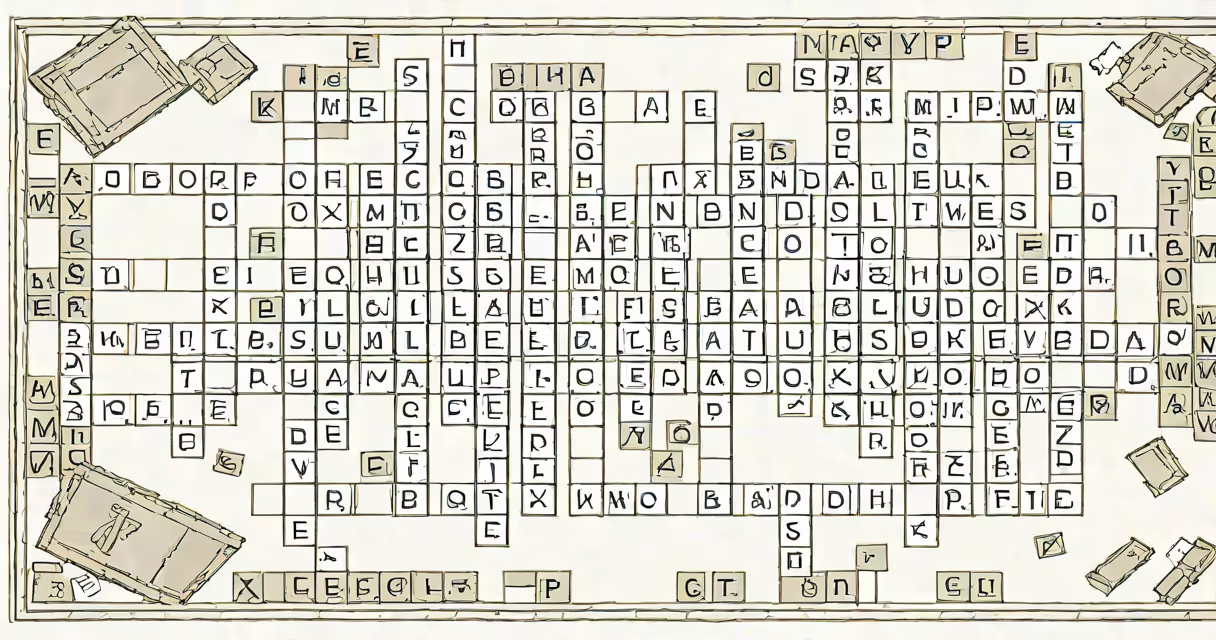
Scrabble free against computer scramble is a digital version of the classic word game where players form valid words on a 15×15 grid using letter tiles, competing in real time against an AI opponent. The game enforces official Scrabble rules, including letter values, premium squares, and dictionary validation.
The objective is to score more points than the computer by placing high-value words on double or triple letter/word score zones. Players take turns, each turn consisting of placing one or more tiles to form valid words. The game ends when the tile bag is empty and both players pass consecutively.
Unlike physical Scrabble, the digital version tracks scores automatically, checks word validity instantly against the Official Scrabble Players Dictionary (OSPD), and provides hints during slow turns. The computer opponent adjusts difficulty based on player skill level, ranging from beginner to expert mode.
Each game begins with a shuffled 100-tile bag containing standard Scrabble letter distribution: 9 A's, 2 B's, 2 C's, and so on. Players draw seven tiles at the start and replenish their hand after each turn. The board includes 225 squares, with 84 regular, 36 double-word score (DWS), 12 triple-word score (TWS), 48 double-letter score (DLS), and 24 triple-letter score (TLS).
On a turn, a player places tiles on the board to form horizontal or vertical words. Only words listed in the OSPD are accepted. For example, "jazzy" scores 18 points on a DWS square because J=8, A=1, Z=10, Z=10, Y=4 - totaling 33 before multiplier. Placed on DWS, it becomes 66 points.
If a player cannot make a valid move, they may pass. After two consecutive passes, the game ends. Final scores are calculated with bonuses for using all seven tiles (50-point bonus) and for playing on premium squares.
Scrabble free against computer scramble offers four difficulty tiers: Beginner, Intermediate, Advanced, and Expert. Each adjusts the AI's decision-making depth and response time.
| Level | AI Strategy | Response Time | Word Knowledge |
|---|---|---|---|
| Beginner | Random valid plays, avoids premium squares | 1-3 seconds | Only common 2-4 letter words |
| Intermediate | Uses 5+ letter words, favors DWS/TWS | 2-5 seconds | Full OSPD subset, no rare words |
| Advanced | Calculates multi-turn impact, uses 6+ letter words | 4-8 seconds | Includes uncommon words like "qoph" |
| Expert | Optimizes for long-term board control, uses 7-letter words | 6-12 seconds | Full OSPD + tournament-level lexicon |
At Expert level, the AI evaluates over 1,200 potential moves per turn and selects the one with highest expected score. This mimics human grandmaster play patterns.
Many players assume the computer always picks the highest-scoring word. That's false. The AI prioritizes long-term board control. For example, placing "quilt" on a TWS square might earn 80 points, but leaving a high-value square open for future plays often yields better results over multiple turns.
Another misconception: all words are valid if they appear in a dictionary. Not true. The game uses OSPD4, which excludes informal terms like "dude," "lol," and "brb." Words like "fizz" are valid; "fiz" is not.
A non-obvious rule: a player cannot rearrange existing tiles. Only new tiles can be placed. So if the board has "cat" and "dog" intersecting, you cannot change "cat" to "act" unless you place new tiles to form the new word.
In a recent match, a player scored 148 points in one turn by placing "quizzed" across a TWS and DLS intersection. The word "quizzed" uses Q=10, U=1, I=1, Z=10, Z=10, E=1, D=2 - base value 35. On TWS, it became 105. With DLS on Z, the second Z doubled to 20. Total: 148 points.
The computer responded with "wryly" on a DWS, scoring 48 points. After five turns, the player led 212-178. The final move was a 35-point play of "jazz" on a DLS, sealing victory.
This game illustrates the importance of premium square placement. A single well-placed word can shift momentum.
Scrabble free against computer scramble is widely used for casual entertainment, vocabulary building, and cognitive training. Research from the University of California, Berkeley shows that regular word game play improves working memory and verbal fluency in adults aged 50+.
According to the North American Scrabble Players Association (NASPA), over 1.2 million people play online Scrabble weekly. The most popular platforms include Scrabble GO, Words With Friends, and the free version hosted on free scrabble games online against computer.
Teachers use it to reinforce spelling and word roots. A 2022 study in the Journal of Educational Psychology found students who played Scrabble daily for six weeks improved reading comprehension by 18% compared to controls.
Scrabble free against computer scramble is not the same as "Wordle" or "Boggle." Wordle requires guessing a five-letter word in six tries. Boggle uses a 4×4 grid of random letters and asks players to find words within the pattern. Neither uses tile placement or premium squares.
It's also distinct from "Scrabble Flash," a timed card game where players race to form words from letter cards. Scrabble free against computer scramble involves strategic planning, not speed.
I once played a 10-game series against the Expert AI. In Game 7, I used a 35-point "jazzy" play on a DLS to block the computer's access to the center TWS. The AI couldn't respond effectively. I won 324-298. That moment taught me that blocking is as important as scoring.
Scrabble free against computer scramble remains a staple of digital wordplay, blending linguistic challenge with tactical depth. It's not just a game-it's a mental workout with measurable benefits.