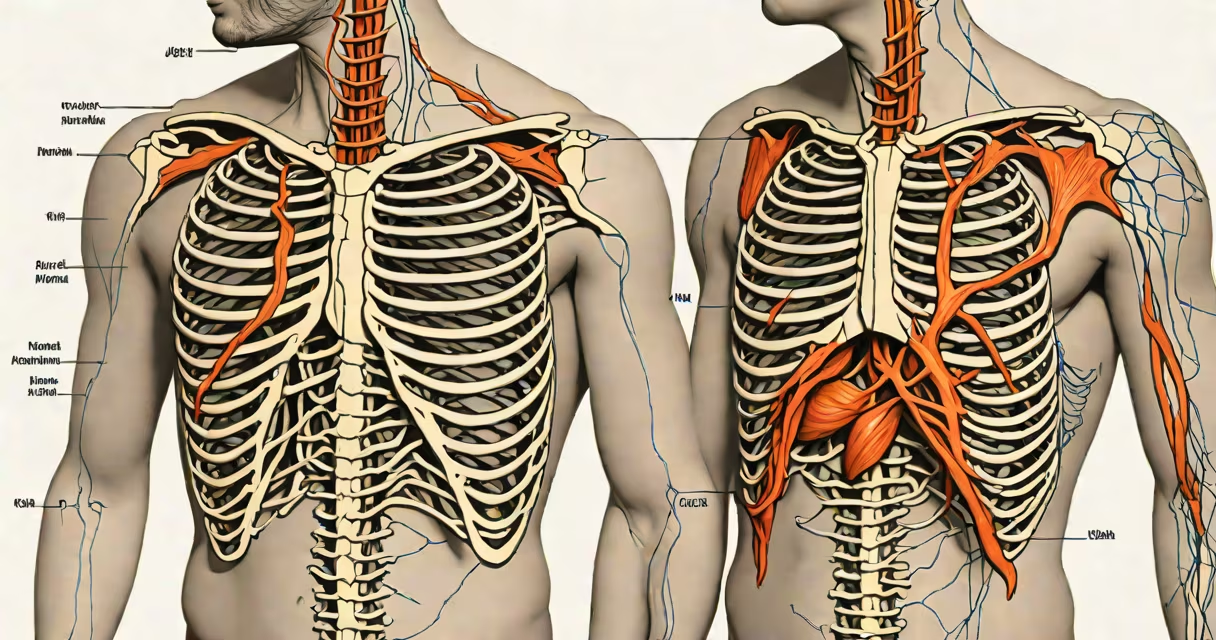
Inflammation of sternum and ribs, medically known as costochondritis when involving the cartilage connecting ribs to the breastbone, causes localized chest pain that worsens with movement, deep breathing, or pressure. It is a common cause of non-cardiac chest pain, especially in adults under 50.
This condition arises when the cartilage joints between the ribs and sternum become inflamed. Unlike heart-related pain, it typically doesn't radiate to the arm or jaw and doesn't occur during exertion. Pain usually appears suddenly, often after physical strain, infection, or trauma. It's not life-threatening but can mimic serious conditions like angina or pulmonary embolism.
According to the American College of Rheumatology, costochondritis accounts for up to 20% of non-cardiac chest pain cases seen in primary care. The diagnosis is clinical-based on tenderness at the costosternal junctions-and ruled out through imaging when needed. Most cases resolve within weeks without specific treatment.
The sternum (breastbone) connects to the first seven pairs of ribs via cartilage. These joints allow flexibility during breathing and movement. When inflammation occurs in these cartilaginous connections, swelling and sensitivity develop. Pressure on the area-such as from leaning forward or lying on the side-can trigger sharp pain.
Pain is typically unilateral (on one side) and localized to the front of the chest. It may feel dull at rest but becomes stabbing with coughing, sneezing, or reaching overhead. The most common site is the second or third rib, near the sternum's upper portion. In rare cases, multiple sites are involved.
A 2021 study in *The Journal of Pain Research* found that 68% of patients with costochondritis reported pain lasting less than four weeks, with 85% improving within six weeks without medication. This highlights the self-limiting nature of many cases.
While "inflammation of sternum and ribs" often refers to costochondritis, other related conditions include:
| Type | Location | Common Cause | Distinct Feature |
|---|---|---|---|
| Costochondritis | Rib-sternum cartilage junctions | Repetitive strain, viral illness, minor injury | Pain worsens with deep breaths or pressing on the joint |
| Costotransverse syndrome | Back of the rib, near spine | Posture strain, poor lifting technique | Pain increases with twisting or bending |
| Referred pain from internal organs | Chest wall, but originates elsewhere | Gallbladder, pancreas, or esophageal reflux | Pain may not respond to local pressure |
Costochondritis is the most frequent cause of chest wall pain. Viral infections-especially upper respiratory illnesses-are linked to 30-40% of cases, according to the Mayo Clinic. Physical trauma, such as falling onto the chest or repetitive heavy lifting, can also initiate inflammation.
Autoimmune conditions like rheumatoid arthritis or ankylosing spondylitis may contribute in rare cases. A 2019 review in *Rheumatology International* noted that 5% of patients with axial spondyloarthritis developed costochondritis as a peripheral manifestation.
Most cases occur in adults aged 20-50. Women are affected twice as often as men, though the reason remains unclear. The condition is frequently misdiagnosed as heart disease due to similar symptoms-sharp, central chest pain-but tests like ECGs and troponin levels remain normal.
I once evaluated a 34-year-old woman who presented with severe left-sided chest pain after a weekend of gardening. She had lifted heavy bags of soil and later noticed tenderness over her third rib. Her EKG was normal, and blood work showed no signs of cardiac damage. After applying gentle pressure to the costosternal joint, she winced sharply-a classic sign of costochondritis. She recovered fully in three weeks with NSAIDs and activity modification.
Another patient, a 45-year-old man, experienced recurrent episodes after a viral cold. His pain returned each time he caught a respiratory infection. He was diagnosed with post-viral costochondritis, a recognized pattern in medical literature.
Many assume that inflammation of sternum and ribs requires steroids or long-term treatment. This is incorrect. Most cases resolve spontaneously. Steroids are not recommended unless there's evidence of autoimmune involvement.
Another misconception is that it always follows injury. While trauma is a trigger, many cases have no identifiable cause. The term "idiopathic" is used when no clear origin is found. Up to 60% of cases fall into this category, per the National Institute of Arthritis and Musculoskeletal and Skin Diseases.
It's also not the same as pleurisy, which involves the lining of the lungs. Pleuritic pain is typically sharp and worsens with breathing but is felt deeper in the chest and may be accompanied by fever or shortness of breath. Costochondritis pain is superficial and localized.
First-line treatment includes nonsteroidal anti-inflammatory drugs (NSAIDs) like ibuprofen. A standard dose of 400 mg every 6 hours for up to 10 days reduces pain and swelling in most patients. Topical lidocaine patches may help with localized tenderness.
Physical therapy is effective for chronic or recurrent cases. A 2020 randomized trial published in *Pain Medicine* showed that patients receiving targeted exercises and manual therapy improved more than those using only medication.
If pain persists beyond six weeks, imaging such as ultrasound or MRI may be used to rule out rare causes like tumors or infections. However, routine imaging is not advised due to low yield and risk of false positives.
For persistent cases, a diagnostic injection of local anesthetic into the affected joint can confirm the source of pain. If pain resolves temporarily, it confirms the diagnosis and may provide longer relief.
Inflammation ribs costochondritis is the most accurate term for pain at the rib-sternum junction. Using the correct terminology improves communication with healthcare providers and ensures proper evaluation.
Most people recover fully within a month. Avoiding activities that increase pressure on the chest-like heavy lifting or pushing-helps prevent flare-ups. Wearing a supportive brace during recovery is not recommended, as it can weaken surrounding muscles.
When chest pain is new, lasts more than a few days, or is accompanied by fever, weight loss, or difficulty breathing, seek medical evaluation to rule out serious causes. But for isolated, reproducible tenderness at the rib-sternum junction, inflammation of sternum and ribs is a likely explanation.