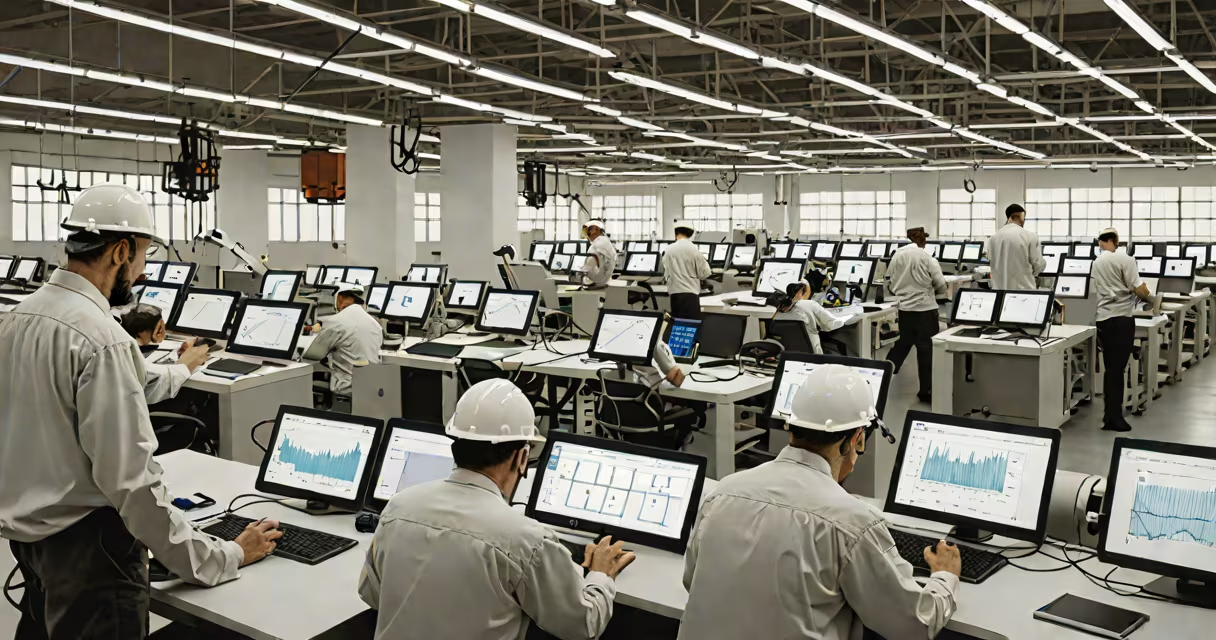
Industrial engineering and management integrates technical problem-solving with strategic decision-making to improve complex systems involving people, processes, materials, and information. It focuses on improving efficiency, reducing waste, and enhancing quality across manufacturing, healthcare, logistics, and service environments.
This discipline applies mathematical modeling, data analysis, and human factors research to redesign workflows and allocate resources effectively. Unlike pure engineering fields focused on product design, industrial engineering and management centers on system performance-how well work gets done, not just what gets built.
For example, a hospital implementing a new patient scheduling system uses industrial engineering principles to reduce wait times by analyzing staff availability, room turnover rates, and appointment duration variability. The result is fewer delays and higher throughput without adding staff.
Industrial engineering and management relies on structured approaches to identify inefficiencies and implement measurable improvements. Key methods include time and motion studies, queuing theory, simulation modeling, and statistical process control.
Time and motion studies track how long tasks take and where bottlenecks occur. A warehouse team might record how long it takes to pick an item from a shelf, pack it, and label it. By analyzing hundreds of such observations, they discover that packing takes 40% longer than expected due to inconsistent box sizes. Adjusting packaging standards reduces average processing time by 22%.
Simulation tools like Arena or AnyLogic allow teams to test changes virtually before implementation. For instance, a call center used simulation to model the impact of adding two new shifts during peak hours. The model predicted a 35% drop in abandoned calls-a change that saved $1.2 million annually in customer retention costs.
The field draws from multiple domains: operations research, ergonomics, supply chain science, and organizational behavior. These form the foundation of both technical and managerial competencies.
Specializations within industrial engineering and management include:
| Type | Focus Area | Common Application |
|---|---|---|
| Manufacturing Systems | Production line design, automation integration | Automotive assembly plants optimizing robot placement |
| Supply Chain Management | Inventory forecasting, distribution network design | Retailers adjusting warehouse locations based on regional demand patterns |
| Healthcare Operations | Emergency room flow, surgical set utilization | Hospitals reducing patient length of stay through bed assignment algorithms |
| Human Factors & Ergonomics | Workstation layout, fatigue reduction | Factory floors redesigned to minimize repetitive strain injuries |
A lesser-known but critical element is behavioral economics applied to incentive structures. Research from MIT's Sloan School shows that workers respond more predictably to variable pay tied to output metrics than to flat bonuses-even when total compensation is equal. This insight underpins many modern performance-based reward systems in factories and warehouses.
Industries ranging from aerospace to food processing rely on industrial engineering and management to maintain competitiveness. In automotive manufacturing, it helps each vehicle moves smoothly through assembly stations with minimal idle time.
At Amazon fulfillment centers, industrial engineers analyze package sorting routes, conveyor speeds, and picker paths. One study found that rearranging bins based on item popularity reduced average picking time by 18%. That translates to 600,000 more packages processed daily across U.S. facilities.
In healthcare, the Veterans Health Administration implemented a standardized workflow for managing chronic disease patients. Using industrial engineering techniques, they reduced missed appointments by 27% and improved medication adherence scores by 31% over 18 months.
Contrary to common belief, this field isn't limited to factories. It plays a major role in software deployment cycles-where DevOps teams apply similar principles to reduce build failure rates and improve release velocity.
Many assume industrial engineering and management is synonymous with cost-cutting or layoffs. That's incorrect. Its goal is sustainable improvement-not just reducing expenses. A 2021 study published in *Production and Operations Management* found that companies using industrial engineering practices saw a 14% increase in employee satisfaction over five years, partly because better-designed workflows reduced burnout.
Another misconception is that it requires advanced degrees. While many roles require a bachelor's in industrial engineering or a related field, entry-level positions exist in logistics coordination, production planning, and quality assurance. Certifications like Certified in Production and Inventory Management (CPIM) or Six Sigma Green Belt provide pathways into the field without a formal degree.
I once observed a team at a consumer electronics plant struggling with high defect rates. They blamed faulty components until an industrial engineer ran a root cause analysis using Pareto charts. The data showed that 80% of defects originated from a single soldering station. Adjusting temperature settings and retraining operators cut defects by 65%-without changing parts or suppliers.
Understanding these differences prevents misalignment in hiring, project planning, and training. A hospital looking to reduce patient wait times should consult an industrial engineer, not a biomedical device specialist-even if both work in healthcare.
Industrial engineering and management is not a niche specialty. It's a foundational discipline for scaling operations, improving safety, and enabling innovation across sectors. Its methods are proven, its applications broad, and its impact measurable in time saved, errors reduced, and lives improved.