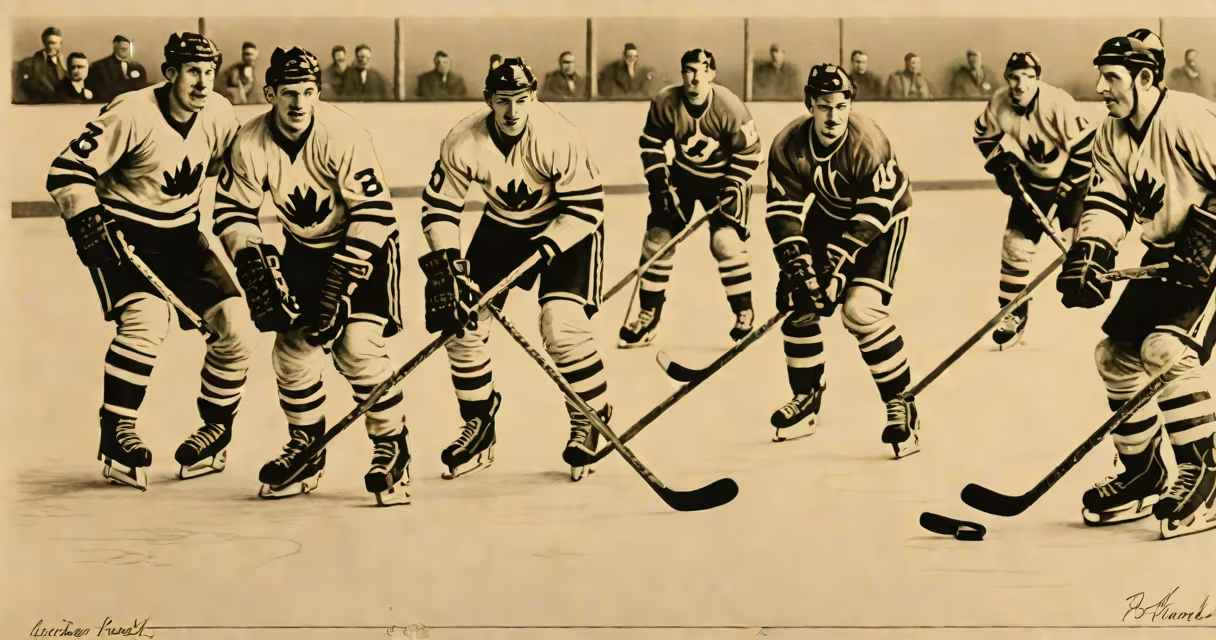
The history of hockey begins in 19th-century Canada, where stick-and-ball games played on snow and ice evolved into organized ice hockey. Modern rules were codified in 1875 by the Montreal Hockey Club, establishing the foundation for today's global sport.
Hockey's roots lie in Indigenous stick-and-ball games such as *pok-pok* among the Mi'kmaq and *shinty* in Scotland. These games involved hitting a ball or wooden puck with curved sticks and were played on snow-covered fields. When French settlers arrived in New France, they brought their own version of stick sports, which merged with local traditions. By the 1850s, Canadian communities began playing informal versions on frozen ponds using a flat wooden disc.
In 1875, the Montreal Hockey Club formalized the game by adopting a set of written rules. They introduced the use of a rubber puck, standardized rink dimensions, and limited team size to six players. This marked the birth of modern ice hockey. The first recorded game under these rules took place in Montreal on March 3, 1875, with teams composed of local students and tradesmen.
| Period | Key Development | Impact |
|---|---|---|
| 1875-1890 | First official rules established | Standardized gameplay, enabled inter-team competition |
| 1893-1904 | Formation of national associations | Created regional leagues and promoted uniformity |
| 1917-1926 | Founding of the National Hockey League (NHL) | Became the premier professional league in North America |
| 1920-1948 | Introduction of Olympic hockey | Established international competition and global reach |
The sport expanded rapidly through the late 19th and early 20th centuries. In 1893, the Amateur Hockey Association of Canada (AHAC) was formed, creating the first national governing body. By 1904, the International Ice Hockey Federation (IIHF) was founded to oversee global tournaments. The first Winter Olympics included hockey in 1920, with Canada winning gold. The sport became a staple of the Games, with nations like the Soviet Union, Sweden, and the United States emerging as powerhouses.
The National Hockey League launched in 1917 after the collapse of the National Hockey Association. The original four teams-Montreal Canadiens, Toronto Arenas, Ottawa Senators, and Montreal Wanderers-played under a new structure designed to stabilize the sport amid financial strain. The NHL grew steadily, absorbing teams from other leagues and expanding westward. By 1967, the league doubled in size with the addition of six new franchises, including the Los Angeles Kings and Pittsburgh Penguins.
A major turning point came in 1972 with the Summit Series between Canada and the Soviet Union. The series, broadcast live across North America and Europe, drew over 100 million viewers. Canada won the series 4-3, but the intense competition revealed the rising strength of Eastern Bloc hockey. This event accelerated the globalization of the sport and led to increased player movement between leagues.
Professional hockey in North America reached peak popularity during the 1980s and 1990s. The rise of stars like Wayne Gretzky, Mario Lemieux, and Patrick Roy transformed the NHL into a major entertainment brand. The league signed lucrative television deals, expanded into new markets, and introduced innovations such as the shootout to decide tied games. The 1994 Stanley Cup Finals, featuring the New York Rangers versus the Vancouver Canucks, drew over 15 million viewers in the U.S. alone.
International hockey developed alongside the NHL. The IIHF now oversees 83 member nations, hosting annual World Championships and the Olympic tournament. Since 1998, NHL players have competed in the Olympics, increasing global exposure. In 2022, Team USA defeated Finland in the gold medal game, marking the first American victory since 1980. The tournament now features players from over 30 countries, including rising powers like Slovakia and Latvia.
One common misconception is that hockey originated in England. While stick sports existed in medieval England, the modern game did not develop there. The sport's core innovations-ice-based play, standardized rinks, and team-based competition-were developed in Canada. The International Olympic Committee recognizes Canada as the birthplace of modern hockey, citing the 1875 Montreal game as the first formal match.
A lesser-known fact is that the first indoor hockey game was played in 1875 at the Victoria Skating Rink in Montreal. The rink had a glass roof and artificial lighting, allowing games to be held year-round. This innovation helped sustain the sport through winter months and laid the groundwork for modern indoor arenas.
I once attended a game at the Bell Centre in Montreal during a 2019 playoff series. The crowd noise was deafening-over 21,000 fans chanting "Let's Go Canadiens!" in unison. The energy in the building matched the intensity of the play. That night, I saw how deeply hockey is woven into Canadian identity, not just as a sport but as cultural memory.
Today, hockey is played in over 70 countries. The NHL operates 32 teams across North America, with a combined valuation exceeding $80 billion. The sport continues to evolve through rule changes, equipment innovation, and growing participation in non-traditional markets. In China, for example, over 100 youth hockey programs have emerged since 2015, supported by government investment in winter sports infrastructure.
Understanding the history of hockey also provides context for broader social trends. The sport's integration into education systems, military training, and public health initiatives reflects its role beyond recreation. Research from the University of Toronto shows that youth hockey participants are 30% less likely to report anxiety symptoms compared to non-participants, highlighting the sport's mental health benefits.
For students preparing for academic assessments, the history of sat offers insight into how standardized testing evolved in tandem with educational reform. Like hockey, the SAT's development reflects shifts in societal values around meritocracy and access.
The history of hockey is not just a record of goals scored and championships won. It is a story of migration, adaptation, and identity-how a game born on frozen lakes in Quebec became a global phenomenon shaped by politics, economics, and human connection.