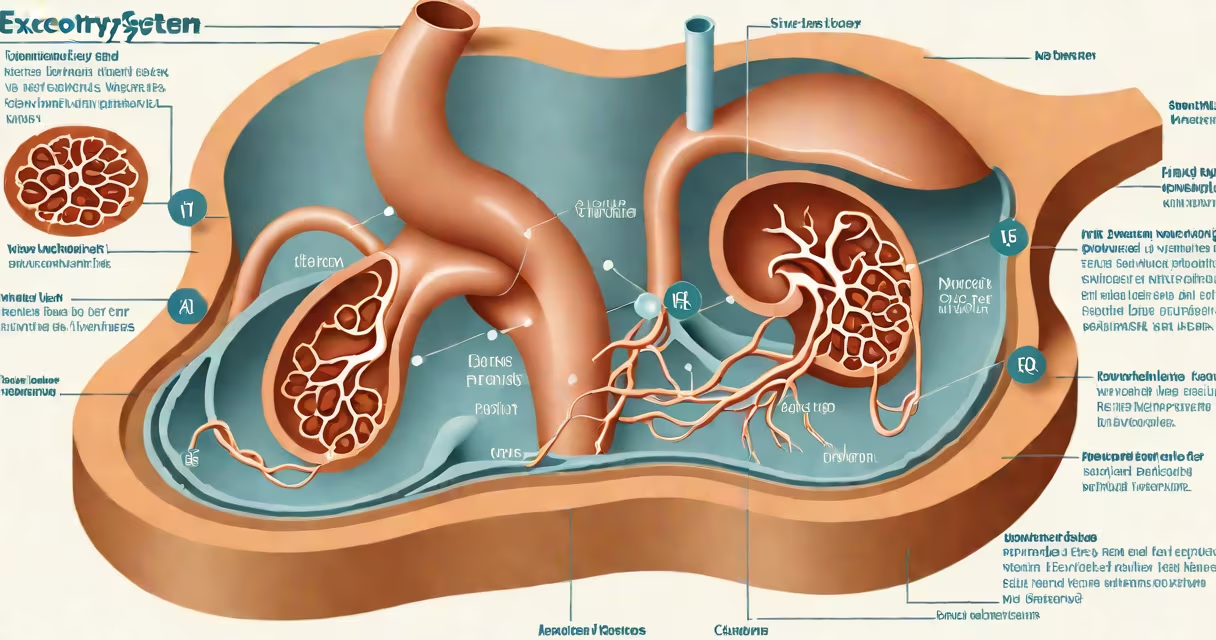
The excretory system eliminates metabolic waste products like urea, excess ions, and water while regulating blood composition, fluid volume, and electrolyte balance. It centers on the kidneys, which filter blood through millions of nephrons, producing urine that travels via ureters to the bladder for storage and eventual expulsion through the urethra.
Each kidney contains about one million nephrons-functional units responsible for filtering blood and adjusting solute concentration. Blood enters the nephron through the afferent arteriole, passes through the glomerulus (a capillary network), and exits via the efferent arteriole. Fluid filtered from the glomerulus becomes the initial filtrate, which moves into the proximal convoluted tubule, loop of Henle, distal convoluted tubule, and collecting duct. Along this path, reabsorption and secretion fine-tune the composition of the final urine.
For example, during dehydration, antidiuretic hormone (ADH) increases water reabsorption in the collecting duct. This reduces urine volume and conserves water. Conversely, high blood sodium triggers aldosterone release, promoting sodium reabsorption and potassium excretion in the distal tubule. These processes maintain osmotic balance and prevent cellular swelling or shrinkage.
The primary organs of the excretory system include the kidneys, ureters, urinary bladder, and urethra. The kidneys perform filtration, reabsorption, secretion, and hormone production. They regulate pH by excreting hydrogen ions and reabsorbing bicarbonate. They also produce erythropoietin, which stimulates red blood cell formation, and activate vitamin D for calcium absorption.
The ureters are muscular tubes transporting urine from the kidneys to the bladder using peristaltic contractions. The bladder stores urine until voiding. Its walls stretch to accommodate volumes up to 600 mL. The urethra expels urine externally through voluntary control of sphincter muscles.
| Organ | Primary Function | Key Mechanism |
|---|---|---|
| Kidneys | Filtration, reabsorption, secretion | Nephron-based processing |
| Ureters | Transport urine | Peristalsis |
| Urinary bladder | Storage | Stretchable smooth muscle |
| Urethra | Expulsion | Voluntary sphincter control |
Many assume the liver is part of the excretory system because it processes toxins. However, the liver is part of the digestive system and detoxifies substances via metabolism, not direct excretion. Bile excretion occurs through the intestines, not the urinary tract. The excretory system specifically handles nitrogenous waste like urea, creatinine, and uric acid.
Another confusion arises between excretion and defecation. Defecation removes undigested food and bacteria from the gastrointestinal tract. Excretion removes metabolic byproducts from cells and blood. For instance, urea forms from amino acid breakdown in the liver and is transported to the kidneys for filtration-not eliminated through feces.
A lesser-known fact: the kidneys regulate blood pressure through the renin-angiotensin-aldosterone system (RAAS). When blood pressure drops, juxtaglomerular cells release renin, initiating a cascade that produces angiotensin II-a potent vasoconstrictor-and aldosterone, which increases sodium retention. This feedback loop ensures adequate perfusion and stabilizes blood volume.
In chronic kidney disease (CKD), nephron damage reduces filtration capacity. Stage 3 CKD involves a glomerular filtration rate (GFR) below 60 mL/min/1.73 m². Without treatment, waste accumulates, leading to uremia-symptoms include fatigue, nausea, and confusion. Dialysis mimics kidney function by filtering blood artificially, removing waste and excess fluid.
I once observed a patient with acute kidney injury after a severe infection. His serum creatinine rose from 1.0 mg/dL to 4.5 mg/dL in 48 hours. Creatinine is a waste product from muscle metabolism. Normally cleared by kidneys, elevated levels indicate impaired filtration. He required hemodialysis until his kidneys recovered.
Understanding the excretory system's structure and function is essential for diagnosing and managing conditions like diabetes insipidus (defective ADH action), hyperkalemia (high potassium due to reduced excretion), and polycystic kidney disease (genetic cyst formation disrupting nephron architecture).
The excretory system works closely with the circulatory, endocrine, and nervous systems. Hormones such as ADH, aldosterone, and atrial natriuretic peptide (ANP) coordinate fluid balance. ANP, released by heart atria during high blood volume, promotes sodium and water excretion, reducing blood pressure.
Similarly, bone structure within the skeletal system supports mineral storage and blood cell production. Bones release calcium and phosphate into the bloodstream, regulated by parathyroid hormone and calcitonin. The kidneys monitor calcium levels and adjust excretion accordingly. Disruption in either system affects homeostasis.
When kidney function declines, bones lose calcium, increasing fracture risk. This interdependence shows that organ systems do not operate in isolation. The excretory system's role in maintaining equilibrium extends beyond waste removal-it integrates with hormonal regulation, fluid dynamics, and systemic health.
Understanding the excretory system structure and function reveals how biology maintains internal consistency despite external changes. From daily water intake to sudden dehydration, the system adapts precisely. It is not merely a disposal unit but a changing regulator of life-sustaining conditions.