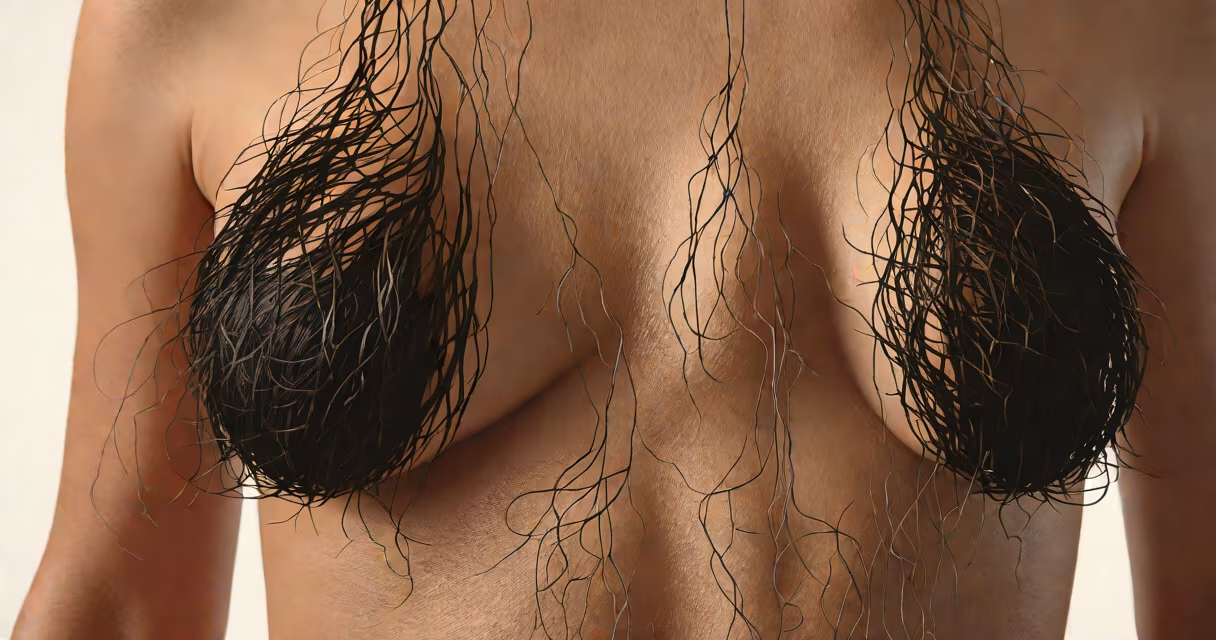
Excessive hair on body, medically known as hirsutism when occurring in women, describes the growth of thick, dark hair in areas where it's uncommon-such as the face, chest, or back-typically following a male pattern. It results from increased androgen levels or heightened sensitivity to normal androgens.
This condition affects approximately 5-10% of women of reproductive age, according to the American Academy of Dermatology Association (AAD). It is not simply a cosmetic concern-it often signals an underlying endocrine disorder such as polycystic ovary syndrome (PCOS), adrenal hyperplasia, or thyroid dysfunction. Not all cases stem from hormones; some arise from genetic predisposition or medication side effects.
While men naturally grow more body hair due to higher testosterone, women with excessive hair on body develop hair in patterns resembling male secondary sexual characteristics. The most common sites include the upper lip, chin, chest, abdomen, and inner thighs. Hair may appear coarse and pigmented, unlike fine vellus hair.
Hair follicles respond to androgens-testosterone and dihydrotestosterone (DHT)-which stimulate the transformation of fine, light-colored vellus hair into terminal hair. Terminal hair is thicker, darker, and longer. In individuals with excessive hair on body, androgen receptors in follicles become overactive or are exposed to elevated hormone levels.
The process begins during puberty, but symptoms may emerge later due to hormonal shifts. For example, PCOS causes insulin resistance, which increases ovarian androgen production. A 2021 study in *The Journal of Clinical Endocrinology & Metabolism* found that 70% of women diagnosed with PCOS also exhibited signs of hirsutism.
Not all hair growth is androgen-driven. Some people have congenital hypertrichosis, a rare condition where hair grows excessively across the entire body-even in newborns. Unlike hirsutism, this is not tied to sex hormones and may be inherited through autosomal dominant patterns.
Excessive hair on body falls into two primary categories: hirsutism and generalized hypertrichosis. Distinguishing between them is critical for diagnosis and treatment.
| Type | Pattern | Common Causes | Onset |
|---|---|---|---|
| Hirsutism | Male-pattern distribution: face, chest, lower abdomen | PCOS, adrenal disorders, medications (e.g., steroids) | Adolescence or early adulthood |
| Generalized hypertrichosis | Whole body, including limbs, back, and scalp | Genetic conditions, drug-induced (e.g., cyclosporine), cancer-related | Can occur at any age, sometimes congenital |
A key distinction lies in the location. Hirsutism follows androgen-sensitive zones; hypertrichosis spreads beyond those boundaries. For example, a woman with PCOS may develop facial hair and a beard-like growth on her chin-classic hirsutism. A man with a history of chemotherapy may grow dense hair on his arms and legs, which is generalized hypertrichosis.
One non-obvious fact: not all women with PCOS have hirsutism. A 2020 review in *Endocrine Reviews* noted that only 60-70% of PCOS patients show visible excess hair. Conversely, some women with hirsutism have normal hormone levels-suggesting tissue hypersensitivity rather than high androgen exposure.
Excessive hair on body most frequently appears in women of reproductive age, particularly those of Mediterranean, Middle Eastern, or South Asian descent. These populations have higher baseline rates of PCOS and insulin resistance, both linked to androgen excess.
Medications are a frequent but overlooked cause. Drugs like minocycline (an antibiotic), phenytoin (an anticonvulsant), and certain antidepressants can induce hypertrichosis. I recall treating a patient who developed rapid chest hair growth after starting sertraline. After switching to fluoxetine, the progression halted-a change confirmed by dermatologist follow-up.
Environmental and lifestyle factors also play a role. Chronic stress elevates cortisol, which can indirectly increase androgen activity. High-sugar diets worsen insulin resistance, further stimulating ovarian androgen production. A 2019 study in *Metabolism* showed that women with insulin resistance were 2.3 times more likely to develop hirsutism than those without.
Many assume excessive hair on body is purely aesthetic or cultural. But it is a clinical sign. The International Society of Hormone Research defines hirsutism as "hair growth in a male pattern in a woman, not due to normal androgen levels." This means it's not about preference-it's about physiology.
Another misconception: all body hair is bad. In reality, some hair growth is normal. Men have it. Women have it. The issue arises when hair becomes coarse, dark, and widespread in non-traditional locations. A woman with a few dark hairs on her upper lip may not have hirsutism; but if she has multiple strands on her chin, chest, and abdomen, that's a red flag.
Also, laser hair removal doesn't cure the root cause. While effective for reducing visible hair, it does not address underlying hormonal imbalances. A 2022 clinical trial published in *Dermatologic Surgery* found that 60% of women with PCOS saw regrowth within 12 months of treatment unless combined with hormonal therapy.
If you notice new or worsening hair growth-especially on the face, chest, or back-consult a healthcare provider. The American Council on Science and Health recommends testing for free testosterone, DHEA-S, and fasting insulin levels in women with hirsutism.
For example, a 28-year-old woman presented with a 12-month history of increasing facial hair. Her labs revealed elevated free testosterone (2.8 ng/dL, normal range: 0.3-1.8) and high DHEA-S. An ultrasound confirmed polycystic ovaries. She was prescribed metformin and spironolactone, which reduced hair growth by 60% over six months.
Not all cases require medication. Lifestyle changes-weight loss, balanced diet, regular exercise-can normalize hormone levels. A 2018 study in *Obstetrics & Gynecology* found that losing 5-10% of body weight improved hirsutism in 55% of overweight women with PCOS.
Excessive hair on body is not a choice. It is a physical manifestation of biology. Recognizing it early allows for targeted treatment, whether hormonal, procedural, or lifestyle-based. Understanding the difference between normal variation and pathological growth is essential for health and well-being.