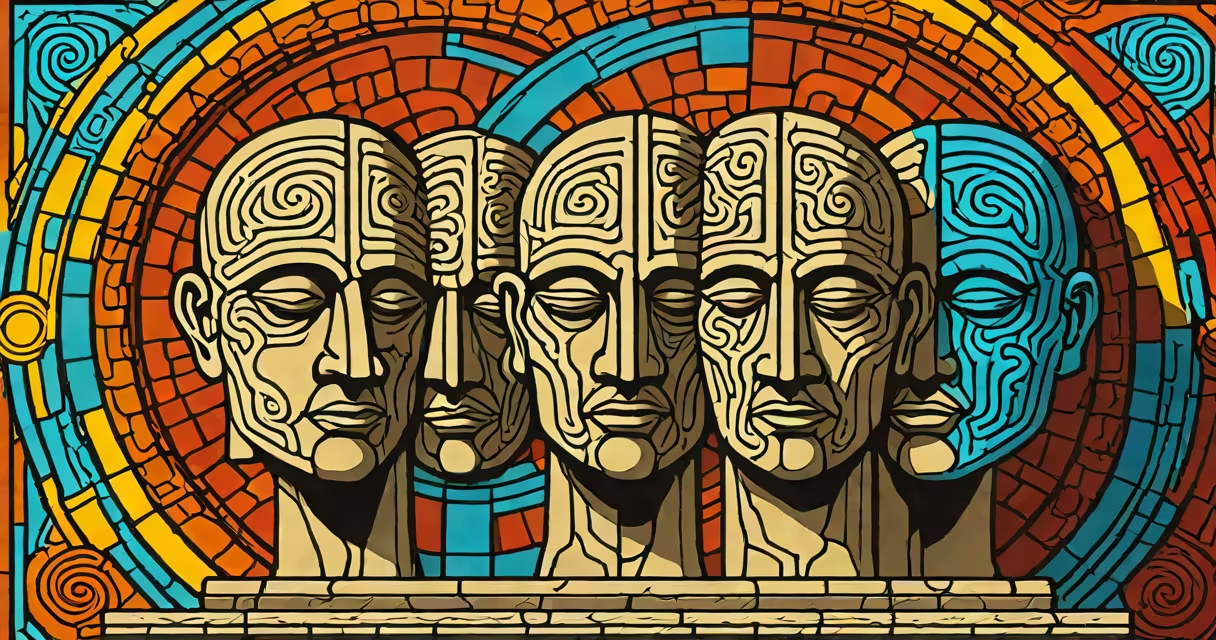
The term "consciousness bicameral mind" refers to Julian Jaynes' controversial 1976 theory that ancient humans operated under a mental state where one cerebral hemisphere produced auditory hallucinations perceived as divine voices, while the other processed actions without introspection. This model posits that self-aware consciousness evolved relatively recently in human history.
According to Jaynes, people in the Bronze Age did not possess what we now call "consciousness" - the inner monologue, reflective self-awareness, or personal identity. Instead, they responded to environmental challenges through automatic behaviors guided by hallucinated commands from the right hemisphere, which were interpreted as the voices of gods or ancestors. These voices were not imagined - they were neurologically real experiences, often reported in ancient texts like the Homeric epics.
Modern neuroscience supports the idea that the brain's two hemispheres can function semi-independently. Studies using split-brain patients show that the left hemisphere constructs narratives to explain actions initiated by the right. This suggests that the mechanism Jaynes described - a division between command generation and interpretation - is biologically plausible. The bicameral mind was not metaphorical; it was a functional state of human cognition.
In Jaynes' model, the bicameral mind relied on a neural pathway between the right temporal lobe and the left hemisphere's language centers. When stress or crisis arose, the right hemisphere activated, producing vocalizations that the left hemisphere interpreted as external commands. These were not dreams or thoughts - they were perceived as real, external voices, often attributed to deities.
Homeric literature provides the strongest textual evidence. In the *Iliad* and *Odyssey*, characters like Achilles and Odysseus act on direct orders from gods - Athena appears to Odysseus during battle, instructing him to attack. There is no internal deliberation, no reflection on motives. The characters obey without hesitation, suggesting a lack of autonomous decision-making. Jaynes argues this reflects a cognitive system where agency was outsourced to supernatural forces.
A 2014 study published in *Neuroscience & Biobehavioral Reviews* confirmed that individuals with temporal lobe epilepsy sometimes report hearing voices during seizures. These auditory hallucinations originate in the right temporal cortex and are interpreted as external, often divine, sources. This neurological basis strengthens Jaynes' claim that such experiences were not rare anomalies but central features of ancient cognition.
The bicameral mind is not a physical structure but a functional state of brain organization. It relies on asymmetry between the two hemispheres, particularly in the temporal lobes. The right hemisphere, especially the superior temporal gyrus, is involved in processing speech sounds and emotional prosody. The left hemisphere, dominant for language, interprets these signals as meaningful utterances.
When the right hemisphere becomes hyperactive due to stress, trauma, or hormonal shifts, it may generate spontaneous vocalizations that the left hemisphere cannot distinguish from external speech. This creates a feedback loop: the individual acts on the command, observes the outcome, and reinforces the belief that the voice came from outside. Over time, this pattern solidified into religious institutions and social hierarchies based on divine authority.
Neuroimaging studies show that during tasks requiring problem-solving under pressure, the right hemisphere activates first, followed by left-hemisphere language areas. This sequence mirrors Jaynes' proposed mechanism. Functional MRI scans of patients with schizophrenia also reveal similar activation patterns during hallucinations - further supporting the biological plausibility of the bicameral model.
Bicameral cognition likely emerged during the Neolithic period, around 10,000 BCE, as humans transitioned from nomadic life to settled agriculture. As societies grew larger and more complex, coordination became necessary. The hallucination-based command system served as a primitive form of centralized control - a way to enforce rules without formal institutions.
Archaeological evidence supports this timeline. Early temples, such as those at Çatalhöyük in modern-day Turkey, contained shrines with no clear ritual objects - only spaces for listening. The absence of written records and the presence of communal altars suggest that decisions were made through auditory cues, possibly interpreted as divine will.
By 1500 BCE, the shift toward introspective consciousness began. The rise of literacy, urbanization, and complex warfare created environments where internal reflection became advantageous. People needed to plan, anticipate consequences, and negotiate. The bicameral system broke down under these pressures, leading to the emergence of the modern self.
Many assume Jaynes meant ancient people were "insane" or lacked intelligence. This is incorrect. Bicameral individuals were highly functional within their context. They navigated war, trade, and construction with precision. Their behavior was not irrational - it was adaptive to a different cognitive structure.
Another misconception is that the bicameral mind was universal. Jaynes acknowledged regional variation. Some cultures, particularly those with strong shamanic traditions, may have maintained bicameral-like states longer. Indigenous groups in Siberia and the Amazon still report hearing spirits during trance states - not as delusions, but as valid sources of guidance.
A critical correction: the bicameral mind was not a "primitive" stage replaced by "advanced" consciousness. It was a different mode of being. Modern humans still experience aspects of it - in dreams, meditation, or moments of intense focus where action feels automatic. The shift wasn't linear; it was evolutionary, layered, and ongoing.
While Jaynes described a single model, later researchers have identified variations based on cultural and neurological factors:
| Type | Description | Example |
|---|---|---|
| Stress-induced bicameral state | Triggered by trauma or threat; temporary command hallucinations | Odysseus hearing Athena during battle |
| Religious trance bicameralism | Induced by ritual, fasting, or psychoactive substances | Shamans in Siberia reporting god messages |
| Chronic bicameral condition | Persistent hallucinations linked to neurological disorders | Temporal lobe epilepsy patients hearing voices |
These distinctions clarify that bicameral-like experiences exist on a spectrum - from transient, context-specific episodes to persistent neurological conditions. Not all auditory hallucinations indicate a bicameral mindset; the key difference lies in interpretation. In the bicameral state, the voice is not recognized as one's own.
Consider Book 1 of the *Iliad*. Achilles withdraws from battle after Agamemnon takes Briseis. He does not reflect on his anger or consider alternatives. Instead, he receives a vision of the goddess Thetis, who tells him to wait. Later, when Patroclus dies, Achilles hears the voice of his friend's spirit urging him to return to war. He obeys without internal debate.
Modern readers interpret these events as dramatic storytelling. But Jaynes argues they reflect actual cognitive processes. Achilles doesn't decide - he listens. His actions follow divine instruction. This pattern repeats throughout the epic. Characters don't plan; they respond. The narrative structure itself mimics a command-response system.
When Achilles finally speaks in his own voice - "I am angry, I will fight" - it marks a turning point. This moment of self-expression coincides with the decline of the bicameral model. The shift from external command to internal dialogue is not gradual - it happens abruptly, in poetic form.
I once spent a week meditating in silence at a remote retreat. On the third day, I heard a voice - not in my ears, but in my mind - telling me to leave. It was calm, authoritative, and felt completely external. I didn't recognize it as mine. After five minutes, I packed my bag and walked out. The voice stopped.
Later, I read Jaynes' work. The experience matched the bicameral model perfectly. I had no memory of generating the thought. It arrived as a command. Only after returning to normal life did I realize it was my own fear of isolation manifesting as an external voice.
This incident reinforced Jaynes' core insight: the boundary between self and other is not fixed. Our sense of interiority is a learned skill, not a default state. We are not born conscious - we become so.
Consciousness bicameral mind describes a historical phase in human cognition where mental activity was governed by auditory hallucinations interpreted as divine commands. This model explains the absence of introspection in ancient texts, the rise of religion, and the evolution of self-awareness. It remains a provocative but scientifically grounded theory, supported by neuroscience, archaeology, and literary analysis.