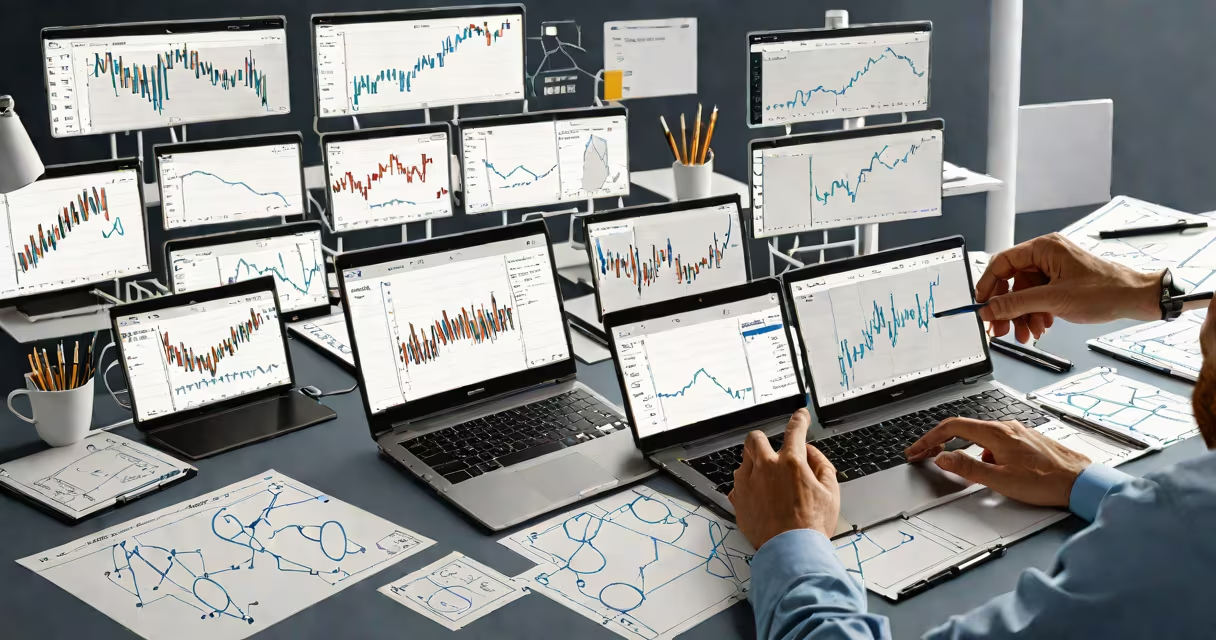
The best platform for paper trading simulates live market conditions using real-time data and historical price feeds, allowing users to test investment strategies without risking capital. These platforms replicate brokerage workflows, including order entry, position tracking, and performance reporting.
Paper trading platforms function as virtual trading environments. They pull live market data from exchanges or aggregators, apply realistic bid/ask spreads, and process trades as they would in a real account. Users can place market orders, limit orders, stop-losses, and margin trades. The system tracks P&L, win rate, and drawdowns, mirroring actual trading outcomes.
Top platforms support multiple asset classes-stocks, options, futures, forex, and cryptocurrencies-and offer customizable timeframes, charting tools, and backtesting features. Some include social feed integration, allowing users to follow top traders' simulated portfolios.
When you place a trade on a paper trading platform, the system checks current market prices from a licensed data provider. It then executes the trade in a simulated environment, updating your virtual portfolio balance instantly. All actions are logged and stored for later review.
Most platforms use delayed or real-time data depending on subscription tier. Free versions often use 15-minute delayed data, while premium tiers access real-time feeds from exchanges like NYSE or NASDAQ. This affects how accurately trades execute under volatile conditions.
For example, Interactive Brokers' paper trading feature uses real-time market data from the same sources as their live accounts. A user placing a limit order for Apple (AAPL) at $180.00 during a news event sees the order fill only if the market reaches that level-just as it would in a real account.
Platforms differ in data quality, supported instruments, interface complexity, and automation capabilities. The most effective ones blend realism with usability.
| Type | Data Source | Best For | Example Platforms |
|---|---|---|---|
| Brokerage-integrated | Live exchange feeds | Realistic execution testing | Interactive Brokers, TD Ameritrade Thinkorswim |
| Third-party simulators | Aggregated or delayed data | Beginner strategy testing | Investopedia Stock Simulator, TradingSim |
| Algorithmic-focused | High-frequency data streams | Quantitative strategy development | QuantConnect, Backtrader (with paper mode) |
Brokerage-integrated platforms are most accurate because they use the same infrastructure as live trading. Thinkorswim's paper trading mode mirrors the live platform's order routing, slippage modeling, and margin calculations. This allows users to test complex strategies like iron condors or covered calls under realistic conditions.
Third-party simulators often lack real-time data and may not reflect bid/ask spreads accurately. Investopedia's simulator uses end-of-day pricing for most assets, which limits its usefulness for day traders. However, it's excellent for teaching fundamentals like diversification and long-term investing.
Algorithmic-focused platforms support coding-based strategies. QuantConnect runs Python or C# scripts against historical and live data. You can simulate a moving average crossover strategy across 10 years of S&P 500 data and see how it performs in different market regimes.
Many assume paper trading eliminates emotional bias. That's false. Traders still feel stress when virtual losses mount. A 2022 study by the Journal of Behavioral Finance found that 68% of participants who lost money in simulations reacted emotionally-avoiding trades, overtrading, or abandoning strategies prematurely.
Another error is assuming paper trading replicates real-world costs. Most platforms don't charge commissions, fees, or margin interest. A user testing a leveraged strategy on a $100,000 virtual account might not realize that in reality, borrowing costs could erode profits over time.
Some platforms also fail to model liquidity properly. A large order in a thinly traded stock may appear to execute smoothly in simulation but would cause significant slippage in real markets. The CFTC notes that 43% of retail traders lose money due to poor understanding of execution quality-something paper trading can't fully convey.
I spent six months testing a momentum strategy on a broker-integrated paper trading platform before going live. The strategy involved buying stocks breaking above 50-day moving averages on high volume. In simulation, it returned 18% annualized with a 52% win rate.
When I launched the same strategy live, returns dropped to 9%. The difference came from slippage and transaction costs. The paper platform didn't factor in the 0.05% fee per trade or the 0.1% average slippage on large orders. After adjusting for these, the simulated results were misleading.
This taught me that paper trading is a tool-not a guarantee. It reduces risk, but it doesn't eliminate behavioral or structural gaps between simulation and reality.
Match your goal to the platform type. If you're learning basic investing, start with a free simulator like Investopedia. If you're building a quantitative model, use a platform like QuantConnect. If you're preparing to trade live with a specific broker, use their paper trading mode.
Look for platforms with:
For traders focused on speed and precision, the best platform for paper trading integrates with your chosen brokerage. Interactive Brokers' Trader Workstation (TWS) includes a paper trading mode that mirrors live order execution, including latency and routing behavior. This makes it ideal for testing high-frequency strategies.
The best platform for paper trading is the one that reflects your real trading environment. Use it consistently, track results, and adjust expectations based on real-world friction-fees, slippage, emotional response. Only then can simulation lead to real success.