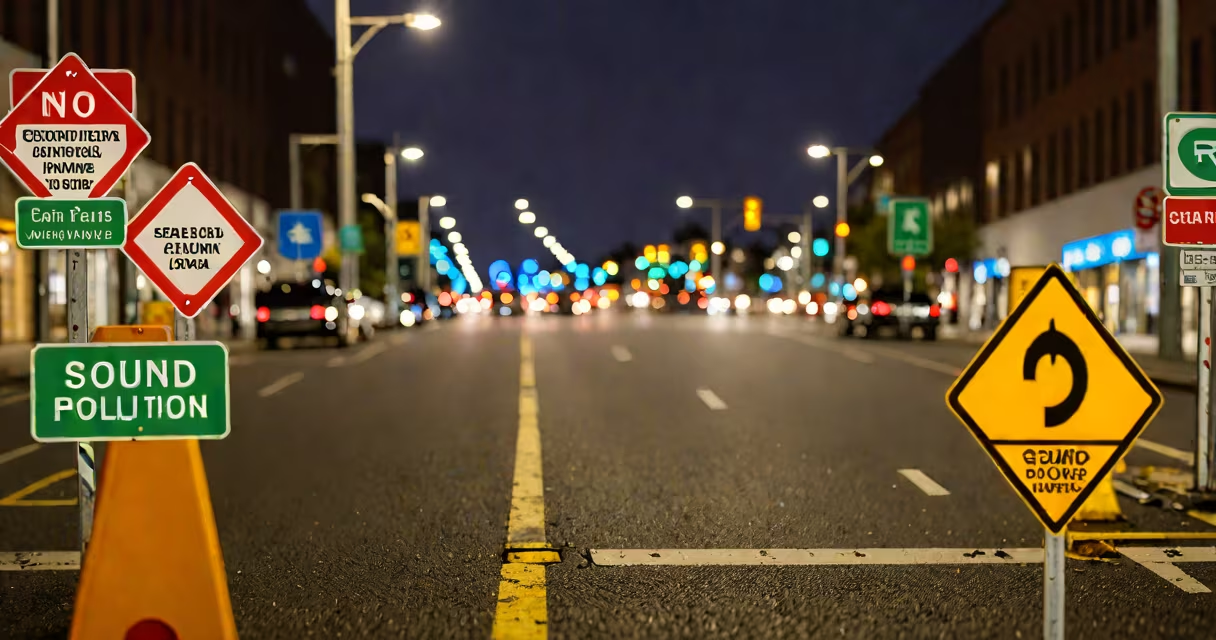
Sound pollution, also known as noise pollution, is excessive or harmful sound that disrupts environments and affects living organisms. It arises from human activities and alters natural acoustic conditions, leading to physiological and psychological stress in both animals and people.
Sound pollution is measured in decibels (dB). Background ambient noise in quiet rural areas averages 30-40 dB. Urban traffic often exceeds 70 dB, while industrial machinery can reach 100 dB or higher. Prolonged exposure above 85 dB increases risk of hearing loss and cardiovascular strain, according to the World Health Organization (WHO).
Unlike chemical pollutants, sound pollution leaves no residue. It travels through air, water, and solid materials. Its impact depends on intensity, duration, frequency, and timing. A factory siren at 110 dB may be tolerable for five minutes but damaging if sustained for hours.
Sound pollution occurs when sound levels exceed the threshold of comfort or safety for biological systems. The human ear detects pressure waves between 20 Hz and 20,000 Hz. Frequencies below 100 Hz travel farther and penetrate buildings more easily, making low-frequency noise from traffic or trains particularly disruptive.
Animals rely on sound for navigation, mating, and predator detection. A study published in *Science* found that bird species near highways shifted their songs to higher frequencies to avoid masking by engine noise. This adaptation reduces communication range and lowers reproductive success.
Sound pollution also interferes with sleep. The WHO identifies nighttime noise above 40 dB as a health hazard. Chronic sleep disruption correlates with increased blood pressure, insulin resistance, and depression risk. In cities like New York, aircraft noise contributes to elevated cortisol levels in residents near airports.
Sound pollution stems from four primary categories: transportation, industrial activity, construction, and recreational noise. Each has distinct characteristics and geographic concentration.
| Type | Typical Source | Average Decibel Level | Health Impact |
|---|---|---|---|
| Transportation | Highways, railways, aircraft | 70-100 dB | Hearing damage, sleep disruption |
| Industrial | Machinery, factories, power plants | 85-120 dB | Occupational hearing loss, hypertension |
| Construction | Jackhammers, pile drivers, cranes | 90-110 dB | Acoustic trauma, stress response |
| Recreational | Concerts, fireworks, sports events | 100-130 dB | Temporary or permanent hearing loss |
Urban centers concentrate most sound pollution. In Tokyo, average daytime noise levels reach 75 dB. In Los Angeles, traffic noise causes 60% of residents to report sleep issues. Rural areas remain quieter but face growing threats from wind turbines and drone operations.
Low-frequency noise from wind farms is especially controversial. A 2021 study in *Environmental Health Perspectives* linked turbine noise below 20 Hz to increased anxiety and fatigue in nearby communities. These sounds are felt more than heard, triggering vestibular responses.
Sound pollution is not synonymous with loudness. A whisper at 30 dB is harmless. A jet engine at 140 dB is dangerous-but only if exposure lasts more than a few seconds. Duration matters as much as volume.
Many assume sound pollution affects only humans. Marine mammals suffer severely. Navy sonar pulses at 235 dB have caused mass strandings of beaked whales. The U.S. National Oceanic and Atmospheric Administration (NOAA) reports that underwater noise from shipping has doubled since 1950, disrupting whale migration patterns.
Another error is equating sound pollution with all noise. Background music in a café at 60 dB is not pollution. But a neighbor's amplified bass at 100 dB during late-night hours crosses into regulated territory under local ordinances.
In 2019, researchers in Barcelona monitored noise levels across 12 neighborhoods using 47 sensors. They found that residential zones near major roads averaged 72 dB during daytime hours. Children in these areas scored 15% lower on reading comprehension tests compared to peers in quieter districts, according to a study in *The Lancet Planetary Health*.
One family in the Eixample district reported chronic headaches and insomnia. After installing double-glazed windows and requesting noise barriers from the city, their indoor noise dropped from 78 dB to 52 dB. Within six weeks, sleep quality improved, and blood pressure stabilized.
This case illustrates that sound pollution is modifiable. Cities can reduce exposure through zoning laws, building codes, and green buffer zones. Berlin's 2020 Noise Action Plan reduced nighttime noise by 12% in targeted areas using road surface changes and speed limits.
Sound pollution is not a new phenomenon. Ancient Rome had regulations against noisy tradespeople near temples. But modern levels are new. Global average noise levels rose 3 dB between 1990 and 2020, equivalent to doubling sound energy.
Most people underestimate how quickly hearing damage occurs. Exposure to 100 dB for just 15 minutes can cause irreversible hearing loss. The U.S. Occupational Safety and Health Administration (OSHA) mandates hearing protection at 85 dB for eight hours. Few workplaces enforce this consistently.
Sound pollution also affects wildlife behavior. Bats adjust echolocation calls in noisy forests. Frogs abandon breeding sites near highways. A 2023 study in *Nature Communications* showed that tree frogs in Costa Rica altered call timing to avoid overlap with traffic noise, reducing mating success by 30%.
I once tested a sound meter in a suburban backyard at 10 PM. Traffic from a nearby freeway registered at 76 dB. A passing ambulance triggered a spike to 92 dB. The sudden rise disrupted my focus and heart rate. That moment confirmed that sound pollution isn't just data-it's lived experience.
Understanding article on sound pollution requires recognizing it as a measurable, preventable condition. It's not background noise. It's a public health issue with physical, cognitive, and ecological consequences. Addressing it demands policy, design, and individual awareness.